SLIDE 1
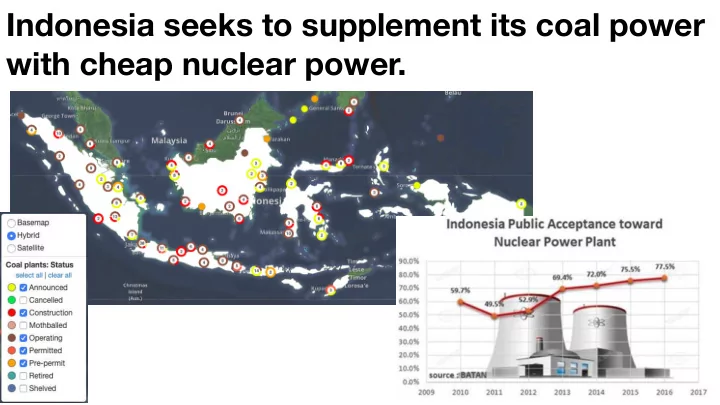
Indonesia seeks to supplement its coal power with cheap nuclear power.
SLIDE 2 Coal power plant costs derive from handling massive amounts of fuel.
<0.1 tonnes/day
SLIDE 3 ThorCon capital and fuel costs are less than for coal.
500 MWe scale comparison; both use same 550°C steam to power conversion. Economics
Coal
generate steam ThorCon
generate steam
Steam to kilowatts Capital, $/kW 500-1500 400-500 500 Fuel, cents/kWh 2.5 0.5
SLIDE 4 Devanney Ultra Large Crude Carrier cost $89 million, built in 10 months
ThorCon designers are experienced in shipyard construction technology.
- Built eight of the world’s largest
supertankers
- $600 million program
- responsible for all specifications,
financing, yard negotiations and supervision
- World-class shipyards will fabricate
blocks quickly, reliably, at low cost.
- Built on firm, fixed price, fixed schedule
project. Hellespont Fairfax
SLIDE 5
October, 2019 ICENES Bali Lars Jorgensen CEO ThorCon US
ThorCon Molten Salt Reactor (TMSR-500) Technology for Indonesia
Two 500 MW ThorCon liquid fission power plants
SLIDE 6
ThorCon prototype will be built in a hull, pretested, towed to Indonesia, settled shoreside, and powered up.
SLIDE 7
ThorCon is a complete power plant.
SLIDE 8
Each 557 MWt power module has an Active and a Cooldown Can.
SLIDE 9
Power conversion occupies most of the plant.
SLIDE 10 47.7% thermal efficiency @ 20C 46.4% thermal efficiency @ 30C
SLIDE 11
SLIDE 12
- The reactor Pot contains the
graphite moderator with channels for molten salt flow.
- Freeze valve melt drains salt
to drain tank.
radiated from drain tank.
natural water circulation.
Replaceable Can unit in Cold Wall
SLIDE 13
ORNL designed freeze valves, quadrupled
SLIDE 14 Cold wall is cooled by natural convection to condenser in Cooling Pond.
Cooling
pond Ten times the water per MW compared to AP1000. Enough water to cool for many months. Likely air cooling is sufficient after that.
SLIDE 15 Cooling
pond
Basement water provides backup passive decay heat cooling.
Basement
water
SLIDE 16
Primary loop is within Can.
SLIDE 17 Prototype ThorCon TMSR-500 has 3 Y-shaped neutron-absorbing shutdown rods.
Three ways to stop fission:
- 1. Increase temperature to reduce
reactivity to nil, reaching elevated temperature idle mode.
- 2. Drop any one of 3 shutdown
rods.
- 3. Drain fuelsalt to drain tank.
SLIDE 18
Radioactive off-gases cool in Can, decay in hold-up tanks, then delay 2 years in charcoal bed ; Xe and Kr bottled; He reused.
SLIDE 19
Cans are exchanged to
CanShip at 4 year intervals.
Graphite life is 4 years.
SLIDE 20
ThorCon CanShip exchanges Cans and Fuel Casks.
SLIDE 21 ThorCon is passively safe.
- Safety is intrinsic; heating stops fission.
- Over-temperature or loss of electricity causes a
- drain. Operators can not stop flow to drain tank.
- Decay heat is removed by silo cold wall continuous
passive water convection, even in power blackout.
- Radioactive fuel salt at low, garden-hose pressure
and 700C below boiling so no dispersal mechanism.
- Fluoride salt chemically locks up hazardous fission
products I-131, Cs-137, Sr-90.
SLIDE 22 Multiple Barriers to Fission Particle Release
First Barrier is the Can+FDT
Can 25mm stainless steel No pressure
350C, helium or argon gas
=> No stress
FDT 10mm stainless steel, <0.5m diameter
Short exposure to >700C
< 1 barg pressure
Helium or argon gas
Second barrier (red outline) is the Silo 25mm stainless steel 140C A few bar pressure
SLIDE 23 Final Barrier is the Hull
25mm Steel 3m Concrete 25mm Steel
SLIDE 24 How would ThorCon survive a Fukushima-like failure?
Fukushima power plant
- 1. Earthquake sensor caused
successful SCRAM shutdown.
- 2. Then, tsunami caused all
power and cooling to be lost.
- 3. Decay heat overheated fuel
rod zirconium cladding, generating hydrogen, causing building explosion.
SLIDE 25 ThorCon Fukushima response:
- 1. Earthquake sensors
- initiate fuelsalt drain
- drop shutdown rods (SCRAM)
- fission stops
- 2. Then, all power and primary cooling
path lost
- 3. Reactor in safe state with fuelsalt in
passively cooled drain tank.
- 4. Fuelsalt temperature max 750°C.
Power Reactivity Temperature
SLIDE 26 Worse, instant station blackout
- 1. Loss of power
- initiates fuelsalt drain
- drops shutdown rods
- fission stops
- 2. As freeze valve melts, core cooled
by natural circulation.
- 3. Reactor in safe state with fuelsalt in
passively cooled drain tank.
- 4. Fuelsalt temperature max 850°C.
Power Reactivity Temperature
SLIDE 27 Worse yet, instant station blackout, shutdown rods stick
- 1. Loss of power
- fuelsalt drain initiated
- fission continues
- primary cooling path lost
- 2. Rising temperature shuts fission down
from natural feedbacks.
- 3. As freeze valve melts, core cooled by
natural circulation.
- 4. Reactor in safe state with fuelsalt in
passively cooled drain tank.
- 5. Temperature max 1000C; 0.5% creep.
Power Reactivity Temperature
SLIDE 28
ThorCon hull towed through North Atlantic storm seas accepts 1 g forces.
SLIDE 29 Scenario: 8 t aircraft engine strikes sand-filled sandwich wall at 200 m/sec.
- Max penetration 200 mm
- Max inner wall deflection
300 mm
- No effect on
- Silo surrounding
- cold wall around
- Can containing
- primary loop containing
- radioactive fuelsalt
Impact Crashworthiness of a Floating Nuclear Power Plant Hull Structure in an Aircraft Strike by Jae Hyeong Park and Jeom Kee Paik
SLIDE 30 Horizontal seismic wave shear limited to 0.6 g in sand. Sand to hull slip limits acceleration to 0.3 g. Analysis to continue.
Bedrock Sand Water Sand/hull slip limit 0.3 g Sand/sand shear limit 0.6 g Strong earthquake 1.2 g
SLIDE 31
Dashpots
Can is seismically isolated from hull.
Elastomeric bearings
SLIDE 32
Tsunami surge up to 15 meters will not float ThorCon hull. Tsunami waves broken by breakwater.
SLIDE 33
A large shipyard can build 20 1-GW ThorCon power plants per year. High-precision steel-fabrication builds ships for $2000 per ton.
ThorCon design uses high-quality, low-cost shipyard block construction technology.
SLIDE 34 Stress tests
Month 0 6 12 18 24 30 36 42 48 54 60 66 72 78 84 90
$ tranche 1
Indonesia 3.5 GW ThorCon power plant project
Design Pre-fission
construction ThorConIsle
construction Power up Production Pre-fission
testing
Bids in hand $ tranche 2 Pre-fission tests complete Milestones Power plant delivered to site $ PPA
guaranteed loans Power to grid Type license approval 27.6 billion
kWh/year $ tranche 3
SLIDE 35
Next step: pre-fission test plant
SLIDE 36
October, 2019 ICENES Bali Lars Jorgensen CEO ThorCon US
ThorCon Molten Salt Reactor (TMSR-500) Technology for Indonesia
Two 500 MW ThorCon liquid fission power plants
Thank you. Questions?