The ECEC Emotional Environment An effec've emo'onal environment - - PowerPoint PPT Presentation

the ecec emotional environment
SMART_READER_LITE
LIVE PREVIEW

The ECEC Emotional Environment An effec've emo'onal environment - - PowerPoint PPT Presentation

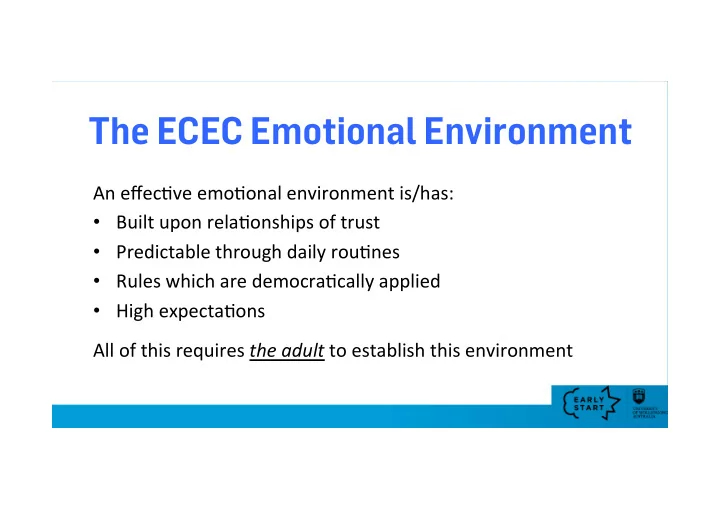
The ECEC Emotional Environment An effec've emo'onal environment is/has: Built upon rela'onships of trust Predictable through daily rou'nes Rules which are democra'cally applied High expecta'ons All of this requires the adult to


slide-1
SLIDE 1

The ECEC Emotional Environment

An effec've emo'onal environment is/has:

  • Built upon rela'onships of trust
  • Predictable through daily rou'nes
  • Rules which are democra'cally applied
  • High expecta'ons

All of this requires the adult to establish this environment

slide-2
SLIDE 2

Adults support social emotional development Adults support social emotional development and self regulation: and self regulation:

  • Model, coach and provide opportuni'es for prac'se.
  • Posi've interest and concern for children and each other
  • Recognise and help children express feelings, without

judgement

  • Support sharing and working together
  • Support choice and autonomy
slide-3
SLIDE 3

Adults support social emotional development Adults support social emotional development and self regulation: and self regulation:

  • Provide challenge for thinking and scaffold learning
  • Address diversity and differences posi'vely, provide non-stereotyped

materials, ac'vi'es and role models.

  • Provide materials and experiences that reflect different cultures and

engage posi'vely with family members and carers - a community of learners

  • In 'mes of distress they are posi've and respecKul and give aLen'on

and care directly to the children though warm suppor've interac'ons.

slide-4
SLIDE 4
  • Help children learn about emo'ons

through books, songs, art

  • Teach children to control their

emo'ons and about others

“Jimmy said it made him angry when you grabbed the watering can from him” “Carla banged her fist on the table. People some=mes do that when they are angry”

  • Engage children in resolving

conflicts/disputes

Opportunities to teach self-regulation

slide-5
SLIDE 5

Confmict Resolution and the Promotion of Self-Regulation

What do you do when children get into arguments, fights or other conflict? Is there an agreed protocol? How consistent are your messages? Do children understand what is expected of them?

slide-6
SLIDE 6

6 Steps to Conflict Resolu1on

Step one: approach calmly stopping any hurKul ac'ons Step two: acknowledge children’s feelings Step three: gather informa'on Step four: restate the problem Step five: ask for solu'ons and choose one Step six: be prepared to follow up

Highscope, 2014 – p.51 of SSTEW

slide-7
SLIDE 7
  • Encourage children to

use language to guide ac'ons

  • Encourage or model

private speech

Language and self-regulation

slide-8
SLIDE 8

Using positive speech and behaviour methods Using positive speech and behaviour methods

  • Tell them what you would like to see, not what you don’t.
  • Explain the rules of the seZng
  • Ensure that talk is more posi've than nega've
  • Agree approaches to problem behaviours with all adults in the

seZng and with parents

  • Approach teaching behaviour in the way you would approach

any learning

  • Look at handout (Good Prac=ce in an Early Years SeEng)
slide-9
SLIDE 9

Supporting the development of meaning and the Supporting the development of meaning and the understanding of how we self-regulate through language understanding of how we self-regulate through language

Tie language to ac'on, descrip'ons and repeat the concept in different situa'ons: ‘I can see you are not paying aIen=on’ or ‘I can see your mind is wandering’ ‘When you pay aIen=on, your mind is like a beam of light and it shines only here’ ‘When you pay aIen=on your body is s=ll and does not wiggle, your eyes are here, and you are thinking about this book’ Give examples: ‘I like how Adrienne is paying aIen=on’ ‘I could see you were really thinking hard and paying aIen=on’