“Early History of Quantum Entanglement,” TAM 2007, August 28, 2007
The Early History of Quantum Entanglement, 1905-1935 Don Howard - - PowerPoint PPT Presentation
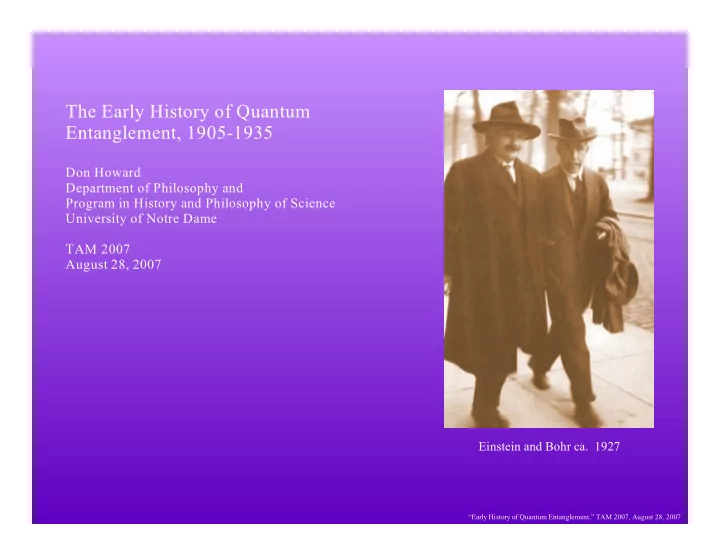
The Early History of Quantum Entanglement, 1905-1935 Don Howard Department of Philosophy and Program in History and Philosophy of Science University of Notre Dame TAM 2007 August 28, 2007 Einstein and Bohr ca. 1927 Early History of
“Early History of Quantum Entanglement,” TAM 2007, August 28, 2007
Entanglement is everywhere today.
“Early History of Quantum Entanglement,” TAM 2007, August 28, 2007
Schrödinger introduces the term, “entanglement,” and the quantum interaction formalism: Erwin Schrödinger. “Die gegenwärtige Situation in der Quantenmechanik.” Die Naturwissenschaften 23 (1935), 807-812, 823-828, 844-849. Erwin Schrödinger. “Discussion of Probability Relations Between Separated Systems.” Proceedings of the Cambridge Philosophical Society 31 (1935), 555-662. Erwin Schrödinger. “Probability Relations Between Separated Systems.” Proceedings of the Cambridge Philosophical Society 32 (1936), 446-452.
“Early History of Quantum Entanglement,” TAM 2007, August 28, 2007
Erwin Schrödinger. “Die gegenwärtige Situation in der Quantenmechanik.” Die Naturwissen- schaften 23 (1935), 807-812, 823-828, 844-849. If two separated bodies, about which, individually, we have maximal knowledge, come into a situation in which they influence one another and then again separate themselves, then there regularly arises that which I just called entanglement [Verschränkung] of our knowledge of the two
- bodies. Athe outset, the joint catalogue of expectations consists of a logical sum of the individual
catalogues; during the process the joint catalogue develops necessarily according to the known law [linear Schrödinger evolution] . . . . Our knowledge remains maximal, but at the end, if the bodies have again separated themselves, that knowledge does not again decompose into a logical sum of knowledge of the individual bodies.
“Early History of Quantum Entanglement,” TAM 2007, August 28, 2007
Einstein and Entanglement, 1905-1927
Einstein ca. 1905 Einstein in the 1920s
“Early History of Quantum Entanglement,” TAM 2007, August 28, 2007
Albert Einstein. “Über einen die Erzeugung und Verwandlung des Lichtes betreffenden heuristischen Gesichtspunkt.” Annalen der Physik 17 (1905), 132-148. Monochromatic radiation of low density (within the domain of validity of Wien's radiation formula) behaves from a thermodynamic point of view as if it consisted of mutually independent energy quanta of the magnitude Rßí /N. If we have two systems S1 and S2 that do not interact with each other, we can put S1 = ö1(W1), S2 = ö2(W2). If these two systems are viewed as a single system of entropy S and probability W, we have S = S1 + S2 = ö(W) and W = W1 W2. The last relation tells us that the states of the two systems are mutually independent events.
“Early History of Quantum Entanglement,” TAM 2007, August 28, 2007
Einstein to H. A. Lorentz, 23 May 1909 (EA 16-419). I must have expressed myself unclearly in regard to the light quanta. That is to say, I am not at all of the opinion that one should think of light as being composed of mutually independent quanta localized in relatively small spaces. This would be the most convenient explanation of the Wien end
- f the radiation formula. But already the division of a light ray at the surface of refractive media
absolutely prohibits this view. A light ray divides, but a light quantum indeed cannot divide without change of frequency. As I already said, in my opinion one should not think about constructing light out of discrete, mutually independent points. I imagine the situation somewhat as follows: . . . I conceive of the light quantum as a point that is surrounded by a greatly extended vector field, that somehow diminishes with distance. Whether or not when several light quanta are present with mutually overlapping fields
- ne must imagine a simple superposition of the vector fields, that I cannot say. In any case, for the
determination of events, one must have equations of motion for the singular points in addition to the differential equations for the vector field.
“Early History of Quantum Entanglement,” TAM 2007, August 28, 2007
Mieczys³aw Wolfke. “Antwort auf die Bemerkung Herrn Krutkows zu meiner Note: ‘Welche Strahlungsformel folgt aus den Annahme der Lichtatome?’” Physikalische Zeitschrift 15 (1914), 463-464. In fact the Einsteinian light quanta behave like the individual, mutually independent molecules of a gas . . . . However, the spatial independence of the Einsteinian light quanta comes out even more clearly from Einstein’s argument itself. From the Wien radiation formula Einstein calculates the probability W that all n light quanta of the same frequency enclosed in a volume v0 find themselves at an arbitrary moment of time in the subvolume v of the volume v0. The expression for this probability reads: W = (v/v0)n. This probability may be interpreted as the product of the individual probabilities v/v0 that an individual one of the light quanta under consideration lies in the subvolume v at an arbitrary moment
- f time. From the fact that the total probability W is expressed as the product of the individual
probabilities v/v0, one recognizes that it is a matter of individual mutually independent events. Thus we see that, according to Einstein’s view, the fact that a light quantum lies in a specific subvolume is independent of the position of the other light quanta.
“Early History of Quantum Entanglement,” TAM 2007, August 28, 2007
Paul Ehrenfest and Heike Kamerlingh Onnes. “Simplified Deduction of the Formula from the Theory of Combinations which Planck Uses as the Basis of His Radiation-Theory.” Amsterdam Academy of Sciences. Proceedings. 17 (1914), 870-873. Appendix: “The Contrast between Planck’s Hypothesis of the Energy-Grades and Einstein’s Hypothesis of Energy- Quanta.” Planck does not deal with really mutually free quanta , the resolution of the multiples of into separate elements , which is essential in his method, and the introduction of these separate elements have to be taken “cum grano salis”; it is simply a formal device . . . . The real object which is counted remains the number of all the different distributions of N resonators over the energy-grades 0, , 2, . . . with a given total energy P. If for instance P = 3, and N = 2, Einstein has to distinguish 23 = 8 ways in which the three (similar) light-quanta A, B, C can be distributed over the space-cells 1, 2. A B C I 1 1 1 II 1 1 2 III 1 2 1 IV 1 2 2 V 2 1 1 VI 2 1 2 VII 2 2 1 VIII 2 2 2
“Early History of Quantum Entanglement,” TAM 2007, August 28, 2007
Paul Ehrenfest and Heike Kamerlingh Onnes. “Simplified Deduction of the Formula from the Theory of Combinations which Planck Uses as the Basis of His Radiation-Theory.” Amsterdam Academy of Sciences. Proceedings. 17 (1914), 870-873. Appendix: “The Contrast between Planck’s Hypothesis of the Energy-Grades and Einstein’s Hypothesis of Energy- Quanta.” [Continued] Planck on the other hand must count the three cases II, III, and V as a single one, for all three express that resonator R1 is at the grade 2, R2 at ; similarly he has to reckon the cases IV, VI and VII as one; R1 has here and R2 2. Adding the two remaining cases I (R1 contains 3, R2 0) and II (R1 has 0, R2 3) one actually obtains different distributions of the resonators R1, R2 over the energy-grades. We may summarize the above as follows: Einstein’s hypothesis leads necessarily to formula (÷) for the entropy and thus necessarily to Wien’s radiation formula, not Planck’s. Planck’s formal device (distribution of P energy-elements over N resonators) cannot be interpreted in the sense of Einstein’s light-quanta.
“Early History of Quantum Entanglement,” TAM 2007, August 28, 2007
Albert Einstein. Äther und Relativitätstheorie. Rede gehalten am 5. Mai 1920 and der Reichs- Universität zu Leiden. Berlin: Julius Springer, 1920. The special theory of relativity does not compel us to deny the aether. We may assume the existence of an ether; only we must give up ascribing a definite state of motion to it, i.e., we must by abstraction take from it the last mechanical characteristic which Lorentz had still left it. . . . Think of waves on the surface of water. Here we can describe two entirely different things. Either we may follow how the undulatory surface forming the boundary between water and air alters in the course of time; or else–with the help of small floats, for instance–we can follow how the position of the individual particles of water alters in the course of time. If the existence of such floats for tracking the motion of the particles of a fluid were a fundamental impossibility in physics–if, in fact, nothing else whatever were discernible than the shape of the space occupied by the water as it varies in time, we should have no ground for the assumption that water consists of movable particles. But all the same we could characterize it as a medium. We have something like this in the electromagnetic field. For we may picture the field to ourselves as consisting of lines of force. If we wish to interpret these lines of force to ourselves as something material in the ordinary sense, we are tempted to interpret the dynamic processes as motions of these lines of force, such that each individual line of force is tracked through the course of time. It is well known, however, that this way of regarding the electromagnetic field leads to contradictions. Generalizing we must say this: There may be supposed to be extended physical objects to which the idea of motion cannot be applied. They may not be thought of as consisting of particles that allow themselves to be individually tracked through time. In Minkowski’s idiom this is expressed as follows: Not every extended structure in the four-dimensional world can be regarded as composed of world-threads. The special theory of relativity forbids us to assume the ether to consist of particles that can be tracked through time, but the hypothesis of the ether in itself is not in conflict with the special theory of relativity. Only we must be on our guard against ascribing a state of motion to the ether.
“Early History of Quantum Entanglement,” TAM 2007, August 28, 2007
The theory of genidentity has received quite a blow from the criticism of the concept of substance, which was brought about by a reconsideration of the ether theory. Accordingly it is no longer necessary to consider the world-lines of a material field as striated in a definite direction; the choice of the grain includes a certain amount of arbitrariness. If the state of a field is graph- cally represented in the customary fashion, as in Fig. 46, then the vertical lines as well as the dotted slanted lines may be considered as world-lines of the individual “field particles.” Particle A1 may thus be considered as genidentical with A2, A3 . . . as well as with B2, C3, D4 . . . . Nature does not supply a unique rule in this case. Einstein saw in this fact the collapse of the old concept of substance.1 This means only (and that is how it is formulated by Einstein) that there are material fields in which this arbitrariness exists. Einstein thus wishes to characterize the metrical field that propagates gravitational forces. On the other hand, there are also material fields in which there is a natural striation; an example is atomic matter, the world-line bundles of which can by no means be considered as arbitrary in the sense of Fig. 46. ___________________________________
1 A. Einstein, Äther und Relativitätstheorie, Springer 1920.
- Reichenbach. Philosophie der Raum-Zeit-Lehre. Berlin and Leipzig: Walter de Gruyter, 1928.
“Early History of Quantum Entanglement,” TAM 2007, August 28, 2007
Albert Einstein. “Quantentheorie des einatomigen idealen Gases. Zweite Abhandlung.” Preussische Akademie der Wissenschaften. Physikalisch-mathematische Klasse. Sitzungsberichte (1925), 3-14. Bose’s theory of radiation and my analogous theory of ideal gases have been reproved by Mr. Ehrenfest and other colleagues because in these theories the quanta or molecules are not treated as structures statistically independent of one another, without this circumstance being especially pointed out in our papers. This is entirely correct. If one treats the quanta as being statistically independent of one another in their localization, then one obtains the Wien radiation law; if one treats the gas molecules analogously, then one obtains the classical equation of state for ideal gases, even if one otherwise proceeds exactly as Bose and I have. . . . It is easy to see that, according to this way of calculating [Bose-Einstein statistics], the distribution of molecules among the cells is not treated as a statistically independent one. This is connected with the fact that the cases that are here called “complexions” would not be regarded as cases of equal probability according to the hypothesis of the independent distribution of the individual molecules among the cells. Assigning different probability to these “complexions” would not then give the entropy correctly in the case of an actual statistical independence of the molecules. Thus, the formula [for the entropy] indirectly expresses a certain hypothesis about a mutual influence of the molecules–for the time being of a quite mysterious kind–which determines precisely the equal statistical probability of the cases here defined as “complexions.”
“Early History of Quantum Entanglement,” TAM 2007, August 28, 2007
Einstein to Erwin Schrödinger, 28 February 1925 (EA 22-002). In the Bose statistics employed by me, the quanta or molecules are not treated as being independent
- f one another. . . . A complexion is characterized through giving the number of molecules that are
present in each individual cell. The number of the complexions so defined should determine the
- entropy. According to this procedure, the molecules do not appear as being localized independently
- f one another, but rather they have a preference to sit together with another molecule in the same
- cell. One can easily picture this in the case of small numbers. [In particular] 2 quanta, 2 cells:
Bose-statistics independent molecules 1st cell 2nd cell 1st cell 2nd cell 1st case !! – 1st case I II – 2nd case I II 2nd case ! ! 3rd case II I 3rd case – !! 4th case – I II According to Bose the molecules stack together relatively more often than according to the hypothesis of the statistical independence of the molecules.
“Early History of Quantum Entanglement,” TAM 2007, August 28, 2007
Erwin Schrödinger. “Zur Einsteinschen Gastheorie.” Physikalische Zeitschrift 27 (1926), 95- 101. In the new gas theory recently developed by A. Einstein, this surely counts, in general, as the essential point, namely, that an entirely new kind of statistics, the so-called Bose statistics, are to be applied to the movements of gas molecules. One’s natural instinct rightly resists viewing this new statistics as something primary, incapable of further explanation. On the contrary, there seems to be disguised within it the assumption of a certain dependence of the gas molecules upon one another, or an interaction between them, which nevertheless in this form can only be analyzed with difficulty. One may expect that a deeper insight into the real essence of the theory would be obtained if we were able to leave as it was the old statistical method, which has been tested in experience and is logically well founded, and were to undertake a change in the foundations in a place where it is possible without a sacrificium intellectus. Thus one must simply fashion our model of the gas after the same model of cavity radiation that corresponds to what is still not the extreme light quantum idea; then the natural statistics–basically the convenient Planck method for summing states–will lead to the Einstein gas theory. That means nothing else than taking seriously the de Broglie-Einstein undulation theory of moving corpuscles, according to which the latter are nothing more than a kind of “foamy crest” on wave radiation that constitutes the underlying basis of everything.
“Early History of Quantum Entanglement,” TAM 2007, August 28, 2007
Albert Einstein. “Bestimmt Schrödinger’s Wellenmechanik die Bewegung eines Systems vollständig oder nur im Sinne der Statistik?” Prussian Academy of Sciences, 5 May 1927. “Nachtrag zur Korrektur.” I have found that the schema does not satisfy a general requirement that must be imposed on a general law of motion for systems. Consider, in particular, a system Ó that consists of two energetically independent subsystems, Ó1 and Ó2; this means that the potential energy as well as the kinetic energy is additively composed of two parts, the first of which contains quantities referring only to Ó1, the second quantities referring
- nly to Ó2. It is then well known that
Ø = Ø1 Ø2 , where Ø1 depends only on the coordinates of Ó1, Ø2 only on the coordinates of Ó2. In this case we must demand that the motions of the composite system be combinations of possible motions of the subsystems. The indicated scheme [Einstein’s own hidden variables model] does not satisfy this requirement. In particular, let ì be an index belonging to a coordinate of Ó1, í an index belonging to a coordinate
- f Ó2. Then Øìí does not vanish.
“Early History of Quantum Entanglement,” TAM 2007, August 28, 2007
Bohr and Entanglement, 1924-1927
“Early History of Quantum Entanglement,” TAM 2007, August 28, 2007
Bohr to Hans Geiger, 21 April 1925: I was quite prepared to learn that our proposed point of view about the independence of the quantum processes in separated atoms would turn out to be wrong. . . . Not only were Einstein’s objections very disquieting; but recently I have also felt that an explanation of collision phenomena, especially Ramsauer’s results on the penetration
- f slow electrons through atoms, presents difficulties to our ordinary
space-time description of nature similar in kind to the those presented by the simultaneous understanding of interference phenomena and a coupling of changes of state of separated atoms by radiation. In general, I believe that these difficulties exclude the retention of the
- rdinary space-time description of phenomena to such an extent that,
in spite of the existence of coupling, conclusions about a possible corpuscular nature of radiation lack a sufficient basis. Bohr to James Franck, 21 April 1925 It is, in particular, the results of Ramsauer concerning the penetration
- f slow electrons through atoms that apparently do not fit in with the
assumed viewpoint. In fact, these results may pose difficulties for our customary spatio-temporal description of nature that are similar in kind to a coupling of changes of state in separated atoms through
- radiation. But then there is no more reason to doubt such a coupling
and the conservation laws generally.
“Early History of Quantum Entanglement,” TAM 2007, August 28, 2007
Walther Bothe. “Über die Kopplung zwischen elementaren Strahlungsvorgängen.” Zeitschrift für Physik 37 (1926), 547.
“Early History of Quantum Entanglement,” TAM 2007, August 28, 2007
Niels Bohr. “The Quantum Postulate and the Recent Development of Atomic Theory.” Nature (Suppl.) 121 (1928). Now, the quantum postulate implies that any observation of atomic phenomena will involve an interaction with the agency of observation not to be neglected. Accordingly, an independent reality in the ordinary physical sense can neither be ascribed to the phenomena nor to the agencies of
- bservation. . . .
This situation has far-reaching consequences. On one hand, the definition of the state of a physical system, as ordinarily understood, claims the elimination of all external disturbances. But in that case, according to the quantum postulate, any observation will be impossible, and, above all, the concepts
- f space and time lose their immediate sense. On the other hand, if in order to make observation
possible we permit certain interactions with suitable agencies of measurement, not belonging to the system, an unambiguous definition of the state of the system is naturally no longer possible, and there can be no question of causality in the ordinary sense of the word. The very nature of the quantum theory thus forces us to regard the space-time co-ordination and the claim of causality, the union of which characterizes the classical theories, as complementary but exclusive features of the description, symbolizing the idealization of observation and definition respectively. . . . According to the quantum theory a general reciprocal relation exists between the maximum sharp- ness of definition of the space-time and energy-momentum vectors associated with the individuals. This circumstance may be regarded as a simple symbolical expression for the complementary nature
- f the space-time description and the claims of causality.
“Early History of Quantum Entanglement,” TAM 2007, August 28, 2007
The Textbooks, 1927-1935
“Early History of Quantum Entanglement,” TAM 2007, August 28, 2007
Hermann Weyl. Gruppentheorie und Quantenmechanik, 2nd. ed. Leipzig: S. Hirzel, 1931.
- Ch. II, § 10, “The Problem of Several Bodies. Product Space.”
Conditions that insure a maximum of homogeneity within c [a composite system] need not require a maximum in this respect within the partial system a. Furthermore: if the state of a and the state of b are known, the state of c is in general not uniquely specified, for a positive definite Hermitian form ai,k, ik in the product space, which describes a statistical aggregate of states c, is not uniquely determined by the Hermitian forms to which it gives rise in the spaces R, S. In this significant sense quantum theory subscribes to the view that “the whole is greater than the sum of its parts,” which has recently been raised to the status
- f a philosophical creed by the Vitalists and the Gestalt Psychologists.
“Early History of Quantum Entanglement,” TAM 2007, August 28, 2007
Wolfgang Pauli. “Die allgemeinen Principien der Wellenmechanik.” Handbuch der Physik, 2nd
- ed. Hans Geiger and Karl Scheel, eds. Berlin: Julius Springer, 1933.
§5 “Interaction of Several Particles. Operator Calculus.” An additive decomposition of the Hamiltonian operator in independent summands thus corresponds to a product decomposition of the wave function in independent factors. This corresponds to the circumstance that, in the case of statistically independent particles, the probability W(q1 . . . qf; t) can be decomposed as a product.
“Early History of Quantum Entanglement,” TAM 2007, August 28, 2007
Einstein contra Bohr, 1927-1955
“Early History of Quantum Entanglement,” TAM 2007, August 28, 2007
The Photon-Box Thought Experiment
“Early History of Quantum Entanglement,” TAM 2007, August 28, 2007
Paul Ehrenfest to Bohr, July 9, 1931 He [Einstein] said to me that, for a very long time already, he absolutely no longer doubted the uncertainty relations, and that he thus, e.g., had BY NO MEANS invented the “weighable light-flash box” (let us call it simply L-F-box) “contra uncertainty relation,” but for a totally different purpose. Compare this to: Max Jammer. The Philosophy of Quantum Mechanics: The Interpretations of Quantum Mechanics in Historical Perspective. New York: John Wiley & Sons, 1974. Einstein, continued Ehrenfest in his letter to Bohr, no longer intends to use the box experiment as an argument “against the indeterminacy relations” but for a completely different purpose. The actual German text of Ehrenfest’s letter: “Er sagte mir, daß er schon sehr lange absolut nicht mehr an die Unsicherheitsrelation zweifelt und dass er also z.B. den ‘wägbaren Lichtblitz-Kasten’ (lass ihn kurz L-W-Kasten heissen) DURCHAUS nicht ‘contra Unsicherheits-Relation’ ausgedacht hat, sondern für einen ganz anderen Zweck.”
“Early History of Quantum Entanglement,” TAM 2007, August 28, 2007
The published EPR paper
“Early History of Quantum Entanglement,” TAM 2007, August 28, 2007
Einstein to Erwin Schrödinger, 19 June 1935 I was very pleased with your detailed letter, which speaks about the little essay. For reasons of language, this was written by Podolsky after many discussions. But still it has not come out as well as I really wanted; on the contrary, the main point was, so to speak, buried by the erudition [die Hauptsache ist sozusagen durch Gelehrsamkeit verschüttet]. . . . My way of thinking is now this: properly considered, one cannot get at the talmudist if one does not make use of a supplementary principle: the “separation principle.” That is to say: “the second box, along with everything having to do with its contents, is independent of what happens with regard to the first box (separated partial systems).” If one adheres to the separation principle, then
- ne thereby excludes the second point of view, and only the Born point of view remains, according
to which the above state description is an incomplete description of reality, or of the real states. . . . After the collision, the real state of (AB) consists precisely of the real state A and the real state of B, which two states have nothing to do with one another. The real state of B thus cannot depend upon the kind of measurement I carry out on A. (“Separation hypothesis” from above.) But then for the same state of B there are two (in general arbitrarily many) equally justified ØB, which contradicts the hypothesis of a one-to-one or complete description of the real states.
“Early History of Quantum Entanglement,” TAM 2007, August 28, 2007
Einstein’s Critique of the Quantum Theory
The argument that Einstein intended to give: Separability + Locality Incompleteness (No assumption of Heisenberg indeterminacy) Separability: Independent real states of affairs in spatially (spatio-temporally?) separated regions. Locality: No causal influences between spacelike separated regions.
From: James T. Cushing. “A Background Essay.” In James T. Cushing and Ernan McMullin, eds. Philosophical Consequences of Quantum Theory: Reflections on Bell’s Theorem. Notre Dame, IN: University of Notre Dame Press, 1989.
“Early History of Quantum Entanglement,” TAM 2007, August 28, 2007
Niels Bohr. “Natural Philosophy and Human Cultures.” Nature 143 (1938). The elucidation of the paradoxes of atomic physics has disclosed the fact that the unavoidable interaction between the objects and the measuring instruments sets an absolute limit to the possibility
- f speaking of a behavior of atomic objects which is independent of the means of observation.
We are here faced with an epistemological problem quite new in natural philosophy, where all description of experience has so far been based on the assumption, already inherent in ordinary conventions of language, that it is possible to distinguish sharply between the behavior of objects and the means of observation. This assumption is not only fully justified by all everyday experience but even constitutes the whole basis of classical physics. . . . As soon as we are dealing, however, with phenomena like individual atomic processes which, due to their very nature, are essentially determined by the interaction between the objects in question and the measuring instruments necessary for the definition of the experimental arrangement, we are, therefore, forced to examine more closely the question of what kind of knowledge can be obtained concerning the objects. In this respect, we must, on the one hand, realize that the aim of every physical experiment—to gain knowledge under reproducible and communicable conditions—leaves us no choice but to use everyday concepts, perhaps refined by the terminology of classical physics, not only in all accounts
- f the construction and manipulation of the measuring instruments but also in the description of the
actual experimental results. On the other hand, it is equally important to understand that just this circumstance implies that no result of an experiment concerning a phenomenon which, in principle, lies outside the range of classical physics can be interpreted as giving information about independent properties of the objects.
“Early History of Quantum Entanglement,” TAM 2007, August 28, 2007
Albert Einstein. “Remarks Concerning the Essays Brought together in this Co-operative Volume.” In Albert Einstein: Philosopher-Scientist. Paul Arthur Schilpp, ed. The Library
- f Living Philosophers, vol. 7. Evanston, IL: The Library of Living Philosophers, 1949.
Of the “orthodox” quantum theoreticians whose position I know, Niels Bohr’s seems to me to come nearest to doing justice to the problem. Translated into my own way of putting it, he argues as follows: If the partial systems A and B form a total system which is described by its Ø-function Ø(AB), there is no reason why any mutually independent existence (state of reality) should be ascribed to the partial systems A and B viewed separately, not even if the partial systems are spatially separated from each other at the particular time under consideration. The assertion that, in this latter case, the real situation of B could not be (directly) influenced by any measurement taken on A is, therefore, within the framework of quantum theory, unfounded and (as the paradox shows) unacceptable.
“Early History of Quantum Entanglement,” TAM 2007, August 28, 2007
Einstein to Max Born, 18 March 1948 I just want to explain what I mean when I say that we should try to hold on to physical reality. We are, to be sure, all of us aware of the situation regarding what will turn out to be the basic foundational concepts in physics: the point-mass or the particle is surely not among them; the field, in the Faraday-Maxwell sense, might be, but not with certainty. But that which we conceive as existing (“real”) should somehow be localized in time and space. That is, the real in one part of space, A, should (in theory) somehow “exist” independently of that which is thought of as real in another part of space, B. If a physical system stretches over the parts of space A and B, then what is present in B should somehow have an existence independent of what is present in A. What is actually present in B should thus not depend upon the type of measurement carried out in the part of space, A; it should also be independent of whether or not, after all, a measurement is made in A. If one adheres to this program, then one can hardly view the quantum-theoretical description as a complete representation of the physically real. If one attempts, nevertheless, so to view it, then one must assume that the physically real in B undergoes a sudden change because of a measurement in
- A. My physical instincts bristle at that suggestion.