Avoiding Errors in the Diagnosis and Management of Head and Neck - - PDF document

avoiding errors in the diagnosis and management of head
SMART_READER_LITE
LIVE PREVIEW

Avoiding Errors in the Diagnosis and Management of Head and Neck - - PDF document

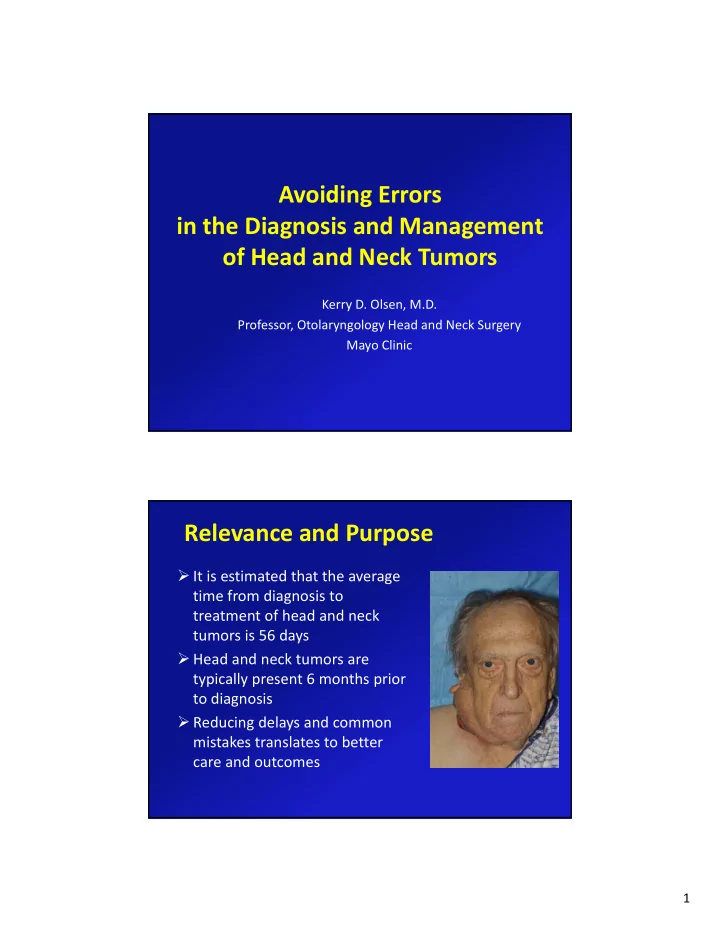
Avoiding Errors in the Diagnosis and Management of Head and Neck Tumors Kerry D. Olsen, M.D. Professor, Otolaryngology Head and Neck Surgery Mayo Clinic Relevance and Purpose It is estimated that the average time from diagnosis to treatment of


slide-1
SLIDE 1

1

Avoiding Errors in the Diagnosis and Management

  • f Head and Neck Tumors

Kerry D. Olsen, M.D. Professor, Otolaryngology Head and Neck Surgery Mayo Clinic

  • It is estimated that the average

time from diagnosis to treatment of head and neck tumors is 56 days

  • Head and neck tumors are

typically present 6 months prior to diagnosis

  • Reducing delays and common

mistakes translates to better care and outcomes

Relevance and Purpose

slide-2
SLIDE 2

2

  • Unilateral
  • Persistent
  • Progressive

Head and Neck Cancer:

Key symptoms and findings

slide-3
SLIDE 3

3

  • 54 yo Female‐ nonsmoker
  • 6 months of tongue pain and earache
  • Saw primary physician, oral surgeon,
  • tolaryngologist
  • Negative oral cavity and neck exam
  • Treated with NSAID, antibiotics x 4 weeks
  • Referred to psychiatrist

Prolonged symptoms

  • Developed 20 lbs weight loss
  • Developed dysarthria
  • Biopsy of tongue‐ negative
  • Referred to neurologist for trigeminal

neuralgia

Delay in Diagnosis

slide-4
SLIDE 4

4

  • Developed lump in neck
  • FNA in office‐ purulent material
  • Cultured and treated with IV

antibiotics for abscess in neck

Delay in Diagnosis Persistent tongue pain

slide-5
SLIDE 5

5

Head and Neck Symptoms

  • Unilateral otalgia
  • Sore throat
  • Acidic food intolerance
  • Dysphagia – odynophagia
  • Persistent hoarseness or dysphonia
  • Bleeding
  • Non‐healing sore
  • Foreign body sensation
  • Hearing loss
  • Unilateral nasal symptoms

Nasal – Sinus Cancers

  • Classic teaching:
  • Facial deformity
  • Orbital symptoms
  • Dental findings
  • Cranial nerve dysfunction
  • Bone destruction
  • Above are too late!
slide-6
SLIDE 6

6

Nasal – Sinus Cancers

  • Early signs – unilateral!
  • Rhinorrhea
  • Obstruction
  • Epistaxis
slide-7
SLIDE 7

7

Oral Carcinomas

  • Persistent swelling
  • Ulcerative lesion
  • Pain or painless
  • Non‐specific

irritation

  • Blood‐tinged saliva
  • Otalgia
  • Lump in the neck

Oral Cancer

  • Late symptom
  • Difficulty swallowing
  • Altered speech
slide-8
SLIDE 8

8

Pharynx Cancer

  • Sore throat
  • Persistent
  • Localized
  • Acidic food

intolerance

  • Otalgia
  • Dysphagia
  • Lump in the throat
slide-9
SLIDE 9

9

  • Tobacco
  • EtOH
  • Lichen planus
  • Chronic dental disease
  • Trauma
  • HPV
  • Immunodeficiency
  • Radiation

Risk factors

  • When is a negative biopsy really

negative

  • How to biopsy
  • small= excisional biopsy
  • Large‐ edge with normal
  • If worried‐ repeat and go deeper

Biopsy of lesion

slide-10
SLIDE 10

10

Avoidable Errors

1) Failure to inquire about head and neck symptoms in patients with a lump in the neck 2) Failure to perform a complete head and neck examination in a patient with a lump in the neck 3) Reliance on scans as a substitute for a complete (ENT) examination in the patient with a lump in the neck 4) Prolonged trial of antibiotics in the patient with a lump in the neck

Metastatic Cancer

  • Hayes Martin 1952 –

“Asymptomatic enlargement of

  • ne or more cervical nodes in an

adult is almost always cancer and usually due to metastasis from a primary in the head and neck region.”

  • M:F

4:1 60 = mean age

  • Majority are squamous cell

carcinoma

  • Other = undifferentiated –

adenocarcinomas ‐ melanomas

slide-11
SLIDE 11

11

  • Exam of the upper aerodigestive tract is

normal‐ neck mass is positive for carcinoma

  • Focus on: nasopharynx, oropharynx,

supraglottic larynx, hypopharynx, skin

Unknown primary

  • Palpate, then look for bleeding on

endoscopy

  • Retract tonsillar pillars
  • Palpate the base of tongue
  • Repeat exam
  • Ask a colleague

Unknown primary

slide-12
SLIDE 12

12

  • CT, PET/CT
  • Surgery: Direct laryngoscopy, tonsillectomy,

lingual tonsillectomy, opposite tonsillectomy

  • Don’t forget nasopharynx

Unknown primary‐ Imaging Avoidable Error

  • Do not assume that a

negative visual exam has eliminated the possibility

  • f an OP primary
  • Induration
  • Bleeding
  • Asymmetry
slide-13
SLIDE 13

13

Avoidable Errors

  • Cystic neck mass= FNA
  • Cystic neck mass is not
  • ften infectious or

branchial cleft cyst

  • Excisional biopsy

should be avoided

  • Anatomic Extent of Parotid Gland
  • Superficial on exam is not always

superficial

  • Approach to parotid gland

Mass in Parotid Gland

slide-14
SLIDE 14

14

Parotid Tumor

Rarely advise observation unless patient’s health contraindicates surgery

  • Paraparotid = parotid neoplasm
  • Anatomic extent of parotid not appreciated
  • Appear superficial or subcutaneous
  • Upper neck – tail of parotid
  • Incisional biopsy
  • Tumor spillage – recurrence
  • Facial nerve damage

Parotid Region

slide-15
SLIDE 15

15

slide-16
SLIDE 16

16

Avoidable Errors

1) Failure to inquire about head and neck symptoms in patients with a lump in the neck 2) Failure to perform a complete head and neck examination in a patient with a lump in the neck 3) Reliance on scans as a substitute for a complete (ENT) examination in the patient with a lump in the neck 4) Prolonged trial of antibiotics in the patient with a lump in the neck 5) Removal of a “parotid area” mass under local anesthesia

slide-17
SLIDE 17

17

Pathology and Parotid Neoplasms

  • Fine needle aspiration – FNA
  • False positive/negative –

high

  • FNA
  • Obvious

malignancy

  • Possible lymphoma
  • Inflammatory node
  • Poor health
  • Frozen section pathology
slide-18
SLIDE 18

18

Case Report

  • Football coach ‐

excellent health

  • Sudden onset ‐

painful parotid mass

  • Enlarging mass
  • Lower pole of the parotid

Case Report

  • FNA ‐ suspicious for squamous

cell carcinoma

  • Trial antibiotics ‐ swelling

reduced but a firm parotid mass remains

  • Repeat FNA read at Mayo Clinic

‐ squamous cell carcinoma

slide-19
SLIDE 19

19

Warthin’s Tumor Warthin’s Tumor

  • Warthin’s tumor with metaplasia of the

epithelial lining mimic SCC

  • All physicians treating tumors of the head

and neck must be aware of possible false- positive cytologic report

  • Warthin’s tumor with metaplasia of the

epithelial lining mimic SCC

  • All physicians treating tumors of the head

and neck must be aware of possible false- positive cytologic report

Avoidable Errors

6) Recommending that one observe a parotid mass since it is “usually” benign 7) Referral of a patient with a parotid mass to an inexperienced surgeon not trained in all aspects of head and neck surgery

slide-20
SLIDE 20

20

slide-21
SLIDE 21

21

  • Experience
  • Team management
  • Availability of Frozen Section pathology
  • Case Experience
  • Specialty

My patient will best benefit by referral to whom?

slide-22
SLIDE 22

22

Head and Neck Tumors

  • Best chance to get well is with initial therapy
  • Knowledgeable – competent head and neck
  • ncology team
  • Regular surgical experience
  • Frozen section pathology
  • Adjunctive therapy when indicated
  • Support personnel

Important Variables

  • Patient’s health
  • Tumor extent
  • Surgical

management

  • Reconstruction
  • Outcomes
  • Overall survival
  • Local/regional

recurrence

  • Quality of live
slide-23
SLIDE 23

23

  • When to operate, when not to operate?
  • Patient/Family Desires
  • Patient age and health
  • Tumor Extent
  • Recurrent tumors: What has been done before?

When should nothing be done and palliative care begin?

  • Failure to inquire about head and neck

symptoms in patients with lump in neck

  • Failure to perform a complete head and neck

exam

  • Reliance on scans as a substitute for a

complete ENT exam

  • Prolonged trial of abx
  • Removal of a parotid mass under local

anesthesia

Summary: Avoidable Errors with Lump in Neck

slide-24
SLIDE 24

24

  • Recommending observation of a “benign”

parotid mass

  • Referral of a patient with a parotid mass to an

inexperienced surgeon not trained in all aspects

  • f head and neck surgery
  • Performing an open neck biopsy without

preparation for proceeding with a neck dissection

  • Referral of patients with head and neck tumors

to the casual operator

Summary Avoidable Errors with Lump in Neck

slide-25
SLIDE 25

25

slide-26
SLIDE 26

26

  • For HPV causative oropharyngeal

cancer

  • Basing treatment on tobacco / alcohol
  • Recognize the growing role of de‐

escalation of therapy to reduce treatment morbidity

Avoidable Errors ‐ Bonus