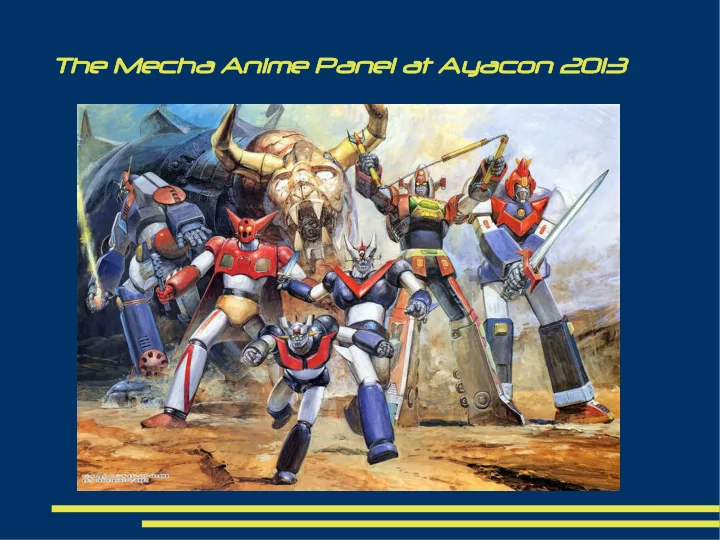
The e Mec echa Anime e Panel el at Aya yacon 20 2013 - - PowerPoint PPT Presentation

the e mec echa anime e panel el at aya yacon 20 2013
SMART_READER_LITE
LIVE PREVIEW

The e Mec echa Anime e Panel el at Aya yacon 20 2013 - - PowerPoint PPT Presentation

The e Mec echa Anime e Panel el at Aya yacon 20 2013 Introduction Wha What Is Mecha Anime? e? Mecha anime is, bluntly, a genre of anime all about robots and similar machines Usually rhey are used for fighting, but the genre


slide-1
SLIDE 1

The e Mec echa Anime e Panel el at Aya yacon 20 2013

slide-2
SLIDE 2

Introduction – Wha What Is Mecha Anime? e?

  • Mecha anime is, bluntly, a genre of

anime all about robots and similar machines

  • Usually rhey are used for fighting, but

the genre has also seen much more thought-provoking, low-key stories

  • The very best mecha anime often are the
  • nes where the robots themselves sit

within the story as something other than just a weapon

  • Mecha shows have existed pretty much

from the start of anime history, and the genre has grown and evolved in interesting ways over time

slide-3
SLIDE 3

What Thi This Panel el Will Be

  • This is going to be a look over

mecha anime past and present – from the genre's roots to where it is now

  • There'll be information about the

most important shows of the decades and the general trends in a changing genre

  • There really isn't time in a single

panel to do justice to all of this huge genre – all I can offer is a series of good starting points

slide-4
SLIDE 4

Timel eline ne Part I – The e 1960s-70s

slide-5
SLIDE 5

The e Early Days – Tet etsujin, Astro Boy y et etc

  • It's fair to say mecha was right

there from the start!

  • One of the first ever anime, Astro

Boy, was about a robot who fought and encountered other robots in the future

  • The first “proper” mech – Tetsujin 28

– hit screens in 1963

  • However, it was not a mecha show

in the traditional sense – protagonist Shotaro controls Tetsujin with a remote control rather than a cockpit!

slide-6
SLIDE 6

Mazinge ger vs Astroganger er

  • The first “traditional” mecha show –

piloted robot, special moves and so

  • n – is technically Astroganger,

which aired in October 1972

  • Yet ask most mecha fans and

they'll say it's Mazinger Z from December that year

  • Mazinger laid down the foundations
  • f an entire genre – introducing

sidekick robots, archetypal supervillains and the secret base

  • It's become an iconic design, often

imitated – most recently by Gipsy Danger from Pacific Rim

slide-7
SLIDE 7

Get etter er Robo

  • Nowadays the combining robot is

almost a given

  • Be it 00-Raiser, GaoGaiGar or Aquarion,

it's become well known that jamming multiple vehicles together makes a better robot

  • It was 1974's Getter Robo that

ultimately came up with the idea though – three fighters come together in different ways to make three unique mechs with different attacks

  • The notoriously illogical combination

sequence was a great way of selling extra action figures

slide-8
SLIDE 8

Combattler V and the e Nagahama Trilogy

  • If Getter was the first combining robot,

then the concept really took off with Tadao Nagahama's Combattler V in 1976

  • A five-vehicle robot, it in its own way laid

down a new set of genre traditions – laundry lists of attacks, and the five-pilot team

  • Taking cues from series like Gatchaman,

Combattler put five hero archetypes (two dashing male leads, a fat guy, a kid and a woman) into the different parts of a combining mech

  • Although Combattler itself doesn't hold

up as a show, its successor Voltes V does

slide-9
SLIDE 9

Mobile Su Suit Gundam

  • Up to this point the mecha genre was quite

superhero-like, drawing on costumed heroes

  • What is now sometimes called the “real

robot” genre had yet to emerge – it was not until 1979's Mobile Suit Gundam that it would

  • Gundam got off to an inauspicious start, too –

the series proved unpopular and it was merchandise sales and much more successful recap movies that would save it

  • The result, though, was a blockbuster pop

culture franchise that continues to this day – but more on that legacy later

slide-10
SLIDE 10

From the e 70s to the he 80s

  • The series discussed above are really the

most significant of the 1960s and 70s – but there were many, many more mecha shows

  • Series like Gowapper V Godam, Machine

Blaster, Groizer X and Mechander Robo never really captured the imagination in the same way

  • Mecha was a new genre at this time and

so it is understandable that it would see experimentation and attempts to cash in

  • Series like Steel Jeeg would enjoy some

success

  • The first sequels and continuities began

to emerge – Getter Robo G, Great Mazinger and Grendizer among others

slide-11
SLIDE 11

Timel eline ne Part II I – The he 1980s

slide-12
SLIDE 12

SDF Macross

  • Macross was originally intended to be a

lighthearted homage to Gundam called Megaroad

  • While aspects of this – transforming fighters,

a battleship-city with its own robot mode – remained, the aesthetic was significantly changed

  • Macross would come to be a fairly unique

kind of mecha show, more about humanity's interactions with an alien species in general

  • Its post-war arc, added after the series was

lengthened, is highly memorable and set the stage for the franchise's tone as a whole

slide-13
SLIDE 13

Gundam's Su Succes essors

  • While Gundam itself was continuing into a

strong franchise in the 1980s, a number of series trying to capture its success emerged

  • They tended to have the basic ingredients

down – evil space empires versus heroic earth citizens, three robots for three pilots, and a good dose of intrigue

  • Probably the best of the bunch is Metal

Armour Dragonar, which while it draws heavily on the Gundam archetype does its

  • wn, very interesting, things
  • Other competitors included Blue Comet SPT

Layzner and Special Powered Armour Troop Dorvack

slide-14
SLIDE 14

Ryosuke e Ta Takahashi hi and the e Military Robot Gen enre

  • While shows like Gundam, Macross and

Dragonar were trying to tell stories about military life, they were still indebted to the mecha anime genre – the emphasis was on colourful characters and superhero theatrics

  • It was Fang of the Sun Dougram and Armoured

Trooper VOTOMS, both from Ryosuke Takahashi, that really took mecha into the realm of military SF

  • The emphasis was much more on politics and

the more conceptual side of sci-fi – Dougram draws on historical war films for its inspiration, while VOTOMS mixes Vietnam War stereotypes with SF mysticism

slide-15
SLIDE 15

Fantastical Robots

  • So far, mecha shows had been the realm of SF –

space travel, alien invasions and mysterious future technology

  • However, there was an undercurrent of

mysticism present – series like Raideen had explored supernatural machines, while VOTOMS moved into distinctly spiritual areas

  • The move into fantasy is really marked by

1983's Aura Battler Dunbine, and 1984's Panzer World Galient – both took mechs into high fantasy settings of fairies and castles

  • A more fantastical design style also came into

SF via Mamoru Nagano, who worked on designs for Heavy Metal L-Gaim and The Five Star Stories

slide-16
SLIDE 16

The e In Infl fluen ence e of Tokus usatsu

  • Tokusatsu – live action “special effects” shows

like Kamen Rider, super sentai and Metal Heroes – forms a kind of adjunct to mecha

  • There are mecha tokusatsu shows like Giant

Robo, Daitetsujin 17 and Red Baron, as well as robots in sentai series

  • The 1980s saw a close design relationship

between sentai, the emerging metal heroes genre and mecha animé; a general trend toward boxier robots and circuit motifs

  • Meanwhile, combining robots continued to

borrow from sentai and hero-team traditions – the animal-themed Dancougar is very much inspired by the sentai aesthetic

slide-17
SLIDE 17

The e Genre's Scope e Wi Widen ens

  • Even for all the design innovation,

robots still might seem the preserve or war stories and the mecha genre a limited one

  • But the 1980s also saw series like Mobile

Police Patlabor – a show about daily life in a future with mechs

  • This tapped into the cyberpunk and

technological-SF stuff of Bubblegum Crisis – exploring worlds where robots were a fact of life, not just the protagonist's weapon of choice

slide-18
SLIDE 18

Aim for

  • r the

he Top! Gunbuster er

  • Gunbuster is both a genre-defining mecha

series (in its at-the-time uncommon use of a mostly-female cast) and a loving pastiche of two decades of anime previous

  • It takes the mecha genre and adds in aspects
  • f Dezaki's high-school shoujo and sports

anime, as well as the more scientific side of science-fiction shows

  • What Gunbuster represents, in a way, is one of

the best examples of showing how a mecha series can be more than just a simple story about heroic robots – it shows the beginning of a move towards widening the scope of robot stories

slide-19
SLIDE 19

Timel eline ne Part III II – The he 1990s

slide-20
SLIDE 20

The e Yuu Yuusha Franchi hise

  • Super robot anime had grown and grown in

the 1980s, with both big-name franchises like Transformers appearing and a number of

  • riginal shows
  • The 90s brought a competitor to

Transformers in the shape of the Yuusha franchise – from 1990's Exkaiser to 1997's GaoGaiGar

  • These had their own unifying features –

sentient robot teams, complex combinations and transformations and a human factor in the child protagonist

  • Yet even within this formula there was

experimentation – from the very silly Goldran to the more serious and plot-driven Da Garn

slide-21
SLIDE 21

Timel eline ne of Yuusha shows

  • 1990-1 – Brave Exkaiser
  • 1991-2 – Hero of the Sun Fighbird
  • 1992-3 – Legendary Hero Da Garn
  • 1993-4 – The Brave Express Might Gaine
  • 1994-5 – Brave Police J-Decker
  • 1995-6 – Hero of Gold Goldran
  • 1996-7 – Brave Command Dagwon
  • 1997-8 – King of Braves GaoGaiGar
  • The Yuusha franchise ultimately ended

with 2000's GaoGaiGar Final, although there were plans for more series – Saint

  • f Braves Baan Gaan and a GaoGaiGar

continuation

slide-22
SLIDE 22

Neo eon Gen enes esis Evangel gelion

  • Probably one of the most-discussed anime of all

time, Evangelion is an undeniably significant part

  • f the mecha genre
  • A case of one series launching not only many

homages, but numerous reworkings, sidestories and a merchandising juggernaught

  • Yet the original series is controversial mostly for

its ambiguous and some would say unfinished nature – while subsequent films, retellings and games have all tried to complete the picture, nothing quite captures the original series' appeal

  • It took classic themes from tokusatsu and mecha

series that had perhaps only been infrequently considered and ran with them

slide-23
SLIDE 23

Evangel gelion Part II II – Diver erse e Inspirations

  • Ultimately, Evangelion takes ideas of the

uncontrollable, sentient robot that were looked at in series as early as the 1980s with Space Runaway Ideon

  • Its themes of alienation and how undesirable

being a robot pilot really is can be seen in shows like Zambot 3 and even just as an extreme version of characters like Zeta Gundam's Kamille Bidan

  • What really sets Evangelion apart, though, is

how far it takes these ideas – whether or not this has proved successful, for its time it was an interesting look over a different side of mecha anime

slide-24
SLIDE 24

Evangel gelion Part II III - Lega egacy

  • Through the 1990s and beyond Evangelion has

had a significant impact on its genre and anime more widely

  • Popularly held to be a more introspective kind of

series which looks at genre staples in a pseudo- critical way, it inspired a number of other approaches to sentient robots

  • Series like Brain Powerd, Rahxephon and Fafner
  • f the Azure all took cues from Evangelion and

ran with them in different ways

  • Comedy series like Daiguard and Martian

Successor Nadesico also owe some debt to Evangelion in introducing a more grounded, inefficient world for giant robots to inhabit

slide-25
SLIDE 25

The e Exp xpansion of the e Genre e – Mec echa meet ets Sho houjo

  • The 1990s marked a general shift in tone for mecha

anime – the aim was to capture new audiences, since new merchandise-driven series like Pokemon and Yugioh were competing within the younger market

  • Series like Magic Knight Rayearth and The Visions of

Escaflowne reached out to a female audience

  • Rayearth combined the popularity of fighting

magical girls like Sailor Moon with mecha traditions

  • Escaflowne was a fantasy mecha series in the vein
  • f Galient, but with a more shoujo-esque romance

plot front and centre

  • Gundam Wing, part of a string of alternate-universe

Gundam series, arguably had much more feminine appeal in its character designs and aesthetic

slide-26
SLIDE 26

Timel eline ne Part IV V – The e 2000s Onwards

slide-27
SLIDE 27

Robots in the he Backgr ground

  • Some would say the 2000s were a time when

there were far fewer classic-style mecha anime; instead, various genres had robots added to them.

  • Anime such as Code Geass took military mecha

traditions and mixed in comedy and school stories

  • At the other extreme Star Driver drew heavily
  • n series like Revolutionary Girl Utena to create

a surreal and engaging super robot story

  • The mecha/superhero comparisons continued

with shows like Tiger & Bunny, Vividred and Symphogear – ultimately all that changed was the genres to which mecha were being added

slide-28
SLIDE 28

Ret etro Thr Throwbacks and Classic Mec echa

  • That isn't to say there were no “classic” mecha

shows – the 2000s had series like Gurren Lagann, Shinkon Gattai Godannar, GEAR Fighter Dendoh and Genesis of Aquarion which all represented a return to the staples of super robots

  • Dendoh took design elements from the unmade

Yuusha series Baan Gaan

  • Series like Valvrave the Liberator and Galactic

Strikeforce Majestic Prince serve as modern takes

  • n the military mecha stories of the 1980s like

Dragonar and L-Gaim

  • As well as this there were a spate of remakes of

classic mecha and SF series – including Tetsujin 28, Steel Jeeg, Space Battleship Yamato and Mazinger Z – and a quirky reimagining of Gatchaman in 2013

slide-29
SLIDE 29

Taking g the e Genre e in New Direc ections

  • Even among the more “traditional” mecha

stories of the 2000s, it is clear how the genre has expanded its ambitions

  • Traditional setups and stories become a basis

for plots which extend beyond the more restrictive cliches of the genre

  • Suisei no Gargantia took story elements from

1980s mecha classic Super Dimension Century Orguss and added in a more contemporary, topical plot

  • Eureka Seven, at first a plain homage to

Gundam and its ilk, turns into a slow-burning love story and a challenging alien-contact plot emerges

slide-30
SLIDE 30

And Finally... .. Pacific Rim

  • The mecha genre has gone in many

directions since Tetsujin 28 and Mazinger Z

  • 2013's Pacific Rim represents probably the

most dedicated return to its roots for some time

  • A straightforward monster movie drawing

both on the super robot genre and kaiju films, it is a long procession of classic homages

  • Perhaps the best way to describe it is

Godannar meets Getter Robo meets Gunbuster meets Godzilla to form an action film where the hero isn't the pilot, but the robot