
SLIDE 1
The Difficult to Sedate ICU Patient
Dan Burkhardt, M.D. Associate Professor Department of Anesthesia and Perioperative Care University of California San Francisco burkhard@anesthesia.ucsf.edu
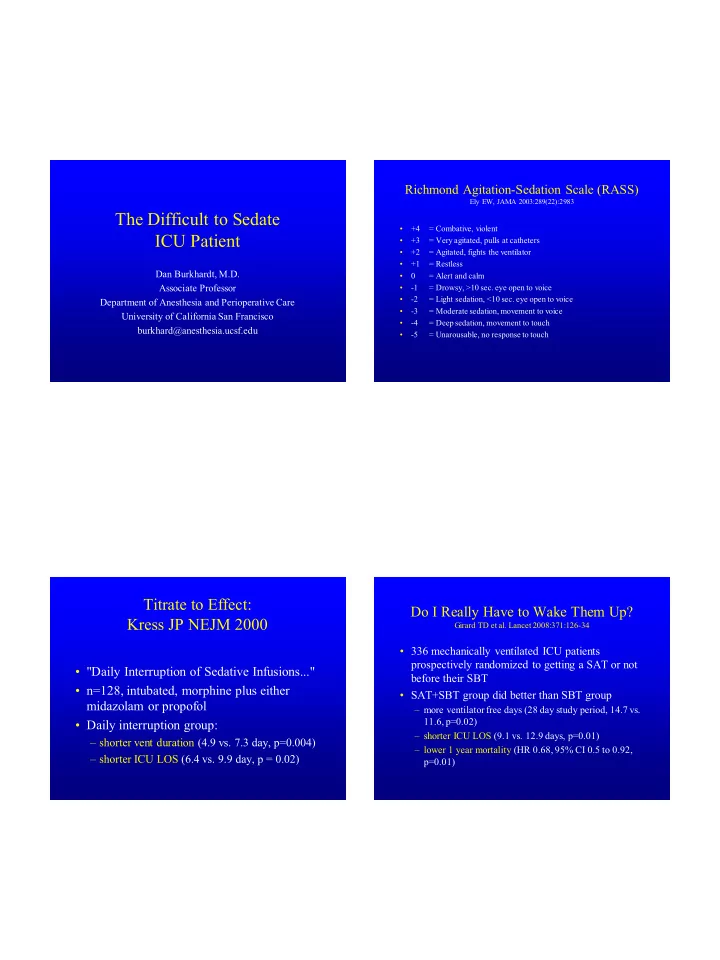
Richmond Agitation-Sedation Scale (RASS)
Ely EW, JAMA 2003:289(22):2983
- +4
= Combative, violent
- +3 = Very agitated, pulls at catheters
- +2 = Agitated, fights the ventilator
- +1 = Restless
- = Alert and calm
- 1
= Drowsy, >10 sec. eye open to voice
- 2
= Light sedation, <10 sec. eye open to voice
- 3
= Moderate sedation, movement to voice
- 4
= Deep sedation, movement to touch
- 5
= Unarousable, no response to touch
Titrate to Effect: Kress JP NEJM 2000
- "Daily Interruption of Sedative Infusions..."
- n=128, intubated, morphine plus either
midazolam or propofol
- Daily interruption group:
– shorter vent duration (4.9 vs. 7.3 day, p=0.004) – shorter ICU LOS (6.4 vs. 9.9 day, p = 0.02)
Do I Really Have to Wake Them Up?
Girard TD et al. Lancet 2008:371:126-34
- 336 mechanically ventilated ICU patients
prospectively randomized to getting a SAT or not before their SBT
- SAT+SBT group did better than SBT group
– more ventilator free days (28 day study period, 14.7 vs. 11.6, p=0.02) – shorter ICU LOS (9.1 vs. 12.9 days, p=0.01) – lower 1 year mortality (HR 0.68, 95% CI 0.5 to 0.92, p=0.01)