The Dialect of Southwest Tyrone 18 major locations across - - PDF document

the dialect of southwest tyrone
SMART_READER_LITE
LIVE PREVIEW

The Dialect of Southwest Tyrone 18 major locations across - - PDF document

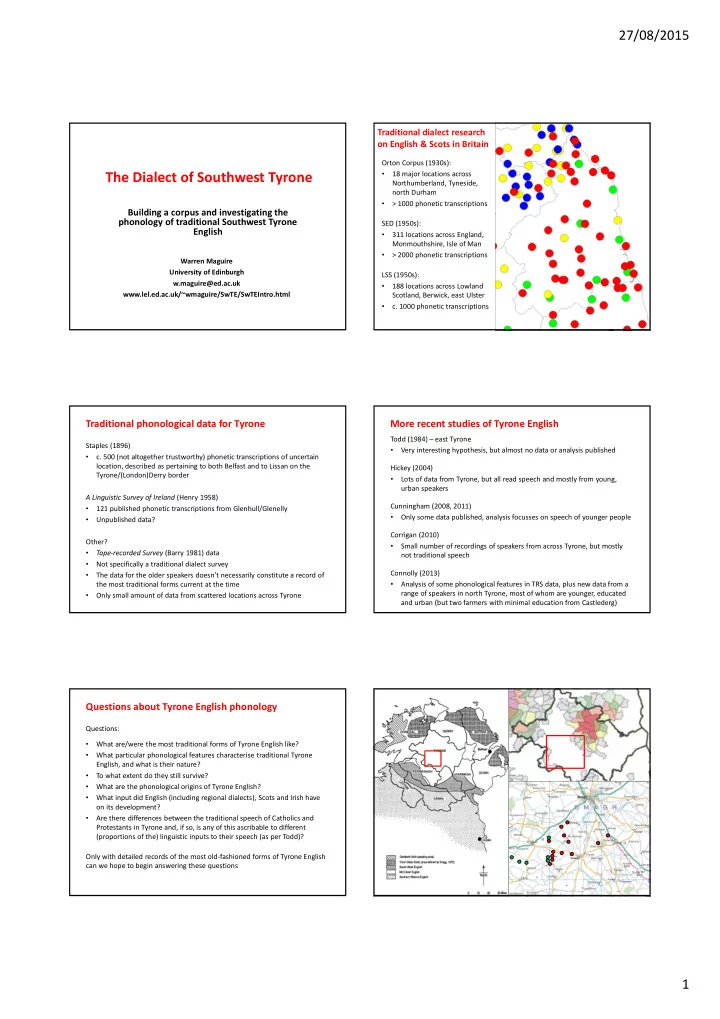
27/08/2015 Traditional dialect research on English & Scots in Britain Orton Corpus (1930s): The Dialect of Southwest Tyrone 18 major locations across Northumberland, Tyneside, north Durham > 1000 phonetic transcriptions


slide-1
SLIDE 1

27/08/2015 1

The Dialect of Southwest Tyrone

Building a corpus and investigating the phonology of traditional Southwest Tyrone English

Warren Maguire University of Edinburgh w.maguire@ed.ac.uk www.lel.ed.ac.uk/~wmaguire/SwTE/SwTEIntro.html Orton Corpus (1930s):

  • 18 major locations across

Northumberland, Tyneside, north Durham

  • > 1000 phonetic transcriptions

SED (1950s):

  • 311 locations across England,

Monmouthshire, Isle of Man

  • > 2000 phonetic transcriptions

LSS (1950s):

  • 188 locations across Lowland

Scotland, Berwick, east Ulster

  • c. 1000 phonetic transcriptions

Traditional dialect research

  • n English & Scots in Britain

Staples (1896)

  • c. 500 (not altogether trustworthy) phonetic transcriptions of uncertain

location, described as pertaining to both Belfast and to Lissan on the Tyrone/(London)Derry border A Linguistic Survey of Ireland (Henry 1958)

  • 121 published phonetic transcriptions from Glenhull/Glenelly
  • Unpublished data?

Other?

  • Tape-recorded Survey (Barry 1981) data
  • Not specifically a traditional dialect survey
  • The data for the older speakers doesn’t necessarily constitute a record of

the most traditional forms current at the time

  • Only small amount of data from scattered locations across Tyrone

Traditional phonological data for Tyrone

Todd (1984) – east Tyrone

  • Very interesting hypothesis, but almost no data or analysis published

Hickey (2004)

  • Lots of data from Tyrone, but all read speech and mostly from young,

urban speakers Cunningham (2008, 2011)

  • Only some data published, analysis focusses on speech of younger people

Corrigan (2010)

  • Small number of recordings of speakers from across Tyrone, but mostly

not traditional speech Connolly (2013)

  • Analysis of some phonological features in TRS data, plus new data from a

range of speakers in north Tyrone, most of whom are younger, educated and urban (but two farmers with minimal education from Castlederg)

More recent studies of Tyrone English

Questions:

  • What are/were the most traditional forms of Tyrone English like?
  • What particular phonological features characterise traditional Tyrone

English, and what is their nature?

  • To what extent do they still survive?
  • What are the phonological origins of Tyrone English?
  • What input did English (including regional dialects), Scots and Irish have
  • n its development?
  • Are there differences between the traditional speech of Catholics and

Protestants in Tyrone and, if so, is any of this ascribable to different (proportions of the) linguistic inputs to their speech (as per Todd)? Only with detailed records of the most old-fashioned forms of Tyrone English can we hope to begin answering these questions

Questions about Tyrone English phonology

slide-2
SLIDE 2

27/08/2015 2

  • Legacy recordings from the late 1980s and early 1990s of a number of old

speakers in the community born in the early 20th century (2 hrs 50 mins)

  • One-to-one interviews (typically involving discussion of local life and

history, farming practices, and superstitions) with 17 current residents of the area born in the early and mid 20th century, made between 2003 and 2015 (18 hrs 45 mins)

  • Answers to the Survey of English Dialects questionnaire by two speakers

(CM39 and PM43, neighbours), made between 2004 and 2015 (5 hrs 30 mins)

  • Range of wordlist and reading tasks designed to investigate various

aspects of the phonology of the dialect, especially the MEAT-MATE (near-) merger (1 hr 25 mins)

SwTE corpus – 28.5 hrs of audio recordings (so far)

Speaker Occupation PM00 †farmer PF14 †housewife PF19 †farmer, housewife PM23* †farmer PM24 †farmer PM26* †farmer PM29 farmer PM38* farmer CM39* farmer PF40* domestic worker PF41* farmer Speaker Occupation PM42* farmer PM43 farmer, salesman CM44 farmer, labourer PM45 unemployed CM47 farmer, digger-man PF49

  • ffice worker

PF50 caterer PM50 farmer, postman PM54* farmer PM55* unemployed PM75* farmer

See transcriptions on the handout PM00

  • Remembering news of the hanging of Joe Moan, the ‘Trillick Murderer’, in

1904 CM39

  • Talking about threshing and wapping straw

PM43

  • Answering SED questions IV.4.1, IV.4.2, IV.4.4 (lice/louse, nits, fleas)

PF50

  • MEAT-MATE minimal pairs

Examples

Pre-R Dentalisation (English, Scots, ?Irish) Epenthesis in liquid + nasal clusters (English, Scots, Irish)

  • film [ˈfələm], farm [ˈfaɹəm]

Velar palatalisation (English, Irish, ?Scots)

  • car [cäːɹ], cat [cat], get [ɟɛt], give [ɟəv] (cf. calm [käːm], calf [käːv])

Palatal velarisation (Irish, ?Scots)

  • Christian [ˈkɹəscən], furniture [ˈfɔ̈ɹnəcəɹ], idiot [ˈiɡət]/[ˈiɟət], Indian

[ˈɛ̈ɲɟən], question [ˈkwɛscən]/[ˈkwɛskən], stupid [ˈscʉpət] The MEAT lexical set (and its relationship with MATE)

Features currently under investigation

The MEAT lexical set has well known (again stereotyped) MATE-like pronunciations in Irish English (including SwTE)

  • e.g. beak, beat, cheap, concrete, decent, easy, eat, flea, Jesus, meat, peas,

speak, tea, teacher, weak Milroy and Harris (1980) and Harris (1985) showed that in Belfast Vernacular English MEAT and MATE are in a situation of near merger

  • they are pronounced almost the same, with near-complete overlap in

realisation, but their pronunciations are statistically different

  • [ɪə] preferred in MATE, [e] in MEAT

BUT: Milroy and Harris’s study was based on a small number of tokens, not analysed acoustically The SwTE corpus affords us an excellent opportunity to investigate the MEAT vowel in a Mid-Ulster English dialect in much more detail, since the feature survives well in the speech of traditional SwTE speakers

The MEAT lexical set MEAT-like pronunciations of MEAT

0.00 20.00 40.00 60.00 80.00 100.00 PM00 PF14 PF19 PM23 PM24 PM26 PM29 PM38 CM39 PF40 PF41 PM42 PM43 CM44 PM45 CM47 PF49 PF50 PM50 PM54 PM55 PM75 % MATE-like MEAT Speaker

slide-3
SLIDE 3

27/08/2015 3

The MEAT-MATE (near-)merger

400 450 500 550 600 2100 2150 2200 2250 2300 2350 2400 2450 f1 (Hz) f2 (Hz)

MATE MEAT A well known, indeed stereotyped feature of Irish English, including SwTE (Harris 1985, Maguire 2012) The realisation of /t/ and /d/ (and sometimes /n/) as [t̪], [d̪] ([n̪]) before /r/ and /ər/

  • try [t̪ɾäˑe], dry [d̪ɾäˑe], better ‘more good’ [ˈbɛt̪əɹ], wonder [ˈwɔ̈n̪d̪əɹ],

hunder ‘hundred’ [ˈhɔ̈n̪əɹ]

  • R-Realisation Effect: /r/ pronounced as tap after dentals (cf. cry [kɹäˑe])
  • Morpheme Boundary Constraint: PreRD blocked by ‘Class 2’ morpheme

boundaries (cf. better ‘one who bets’ [ˈbɛtəɹ], spreader [ˈspɹɛɾəɹ]) Origin in (dialects of) English and Scots (Maguire 2012, in preparation), both

  • f which have/had PreRD, the RRE and the MBC
  • uncertain role for Irish; PreRD was at least compatible with aspects of Irish

phonology (dental vs. non-dental opposition; trá [t̪ˠɾˠäː], trí [t̠ʲɾʲiː], with similar effect to the RRE)

Pre-R Dentalisation

  • PreRD can apply across stressed vowels (start [st̪aɹt], turn [t̪ɔ̈ɹn]) (cf.

spellings such as thurn in the dialect poems of W. F. Marshall, ‘Bard of Tyrone’)

  • PreRD does not operate across word boundaries, but the RRE can (better

at that [ˈbɛt̪əɾ ət ðat], down the road [dəʉn ðə ɾoʊd] vs. go to Rome [goʊ tə ɹoʊm])

  • The RRE doesn’t always apply (try [t̪ɹäˑe]), and sometimes /r/ is elided

with the dentalisation remaining (try [t̪äˑe])

  • There is a degree of non-rhoticity in unstressed syllables in SwTE, and this

does not block PreRD (cf. the similar situation in northern England, Maguire 2012), e.g. better than that [ˈbɛt̪ə ðən ðat]

  • There are low levels of dentalisation, especially of /t/, in other positions

(mostly word-finally), e.g. out [əʉt̪], especially in the speech of CM39

Further complications revealed by the SwTE corpus

More recordings

  • Continuing fieldwork, particularly to record more Catholic speakers

Corpus construction

  • Aligned orthographic transcriptions (ongoing)
  • Transcriptions will be made available to other users

Analyses

  • General description of the phonology of the dialect
  • Detailed synchronic and diachronic analysis of particular phonological

features of the dialect

The future

Barry, Michael (ed.). 1981. Aspects of English dialects in Ireland, Volume 1, Papers arising from the Tape-recorded Survey of Hiberno-English Speech. Belfast: The Institute

  • f Irish Studies.

Connolly, Patrick. 2013. Speaker engagement in language variation and change with specific reference to North Tyrone. PhD thesis, Queen’s University, Belfast. Corrigan, Karen. 2010. Irish English: Vol. 1 – Northern Ireland. Edinburgh: Edinburgh University Press. Cunningham, Una. 2008. Vowel quality and quantity in the English spoken in rural southwest Tyrone. Nordic Irish studies 7, 41-55. Cunningham, Una. 2011. Echoes of Irish in the English of southwest Tyrone. In Raymond Hickey (ed.) Researching the languages of Ireland, 207-221. Uppsala: Uppsala University Press. Harris, John. 1985. Phonological variation and change. Cambridge: Cambridge University Press. Henry, Patrick Leo. 1958. A linguistic survey of Ireland. Preliminary report. Norsk tidsskrift for sprogvidenskap (Lochlann, A review of Celtic studies), Supplement 5, 49- 208. Hickey, Raymond. 2004. A sound atlas of Irish English. Berlin/Boston: Mouton de Gruyter.

References

Mather, James and Hans-Henning Speitel. 1986. The linguistic atlas of Scotland, Scots Section, Vol. 3, Phonology. Beckenham: Croom Helm. Maguire, Warren. 2012. Pre-R dentalisation in northern England. English language and linguistics 16(3), 361-384. Maguire, Warren. In preparation. Pre-R dentalisation in Scotland. Marshall, W. F. 1983. Livin’ in Drumlister: The collected ballads and verses of W. F. Marshall ‘The Bard of Tyrone’. Belfast: The Blackstaff Press. Milroy, James and John Harris. 1980. When is a merger not a merger? The MEAT/MATE problem in a present-day English vernacular. English World-wide 1, 199-210. Orton, Harold and Eugen Dieth (eds.). 1962-71. Survey of English dialects (B): The basic

  • material. Leeds: Arnold & Son.

Rydland, Kurt. 1998. The Orton Corpus: a dictionary of Northumbrian pronunciation, 1928-1939. Oslo: Novus Press. Staples, J. H. 1896. Notes on Ulster English dialect for comparison with English dialects by the late A. J. Ellis, F.R.S., with samples in Palaeotype, comparison specimen and

  • wordlist. Transactions of the Philological Society 23(2), 357-398.

Todd, Loreto. 1984. By their tongue divided: towards an analysis of speech communities in Northern Ireland. English World-wide 5, 159-80.

References