The dialect of the Holy Island of the language of the middle and - - PDF document

the dialect of the holy island of
SMART_READER_LITE
LIVE PREVIEW

The dialect of the Holy Island of the language of the middle and - - PDF document

27/08/2015 Northumbrian dialects When we think of Northumbrian dialect, we might first think of The dialect of the Holy Island of the language of the middle and southeast of the county Lindisfarne with its characteristic sounds in words


slide-1
SLIDE 1

27/08/2015 1

The dialect of the Holy Island of Lindisfarne

Warren Maguire, University of Edinburgh w.maguire@ed.ac.uk

The Roland Bibby Memorial Lecture The Northumbrian Language Society Morpeth 11th October 2014

When we think of Northumbrian dialect, we might first think of the language of the middle and southeast of the county ‒ with its characteristic sounds in words such as snow, hand, coat, dog, pub, boots ‒ and verb forms such as cannit, divn’t But as you all know, Northumberland is quite a diverse county linguistically ‒ the urban dialect of Tyneside ‒ the Pitmatic of the coalfields ‒ the Cumbrian-like speech of the southwest of the county ‒ and North Northumbrian, where influence from Lowland Scotland is most obvious (canna, dinna)

Northumbrian dialects

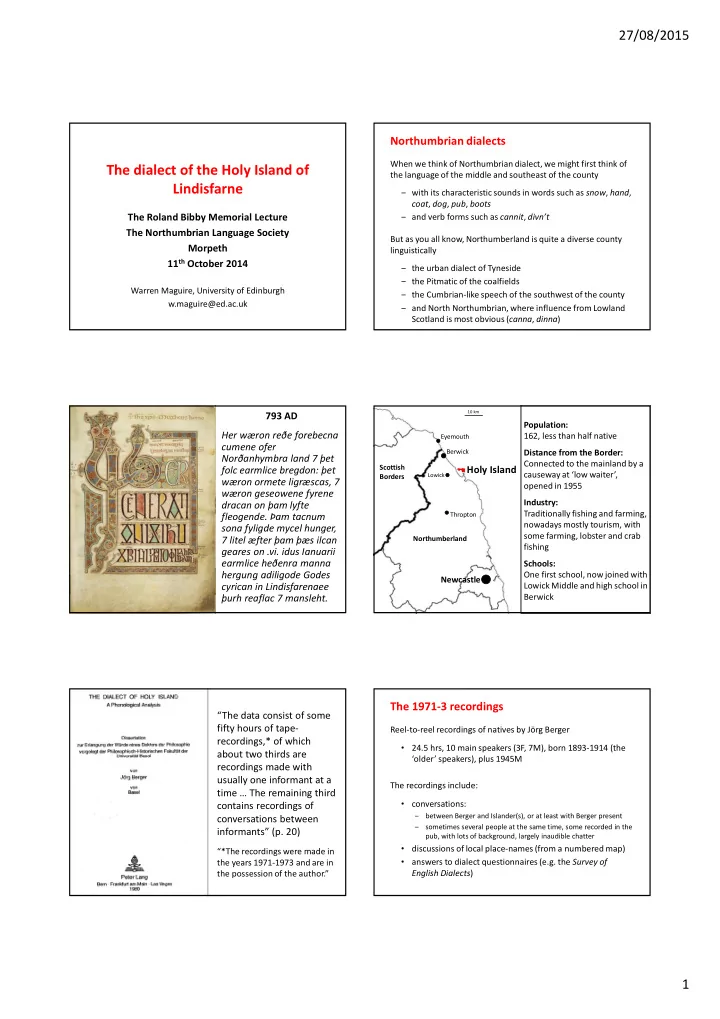
793 AD Her wæron reðe forebecna cumene ofer Norðanhymbra land 7 þet folc earmlice bregdon: þet wæron ormete ligræscas, 7 wæron geseowene fyrene dracan on þam lyfte

  • fleogende. Þam tacnum

sona fyligde mycel hunger, 7 litel æfter þam þæs ilcan geares on .vi. idus Ianuarii earmlice heðenra manna hergung adiligode Godes cyrican in Lindisfarenaee þurh reaflac 7 mansleht. Holy Island

Berwick Eyemouth

Lowick

Population: 162, less than half native Distance from the Border: Connected to the mainland by a causeway at ‘low waiter’,

  • pened in 1955

Industry: Traditionally fishing and farming, nowadays mostly tourism, with some farming, lobster and crab fishing Schools: One first school, now joined with Lowick Middle and high school in Berwick Newcastle

Scottish Borders Northumberland

Thropton

10 km

“The data consist of some fifty hours of tape- recordings,* of which about two thirds are recordings made with usually one informant at a time … The remaining third contains recordings of conversations between informants” (p. 20)

“*The recordings were made in the years 1971-1973 and are in the possession of the author.” Reel-to-reel recordings of natives by Jörg Berger

  • 24.5 hrs, 10 main speakers (3F, 7M), born 1893-1914 (the

‘older’ speakers), plus 1945M The recordings include:

  • conversations:

‒ between Berger and Islander(s), or at least with Berger present ‒ sometimes several people at the same time, some recorded in the pub, with lots of background, largely inaudible chatter

  • discussions of local place-names (from a numbered map)
  • answers to dialect questionnaires (e.g. the Survey of

English Dialects)

The 1971-3 recordings

slide-2
SLIDE 2

27/08/2015 2

Two Millennium Memory Bank recordings (British Library):

  • 1926M (30 years in London), 1965F

On-going data collection by WM

  • 1945Mb (in 2006), 1947M, 1963F, 1967M (in 2013)

Dialect of the Holy Island of Lindisfarne (DHIL) corpus (British Academy grant SG112357), 2012-2014

  • time-aligned orthographically transcriptions
  • hosted on the Diachronic Electronic Corpus of Tyneside

English website (http://research.ncl.ac.uk/decte/dhil.htm)

  • accessed via a password-protected interface subject to

completion of a user agreement form

Other Holy Island recordings and DHIL Conversation types

The speech in the recordings is of different types:

  • normal conversational speech (C)
  • elicited speech – e.g. answers to dialect questionnaires,

where the intention was for the speakers to give their broadest dialect forms (even if that wasn’t always the result) (Q)

  • In my analysis of the data, I’ve kept these two kinds of

speech separate to see if there are differences between them

Speaker Occupation Source Types 1893F ‘Herring girl’ Berger Q and C 1902F Shop keeper Berger Q and C 1908F Housewife Berger C 1903M Fisherman Berger Q and C 1904M* Wireless operator Berger Q and C 1905M Various jobs locally Berger Q and C 1906M Fisherman Berger C 1908M Driver Berger Q and C 1910M* Fisherman, lifeboat man Berger Q and C 1914M* Various, inc. Navy Berger Q 1945Ma Fisherman Berger Q and C

Berger’s speakers

‘Older’ speaker sample in red; speakers marked * had higher status jobs, typically involving time and training away from the Island The ‘younger’ speakers have very different life histories

  • they went to middle and high school in Berwick (where they

boarded through the week)

  • they may have gone to college further away again
  • ften worked away from the Island for substantial periods
  • usually employed in the tourism and hospitality industry

New speakers

Speaker Occupation Source Types 1926M* Merchant Navy, painter and decorator MMB C 1945Mb Fisherman WM 2006 Q and C 1947M Fisherman, bus driver (on the Island) WM 2013 C 1963F* Hotelier WM 2013 C 1965F Priory attendant MMB C 1967M* Navy, publican WM 2013 C Int. And this is? 1893F The door. Int. And, and, and the thing at the door? 1893F That’s the handle, isn’t it, or the -, aye, that’s the handle. Int. Uh-huh. And on the other side, you know? These things, there. 1893F

  • The jambs of the door? Is

that, do you mean the round about - Int. No, uh, these? 1893F Oh, that’s the hinges. Int. Hinges? 1893F Hinges. Int. And this is? 1893F Tha-, that’s the surroundings. Int. Surroundings? 1893F Surroundings. Int.

  • Oh. Beautiful.

1893F Ye couldn’t understand we. 1905M: I've seen it, [when we] used to keep the articles here. You know what them things is, George? Well, I'm going to tell you. Now, there's an art, there's an art, uh, uh, uh, [you know] preparing them first and cutting their throat. Now, if they didn't bleed right, you buggers, they would never cure. You couldn't, they would never cure right. 1906M: Keep a woman out the road. 1905M: Well, there's something in that and all. I dinna know w-, whether that's an old saying or no. 1906M: No, it's quite perfectly true. 1905M: It might be right. But, uh, uh, [I know] we used to keep them and I knew perfectly well as soon as they was killed and their throat was cut, if they didna bleed right, they would never cure right. Couldna cure them right. 1945M: You dinna put any boxes upside down in the boat. B-, when you put your empty boxes in they’ve got to be the right way up. That used to be an old man’s, an old man’s super-. If the box is upside down some of them would go home again. If the box is upside down how the hell can you put anything in it? Everything’s going to fall out. So that was a superstition. Another one. If possible get away from your moorings without going backwards. You know? You’ve got to go ahead if you can. It’s no use going

  • astern. You know? That’s no bloody use.
  • Whistling. No allowed to whistle in the
  • boat. My father would, what, he would

bloody kill me for, “Do you no think there’s enough wind?”. Aye. “Without blowing any more?”. 1965F: Yeah, it’s a lovely place for children to grow up. I know there’s not a lot of facilities but they’re not far away and Berwick’s just easy to nip to. There’s swimming pools and all those kinds of facilities. They go to nurseries

  • n, if they want to in Berwick. They

might actually start a nursery up here if there’s more children. But, yeah, when we were small, there’s a beach as you come on to the Island called the Chare

  • Ends. And everyone, even my dad, my

granny used to take my dad there when they were little. Every day in the summer holidays if it was fine, everybody took their children out there and they all used to sit right along this beach with all the prams and push- chairs and everything.

slide-3
SLIDE 3

27/08/2015 3

  • cow, how, now, etc. with a diphthong (i.e. not coo, hoo, noo)

‒ also shoe and two

  • knee, see, tea with a diphthong (kney, sey, tey)
  • final -y as a diphthong, e.g. happy (happey), jetty (jittey),

twenty (twuntey)

  • short ‘u’ like Scots (but, good)
  • ‘aw’, not ‘aa’ in blow, know, snow; hand, man
  • no ‘Northumbrian fronting’ in coat, hole; dog, on
  • ‘yi’ in words like boots, enough, soot
  • ‘yu’ in hook, tough
  • And of course the Northumbrian Burr, often retained after

vowels before consonants, e.g. bird, turn, work

Notable pronunciation features

My research (so far) concentrates on understanding variation and change in the pronunciation of Holy Island dialect How does it vary?

  • between speakers
  • between different kinds of speech
  • between different social groups

How is it changing?

  • its origins
  • differences between broad and less broad speakers
  • differences between older and younger speakers

Analysing of variation and change in the dialect

I’ve so far analysed four characteristic features of the dialect: 1) The pronunciation of R

  • is it the Burr, Scottish tap/trill, or English (and Standard) R?

2) The MOUTH vowel

  • is it a monophthong ‘oo’ or a diphthong ‘ow’?

3) Negation of verbs, e.g. can’t/canna, don’t/dinna

  • is negation of an ‘English’ or a ‘Scots’ type?

4) The word used for affirmation

  • is it aye or yes (or yeah)?

The features

The ground-breaking Survey of English Dialects by Harold Orton and Eugen Dieth surveyed the traditional rural dialects of England in the 1950s They gathered data at nine locations in Northumberland, the nearest one to Holy Island (and the most northerly one in the survey) being Lowick

  • large collections of phonetic transcriptions of answers to

their dialect questionnaire

  • short audio recording

In my analysis, I’ve compared the data for Lowick with the Holy Island data where possible

The Survey of English Dialects data

The traditional pronunciation of R in Northumberland is of course the Burr

  • Uvular [ʁ]
  • SED Lowick has 100% uvular R

Påhlsson (1972: 222), Thropton:

  • “the Burr seems to be faced with fairly bleak prospects for

the future, although it constitutes a prominent and vigorous feature of the dialect of the community at present” Beal et al. (2012: 40):

  • “The ‘Northumbrian Burr’ [ʁ] is nowadays completely

absent from urban areas and indeed very rare in rural areas”

R pronunciation

20 40 60 80 100 SED (1881) 1893F 1902F 1903M 1904M 1905M 1906M 1908M 1908F 1910M 1914M 1926M 1945Ma 1945Mb 1947M 1963F 1965F 1967M % Uvular R Speaker C Q

R results

slide-4
SLIDE 4

27/08/2015 4

The vowel in words which had Middle English /uː/

  • e.g. about, brown, down, house, out

The monophthong (e.g. [uː]) is retained in traditional Northern English and Scots dialects

  • but it has been diphthongised in word-final position in

some dialects on either side of the Border (‘YOW and MEY’ dialects), including Holy Island Beal (2000: 349) suggests that monophthongal MOUTH has become restricted to a small number of lexical items (especially Brown Ale and Town = Newcastle/Newcastle United) in Newcastle SED Lowick has 96.83% monophthong in MOUTH

The ‘MOUTH’ vowel

20 40 60 80 100 SED (1881) 1893F 1902F 1903M 1904M 1905M 1906M 1908M 1908F 1910M 1914M 1926M 1945Ma 1945Mb 1947M 1963F 1965F 1967M % Monophthong Speaker C Q

MOUTH results

Scots dialects have a rather different form of verbal negation than Standard English and (most) dialects in England:

  • inflected negatives with non-contracting verbs: non-Scots
  • n’t vs. Scots -nae (e.g. She didnae see it)
  • full negatives with contracted verbs: non-Scots not vs.

Scots no (e.g. He’s no been here) Similar forms of ‘Scots’-type negation are also found in north Northumberland, as indicated in sources such as the SED

  • usually -na (canna, dinna), rather than -nae
  • south and mid-Northumberland dialect forms such as

cannit and divn’t are much less common

Negation of verbs

20 40 60 80 100

SED (1881) SED (rec.) 1893F 1902F 1903M 1904M 1905M 1906M 1908M 1908F 1910M 1914M 1926M 1945Ma 1945Mb 1947M 1963F 1965F 1967M % Usage Speaker not

  • n't

no

  • na

Other

Verbal negation results

aye for ‘yes’ is a well known feature of Scots and Northern English speech, and is common in local Holy Island dialect, as it is elsewhere in Northumberland

  • alongside yes and yeah

Smith, Durham and Richards (2013) looked at the use of aye and yes in Buckie in northeast Scotland:

  • they find that aye is far and away the preferred form in the

adult speech community in Buckie (at 99% use)

  • aye “remains today one of the defining features of the

Scots tongue” (p. 304)

  • “In more formal situations, it is somewhat stigmatized … In
  • ther words it is a stereotype” (p. 304)

Affirmative words

20 40 60 80 100 1893F 1902F 1903M 1904M 1905M 1906M 1908M 1908F 1910M 1914M 1926M 1945Ma 1945Mb 1947M 1963F 1965F 1967M % Usage Speaker Yeah Yes Aye

Affirmative results

slide-5
SLIDE 5

27/08/2015 5

Putting all the features together (C speech only)

20 40 60 80 100 SED (1881) SED (rec.) 1893F 1902F 1903M 1904M 1905M 1906M 1908M 1908F 1910M 1914M 1926M 1945Ma 1945Mb 1947M 1963F 1965F 1967M % Local/Non-standard Form Speaker R MOUTH Negation Aye

If the average % across all the local features is calculated, a fairly clear distinction between very broad (traditional dialect) speakers and much less local (modern dialect) speakers is evident

  • note that 1945M is more local even than his father, 1906M

‘Broadness’

1947M 1914M 1926M 1902F 1910M 1904M 1963F, 1965F, 1967M 1906M, 1908F 1908M 1945Ma SED (1881), 1945Mb 1905M SED (rec.), 1893F, 1903M % ‘Broadness’

In the early 1970s, there was plenty of broad Holy Island dialect spoken, as we might expect

  • though some speakers weren’t so broad all the time
  • some speakers shifted a lot, depending on the

circumstances At the start of the 21st century, the Holy Island dialect still survives in quite a broad form, but only amongst a very small number of older speakers Young speakers (so far) seem not to use traditional Holy Island dialect forms much at all In other words, there appears to be evidence of what’s called dialect death

  • which won’t surprise anyone who has grown up in such a

community

Summary of patterns

Holy Island is home to a unique dialect, characterised by a mix of Northumbrian and Scots features, as well as many peculiarities

  • f its own
  • we’re very lucky to have been left with a collection of

recordings from the 1970s, when the dialect was still going strong

  • these allow us to find out what the dialect was really like

and to investigate variation and change in it Things have changed dramatically on the Island in the last 60 years

  • including its dialect, which is now only spoken in its

broadest form by a few older people on the Island

  • the younger residents of the Island often don’t speak it at

all

Final thoughts

The dialect still does survive

  • and in a form as broad as that of the early 1970s, and

there’s more we can (and hopefully will) learn about it This collection of recordings is especially important to the Holy Island community

  • they often have fond memories of the people in the

recordings and are all too aware of the precarious state of their unique dialect Together, we’ve begun working on new recordings of natives of the Island, young and old, in an effort to record and preserve this enormously important cultural heritage

But …

Thanks to …

  • The NLS, esp. Kim Bibby-Wilson
  • The British Academy
  • Eleanor Robert (transcription)
  • Karen Corrigan and Adam Mearns

(Newcastle University, DECTE)

  • Jonathan Robinson (British Library

recordings)

  • Jörg Berger
  • … and especially the people of Holy

Island, past and present