The Clusters Around Radio- Loud AGN (CARLA) project Carlos De - - PowerPoint PPT Presentation

the clusters around radio loud agn carla project
SMART_READER_LITE
LIVE PREVIEW

The Clusters Around Radio- Loud AGN (CARLA) project Carlos De - - PowerPoint PPT Presentation

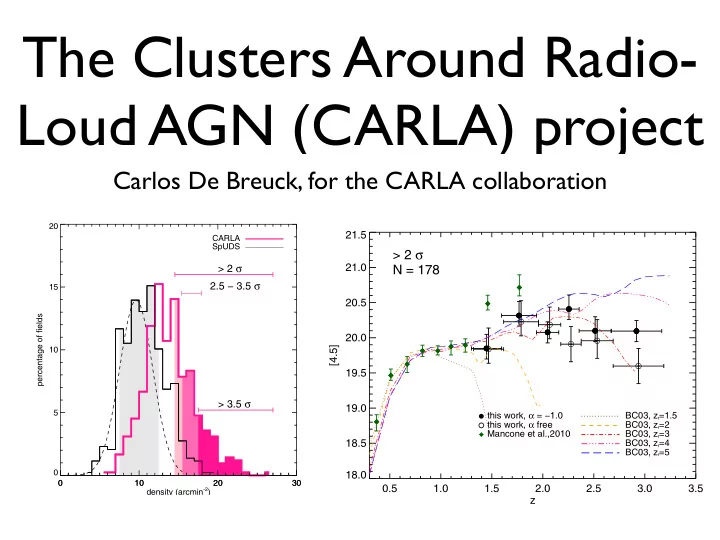
The Clusters Around Radio- Loud AGN (CARLA) project Carlos De Breuck, for the CARLA collaboration 20 21.5 CARLA SpUDS > 2 21.0 > 2 N = 178 2.5 3.5 15 20.5 percentage of fields 20.0 [4.5] 10 19.5 > 3.5 19.0 5


slide-1
SLIDE 1

The Clusters Around Radio- Loud AGN (CARLA) project

Carlos De Breuck, for the CARLA collaboration

0.5 1.0 1.5 2.0 2.5 3.0 3.5 z 18.0 18.5 19.0 19.5 20.0 20.5 21.0 21.5 [4.5]

BC03, zf=1.5 BC03, zf=2 BC03, zf=3 BC03, zf=4 BC03, zf=5 this work, α = −1.0 this work, α free Mancone et al.,2010

> 2 σ N = 178

10 20 30 density (arcmin-2) 5 10 15 20 percentage of fields CARLA SpUDS

> 2 σ 2.5 − 3.5 σ > 3.5 σ

10 20 30

slide-2
SLIDE 2

The seeds of the project

  • 1996-2000: trying to find the most distant radio galaxies

✴ ultra-steep spectrum radio selection DB + 2000 ✴ K-band follow-up (mostly Keck/NIRC) DB, DS + 2002 ✴ optical spectroscopy (mostly Keck) DB, DS + 2001

  • 1999-2005: Lyα emitter search with narrow-band filters

✴ prototype: Spiderweb cluster @z=2.16 Pentericci + 2000 ✴ follow-up known high-z radio galaxies. ✴ mostly done by George Miley’s group in Leiden + DB ✴ ~10 proto-clusters found at 2<z<5.2

Venemans, DB + 2007

slide-3
SLIDE 3

VLT Lyα emitters

slide-4
SLIDE 4

The massive host galaxies

  • Remarkably tight correlation in the K-z diagram
  • Interpreted as most massive galaxies at each epoch Rocca-

Volmerange, DB + 2003

  • Bandpass shifting, evolution, etc. complicate interpretation.
  • Solution: observe radio galaxies with Spitzer.
  • bserved K
slide-5
SLIDE 5

Spitzer High-z Radio Galaxies


http://www.eso.org/~cdebreucl/shzrg/index.html

Co-conspirators: Nick Seymour (SSC), Daniel Stern (JPL), Carlos De Breuck, Joel Vernet, Alessandro Rettura, Robert Fosbury (ESO), Andrew Zirm (STSCI), Brigitte Rocca-Volmerange (IAP), Mark Lacy, Harry Teplitz (SSC), Arjun Dey, Mark Dickinson (NOAO), Wil van Breugel, Adam Stanford (UCLLNL), George Miley, Huub Rottgering (Leiden), Peter Eisenhardt (JPL), Partick McCarthy (OCIW)

slide-6
SLIDE 6

The massive host galaxies

  • Remarkably tight correlation in the K-z diagram
  • Interpreted as most massive galaxies at each epoch Rocca-

Volmerange, DB + 2003

  • Bandpass shifting, evolution, etc. complicate interpretation.
  • Solution: observe radio galaxies with Spitzer.
  • bserved K

rest H

slide-7
SLIDE 7

Using Spitzer for overdensities

  • Overdensities in Spitzer IRAC1-IRAC2 Galametz + 2012
  • Overdensities In Spizer MIPS 24µm Mayo + 2012

IRAC1-IRAC2 MIPS 24µm

slide-8
SLIDE 8

The CARLA project

slide-9
SLIDE 9
  • After initial success based on shallow SHzRG data, go for

a substantial sample of all known z>1 type 2 AGN + matched sample of type 1 AGN from SDSS: 387 fields.

  • Spitzer warm mission proposal in Cycles 7 & 8.
  • Covering 1.3<z<3.2 with uniform z-L500MHz coverage.

The CARLA project

slide-10
SLIDE 10

The CARLA project

  • Covering the peak of the SFDR 1.3<z<3.2.
  • Prior knowledge of AGN redshift simplifies confirmation.
  • Presence of a radio-loud AGN complicates X-ray follow-up.
slide-11
SLIDE 11

The CARLA selection

  • Using IRAC [3.6]-[4.5]>-0.1 criterion (Papovich et al. 2008).
  • Reaching [3.6]AB=22.6 and [4.5]AB=22.9.
  • No statistical difference between type 1 & type II AGN.

1 2 3 4 5 z −0.6 −0.4 −0.2 0.0 0.2 0.4 [3.6]−[4.5] (AB)

IRAC selected sources Bruzual&Charlot03, zf=2 Bruzual&Charlot03, zf=3 Bruzual&Charlot03, zf=5

slide-12
SLIDE 12

The CARLA overdensities

  • 92% of fields are denser than SpUDS comparison fields.
  • 55% >2σ and 10% >5σ overdense.
  • Overdensities statistically centred on AGN position.

10 20 30 density (arcmin-2) 5 10 15 20 percentage of fields CARLA SpUDS

> 2 σ 2.5 − 3.5 σ > 3.5 σ

10 20 30

20 40 60 80 100 120 distance (arcsec) 5 10 15 20 25 density (arcmin−2)

CARLA: > ΣSpUDS+3σSpUDS CARLA: > ΣSpUDS SpUDS CARLA: < ΣSpUDS

Wylezalek et al. 2013

slide-13
SLIDE 13

18 19 20 21 22 23 [4.5] 0.0001 0.0010 0.0100 0.1000 1.0000 10.0000 Φ = dN/dm/dA (arcmin−2)

2.3 < z < 2.6 N = 30 m* = 19.95+0.30

−0.25

α = −1.09+0.15

−0.15

m*

α = −1 = 20.09+0.19 −0.15

Cluster luminosity function

  • Statistical sample allows to sample LF in 6 redshift bins.
  • Evolution of M* consistent with passive galaxy evolution models.
  • Earlier quenching compared to field galaxy cluster samples.

Wylezalek et al. 2014

0.5 1.0 1.5 2.0 2.5 3.0 3.5 z 18.0 18.5 19.0 19.5 20.0 20.5 21.0 21.5 [4.5]

BC03, zf=1.5 BC03, zf=2 BC03, zf=3 BC03, zf=4 BC03, zf=5 this work, α = −1.0 this work, α free Mancone et al.,2010

> 2 σ N = 178

slide-14
SLIDE 14

Protocluster evolution

  • Model estimates maximum ~40% contribution from SF

population vs. 80% in field galaxy clusters.

  • See talks by Cooke & Noirot for further studies.

Wylezalek et al. 2014

0.5 1.0 1.5 2.0 2.5 3.0 3.5 z 18.0 18.5 19.0 19.5 20.0 20.5 21.0 21.5 [4.5]

P = 90 P = 80 P = 70 P = 60 P = 50 P = 40 P = 30 P = 20 P = 10

this work, α = −1.0 this work, α free Mancone et al.,2010 BC03 with ratio (SSP(zf=3):CSP(zf=3, τ=10Gyr)) (100−P):P by mass BC03, zf=5, CSP τ=0.1Gyr BC03, zf=3, CSP τ=0.1Gyr

> 2 σ N = 178

slide-15
SLIDE 15

CARLA J1753+6311: 
 Spectroscopic Confirmation of a Galaxy Cluster at z = 1.58 
 associated with a powerful radio galaxy 


  • A. Rettura (Caltech/IPAC)
  • Collaborators: Stern, Noirot, Cooke, Wylezalek

and the CARLA Team

slide-16
SLIDE 16

CARLA J1753+6311:

Cooke et al. 2016

slide-17
SLIDE 17

Keck-CARLA

Title: “MOSFIRE H-alpha spectroscopy of clusters around Radio-Loud AGN at 1.4 < z < 2.6”

  • Awarded 1 nights to follow up CARLA candidates

Caltech-TAC (P.I.: Rettura)

  • J1753+6311 (z=1.58): 1.0 hr in H-band

TXS2353 (z=2.59/1.49) : 1.5 hr in K-band J0800+4029 (z=2.02): 2.5 hr in K-band J1052+0806 (z=1.64): 1.8 hr in H-band

slide-18
SLIDE 18

1.65 1.70 1.75 Observed Wavelenght [µm] 0.0 0.5 1.0 1.5 2.0 2.5 3.0 Relative units

Hα [NII] [NII]

7C 1753+6311 z=1.578

MOSFIRE Campaign

Rettura et al. 2016, in prep. Mosfire 1D spectra of 7C1753+6311

slide-19
SLIDE 19

K110 z=1.579 K091 z=1.578 K134b z=1.581 7c1753+6311 z=1.578 K075 z=1.587 Rest-Frame Wavelength [nm] 580 590 600 610 620 630 640 650 660 670 680

NII Hα NII [SII] NII Hα NII [SII] NII Hα NII [SII] NII Hα NII [SII] NII Hα NII [SII]

MOSFIRE 2D spectra of Cluster Members

Rettura et al. 2016

slide-20
SLIDE 20

K134b/
 H619 H614 7C1753+6311 H470 H157

HST :2D spectra of additional Cluster Members

See Noirot talk

Rettura et al. 2016, in prep.

slide-21
SLIDE 21

+ + Rettura et al. 2016, in prep.

slide-22
SLIDE 22

AR+16

slide-23
SLIDE 23

CARLA J1753+6311

2.5’x2.5’ IRAC 4.5µm Rettura et al. 2016, in prep.

slide-24
SLIDE 24

CARLA J1753+6311

2.5’x2.5’ i-band Rettura et al. 2016, in prep.

slide-25
SLIDE 25

1.52 1.54 1.56 1.58 1.60 Spectroscopic Redshift 0.0 0.5 1.0 1.5 2.0 2.5

  • No. Gal. (Δ z = 0.002)

Redshift Distribution

7 spectroscopic members with 1200 km/s at <z>=1.582 Rettura et al. 2016, in prep.

See also next talk by Cooke

slide-26
SLIDE 26

CARLA z confirmations

  • HST grism spectroscopy of the 20 densest fields (see talk by

Gaël Noirot).

  • Alternative approach to use CO(2-1) with ALMA (Cycle 4 PI

Galametz) & IRAM NOEMA (PI Mei & Galametz) mosaicing. Dusty & SF population, determine gas fractions.