The Bioeconomy in the Netherlands opportunities for collaboration - - PowerPoint PPT Presentation

the bioeconomy in the netherlands
SMART_READER_LITE
LIVE PREVIEW

The Bioeconomy in the Netherlands opportunities for collaboration - - PowerPoint PPT Presentation

The Bioeconomy in the Netherlands opportunities for collaboration Ir. Kees W. Kwant NL Liaison biobased economy Member IEA Bioenergy Exco The Netherlands 17 million inhabitants on 40.000 sq. km 46.073 US$ GDP/Cap Consumption fuels 11 Mton


slide-1
SLIDE 1

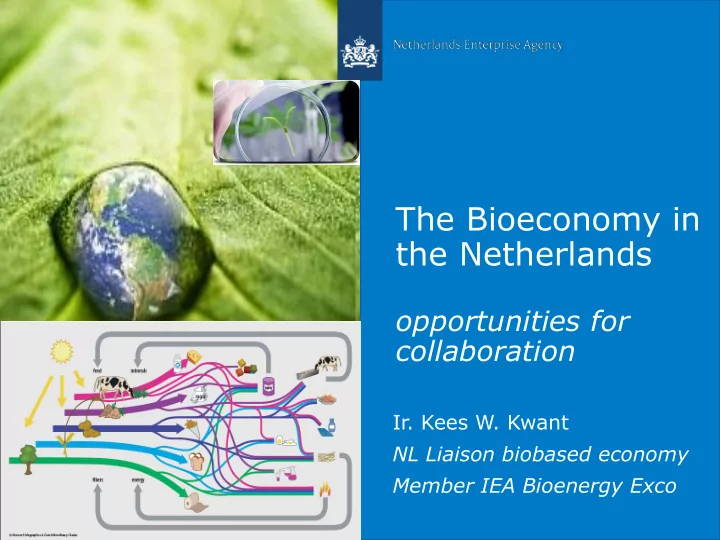
The Bioeconomy in the Netherlands

  • pportunities for

collaboration

  • Ir. Kees W. Kwant

NL Liaison biobased economy Member IEA Bioenergy Exco

slide-2
SLIDE 2

>> Focus on environment

The Netherlands

17 million inhabitants

  • n 40.000 sq. km

46.073 US$ GDP/Cap Consumption fuels 11 Mton Consumption biofuels: 0,4 Mton Production biofuels: 1,9 Mton

  • Delta downstream large European rivers, 2/3 of the country below sea level
  • Surrounded by industrialized area's of Belgium, Germany
slide-3
SLIDE 3

Integrated Approach for Bioeconomy – Biobased Economy - Bioenergy

  • The bio-energy arena is a subset of the bio-based arena

(non-food use of biological resources), itself a subset of the bio economy, and ultimately of the ‘carbon economy’.

  • Our society is to a significant extent based on the ‘carbon

economy’, fed both by fossil and renewable (or biological) carbon.

Source: van Beeck, Kwant, Moerkerken & Stuij – An Innovative Perspective, Transition towards a bio-based economy - see reference last page

slide-4
SLIDE 4

Optimum use of bio-resources implies ‘cascading’

Source: van Beeck, Kwant, Moerkerken & Stuij – An Innovative Perspective, Transition towards a bio-based economy - see reference last page

Policy Netherlands: Biobased Economy Create Sustainable Value from biomass

Biomass for chemicals, products and energy

  • Sustainable Production
  • Innovation
  • Integrated use in

Biorefineries Till now: Main Driver:

  • Renewable Energy

Directive

  • Netherlands: 14% in 2020
slide-5
SLIDE 5

Policy: 2016; Biomass 2030 – Strategic vision for implementation of biomass

5

Main message:

  • In principal there is enough sustainable

biomass available to fulfil the Dutch demand for food, feed, transport, chemicals and materials

  • However, this requires:
  • supply of sustainable biomass
  • efficient and circular use of biomass in

biorefineries

  • use an integral sustainability assessment

framework

  • innovation

https://www.rijksoverheid.nl/documenten/rapporten/2015/12/01/biomassa-2030

slide-6
SLIDE 6

6

Circular & Biobased Economy

Ministry of Economic Affairs Biobased & Circular Economy

slide-7
SLIDE 7

Bioenergy in a low carbon energy supply

slide-8
SLIDE 8

Bioenergy an essential component of IEA Low Carbon Scenarios

Bioenergy to provide some 17% of cumulative carbon savings to 2060 in the 2DS and around 22% of additional cumulative reductions in the B2DS, including an important contribution from BECCS Role of Bioenergy – RTS to B2DS

5 10 15 20 25 30 35 40 45 2015 2020 2025 2030 2035 2040 2045 2050 2055 2060 Global Emissions GT CO2

2DS - Other technologies 2DS - Bioenergy

5 10 15 20 25 30 35 40 45 2015 2020 2025 2030 2035 2040 2045 2050 2055 2060 Global Emissions GT CO2

2DS - Other technologies 2DS - Bioenergy B2DS - Other technologies B2DS - Bioenergy

slide-9
SLIDE 9

Renewable Energy targets: RED: 2020: 14% in NL

2017: 6,6 %

slide-10
SLIDE 10

Renewable Energy: 2017: 6,6 %

About 70% realised with Bioenergy

PJ

20 40 60 80 100 120 140

1990 2000 2006 2008 2010 2012 2014 2016

biomass wind solar

  • ther
slide-11
SLIDE 11

Biomass for Bioenergy use in Netherlands

PJ

10 20 30 40 50 60 70 80 90

1990 1995 2000 2005 2006 2007 2008 2009 2010 2011 2012 2013 2014 2015 2016

biofuel cofiring bioCHP biogas EfWaste bioheat

slide-12
SLIDE 12

Realisation of the Renewable Energy Directive obligation by the Energy Agreement (2013)

slide-13
SLIDE 13

Indicative Contribution of R.E. options

13

Source 2013 2020 Wind on sea 3,1 27,0 Wind on land 20,6 54,0 Solar PV 0,9 11,6 Biomass Cofiring 6,1 25,0 Waste Incineration 13,3 11,7 Biomass CHP 3,5 13,6 Biomass Heat 19,0 31,6 Biofuels 18,0 35,6 Renewable Heat 6,1 36,3 TOTAL 105,5 261,6 Percentage R.E. 4,4% 14% For Biomass: 2013: 59,9 2020: 117,5 Doubling the amount of biomass

slide-14
SLIDE 14

Research and Realisation of Biorefineries in the Circular Economy

slide-15
SLIDE 15

National Research Approach

  • Netherlands:
  • Topsector Approach
  • Biobased as a solution for Chemical Industry

>

Strong Agricultural knowledge (Wageningen)

>

Good Infrastructure (Rotterdam harbour)

>

Collaboration Chemical/Energy/Agriculture/Waste sectors

  • Research agenda 2015 – 2027 published
slide-16
SLIDE 16

Country Report The Netherlands 16

Bioefineries in NL

  • commercial

(red)

  • demo & pilot

(blue)

slide-17
SLIDE 17

Bioprocess Pilot Facility (BPF)

17

  • Open-access multipurpose facility
  • State-of-the-art 5000 m2 facility consisting of complex

piloting equipment and supporting labs to investigate scale-up issues

  • Modules/technologies: pre-treatment and hydrolysis,

fermentation, downstream processing and food grade

http://www.bpf.eu

slide-18
SLIDE 18

AlgaePARC

Country Report The Netherlands 18

  • Microalgae production & refinery platform for the

production of proteins, lipids, carbohydrates and pigments

  • Located in Wageningen
  • Develop technology and processes

to fractionate microalgae biomass

  • Systems analysis
  • Sustainability assessment

http://www.AlgaePARC.c

  • m
slide-19
SLIDE 19

Green chemicals from solar (www.photanol.com )

  • CO2+light -> chemicals
  • Blue algae -> lactic acid
  • Spinn-off Univ. AMS
  • Collaboration AKZO
  • Labscale -> pilot ->demo in

greenhouse Lessons:

  • Partnering for market entry
  • Use existing infrastructure
slide-20
SLIDE 20

COSUN the unbeatable beet

20

  • Beet to food, feed, chemicals, materials and energy
  • Cosun processes about 75,000 ha beet (22-25 tonnes d.m. per

ha/year) into sugars and animal feed

  • Within this pilot project they valorise the whole beet plant, i.e.: the

beet, the leafs and the carrots

http://www.cosun.com

slide-21
SLIDE 21

Sugar Beet for Biobased Economy

slide-22
SLIDE 22

Biomass Cascading and Valorisation

Biomass cascading food & feed final consumption pharma, fine chemicals/ cosmetics commodity and bulk chemicals, fertilizers (transport) fuel, electricity, heat V O L U M E A D D E D V A L U E Suiker Unie products of sugar beet ►Sugar for direct use (e.g., in coffee) ►Sugar as ingredient (raw material for food) ►Beet pulp for animal feed ►… ►Betacal (lime fertilizer for agricultural purposes ►Beet soil (soil attached to the beet) for roads, dykes ►Molasses for the production of yeast ►Beet tails and washing water for biogas (via digestion)

http://cosunbiobased.com

  • Total concept, including a 50% increase in sugar beet yield per hectare, a

50% reduction in fertilizer use, and a 50% efficiency improvement in the sugar plant (all in about 20 years).

  • Further optimization includes export of waste heat, and site utilization for

renewable energy production (solar and wind).

slide-23
SLIDE 23

Pyrolysis Empyro (www.btg-btl.com)

  • First Operational Plant in NL
  • Built in modules in Hengelo,
  • perational since 2015
  • Phasing of applications
  • 1: burning ->
  • 2: transportfuels ->
  • 3: chemicals
  • Take off client:
  • 20 mln. liter/jaar, used by

Friesland Campina Borculo for steam (supported by SDE+)

slide-24
SLIDE 24

23 Dutch water authorities put wastewater to good use :

  • Increased Output:
  • energy, biogas to power cars or electricity
  • raw materials ; phosphate, which is used to produce

fertilizers.

  • Collaboration
  • the water boards have set up a collaborative network
  • rganization called Energy & Raw Materials Factory

(EFGF). http://www.efgf.nl/english

  • Joint Research programme with Universities
slide-25
SLIDE 25

Products from waste water sludge

  • Energy
  • Fosphate
  • Cellulose
  • Bioplastics & Acids
  • Alginate
  • CO2
  • Movie:
  • https://www.youtube.com/watch?v=CT9l

VE6wfIc

slide-26
SLIDE 26

Zambezi Process in a Nutshell

Improved Bergius-Rheinau process: Two-stage, concentrated HCl hydrolysis Acid / sugar separation by proprietary evaporation technology yielding High purity glucose product

Intellectual Property captured through patent filings

Feedstock Flexible

  • Technical Breakthroughs

– Acid sugar separation – Material construction – Lignin deacidification

slide-27
SLIDE 27

Zambezi Project in Delfzijl

27

slide-28
SLIDE 28

IEA Bioenergy, also known as the Technology Collaboration Programme (TCP) for a Programme of Research, Development and Demonstration on Bioenergy, functions within a Framework created by the International Energy Agency (IEA). Views, findings and publications of IEA Bioenergy do not necessarily represent the views or policies of the IEA Secretariat or of its individual Member countries.

International Collaboration

IEA Bioenergy: platform for international collaboration and information exchange in bioenergy research, technology development, demonstration, and policy analysis. Mission: To increase knowledge and understanding

  • f bioenergy systems in order to facilitate

the commercialisation and market deployment of environmentally sound, socially acceptable, and cost competitive bioenergy systems

slide-29
SLIDE 29

Thank you for your attention Questions?

Kees.Kwant@rvo.nl