The Axion Resonant In InterAction Detection Experiment (A - - PowerPoint PPT Presentation

the axion resonant in interaction
SMART_READER_LITE
LIVE PREVIEW

The Axion Resonant In InterAction Detection Experiment (A - - PowerPoint PPT Presentation

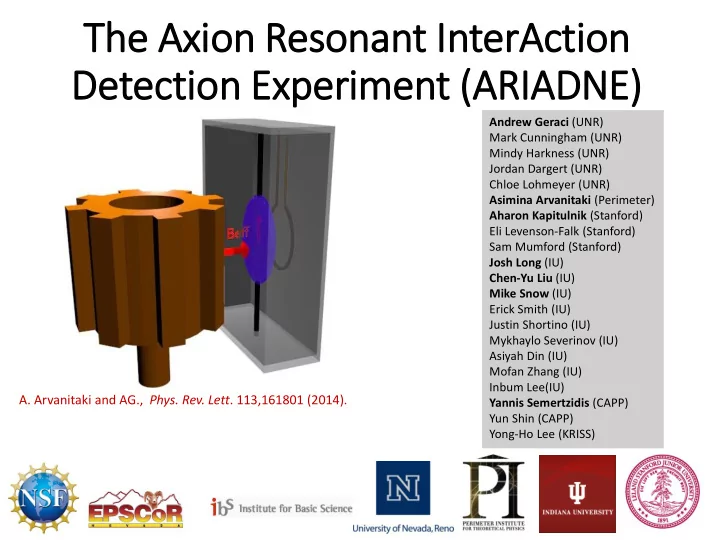
The Axion Resonant In InterAction Detection Experiment (A (ARIADNE) Andrew Geraci (UNR) Mark Cunningham (UNR) Mindy Harkness (UNR) Jordan Dargert (UNR) Chloe Lohmeyer (UNR) Asimina Arvanitaki (Perimeter) Aharon Kapitulnik (Stanford) Eli


slide-1
SLIDE 1

The Axion Resonant In InterAction Detection Experiment (A (ARIADNE)

  • A. Arvanitaki and AG., Phys. Rev. Lett. 113,161801 (2014).

Andrew Geraci (UNR) Mark Cunningham (UNR) Mindy Harkness (UNR) Jordan Dargert (UNR) Chloe Lohmeyer (UNR) Asimina Arvanitaki (Perimeter) Aharon Kapitulnik (Stanford) Eli Levenson-Falk (Stanford) Sam Mumford (Stanford) Josh Long (IU) Chen-Yu Liu (IU) Mike Snow (IU) Erick Smith (IU) Justin Shortino (IU) Mykhaylo Severinov (IU) Asiyah Din (IU) Mofan Zhang (IU) Inbum Lee(IU) Yannis Semertzidis (CAPP) Yun Shin (CAPP) Yong-Ho Lee (KRISS)

slide-2
SLIDE 2

Monopole-Dipole axion exchange

) ˆ ˆ ( 1 1 8 ) (

/ 2 2

r e r r m g g r U

a

r a f N p N s

          

  

eff

B   

  • Different than ordinary B field
  • Does not couple to angular momentum
  • Unaffected by magnetic shielding

Acts as effective magnetic field

Spin-dependent forces

slide-3
SLIDE 3

A spin polarized sample acts as an indicator of the Axion potential

  • A steep drop-off allows the effective field to be

effectively turned on and off

  • Repeated insertion and removal of this mass at the

Larmor frequency allows resonant amplification of the effect

  • Look for changes in the NMR frequency induced by

𝑪𝒇𝒈𝒈

slide-4
SLIDE 4

[1] Phys. Rev. Lett. 111, 102001 (2013), [2] Phys. Rev. Lett. 111, 100801 (2013), [3] Phys. Rev. D 87, 011105(R) (2013), [4] Phys. Rev. Lett. 105, 170401 (2010), [5] Phys. Rev. Lett. 77, 2170 (1996) [1] [2] [3] [4] [5]

1) 129Xe/131Xe NMR 2) 3He/129Xe NMR with SQUID magnetometer 3) 3He NMR with a 250µm window 4) 3He Spin Relaxation with cell walls 5) 199Hg/Cs co-magnetometer

Current experimental limits

slide-5
SLIDE 5

Unpolarized (tungsten) segmented cylinder sources Beff Laser Polarized 3He gas senses Beff (Indiana U) squid pickup loop Superconducting shielding (Stanford) Applied Bias field Bext

ext

2 B

N 

  

  • A. Arvanitaki and A. Geraci, Phys. Rev. Lett. 113,

161801 (2014).

Y.-H. Lee (KRISS)

) ˆ ˆ ( 1 1 8 ) (

/ 2 2

r e r r m g g r U

a

r a f N p N s

          

  

eff

B   

Concept for ARIADNE

slide-6
SLIDE 6

Polarized 𝑰𝒇

𝟒

compression system

  • Modification and rebuilding of existing MEOP

system

  • New fiber laser and optical polarimeter
  • Delivers compressed polarized 𝑰𝒇

𝟒

at room temperature

  • Rev. Sci. Instrum. 76, 053503 (2005)
slide-7
SLIDE 7

Test cryostat

  • Magnetic field coils
  • Produce polarized

𝑰𝒇

𝟒

at 4K

  • Tests of NMR

system

  • Measurement of

polarized 𝑰𝒇

𝟒

relaxation time

slide-8
SLIDE 8
  • Build an interferometer to measure the

change in distance (d).

  • We can find theta (Ө) from:

Ө= cos-1((L-d)/L)

  • We can solve for the wobble distance (X)

by: X= Lsin(Ө)

Interferometers Rotary test chamber

Rotary stage vibration and tilt

slide-9
SLIDE 9
  • DC sputtering system
  • 300W deposition
  • 300V, 1A
  • 12.5nm/min rate

Water cooled Rotation stage Sample shutter Gun – 3” Nb target, .25” thick

Sputtered Niobium on Quartz

slide-10
SLIDE 10

10

10 

QCD

16

10

QCD

  • A. Arvanitaki and AG., Phys. Rev. Lett. 113,161801 (2014).

Sensitivity

slide-11
SLIDE 11

Summary

  • New resonant method to search for monopole-

dipole interaction

  • Sensitive to Axions in the 0.1meV <ma < 10 meV

range

  • Hardware is being developed and tested for the

experiment

slide-12
SLIDE 12

Conceptual drawing of apparatus

  • Experiment is done at 4K
  • Allows for superconducting

shielding

  • Reduces thermal noise
  • Ellipsoidal sample allows near

uniform magnetization

  • Rotating segmented mass oscillates

force in resonance to the Larmor precession

  • SQUID pickup loop for NMR of sample
  • Radiation and superconducting

magnetic shielding used to minimize noise

slide-13
SLIDE 13
slide-14
SLIDE 14

Experimental challenges

  • Magnetic gradients
  • Nonlinearities
  • Barnett Effect
  • Trapped magnetic flux
  • Vibration isolation
  • Magnetic noise from thermal currents
  • Design/Simulation Work: Magnetic gradient reduction strategy
  • Experimental testing in progress: Vibration tests, Shielding factor f test thin-film SC