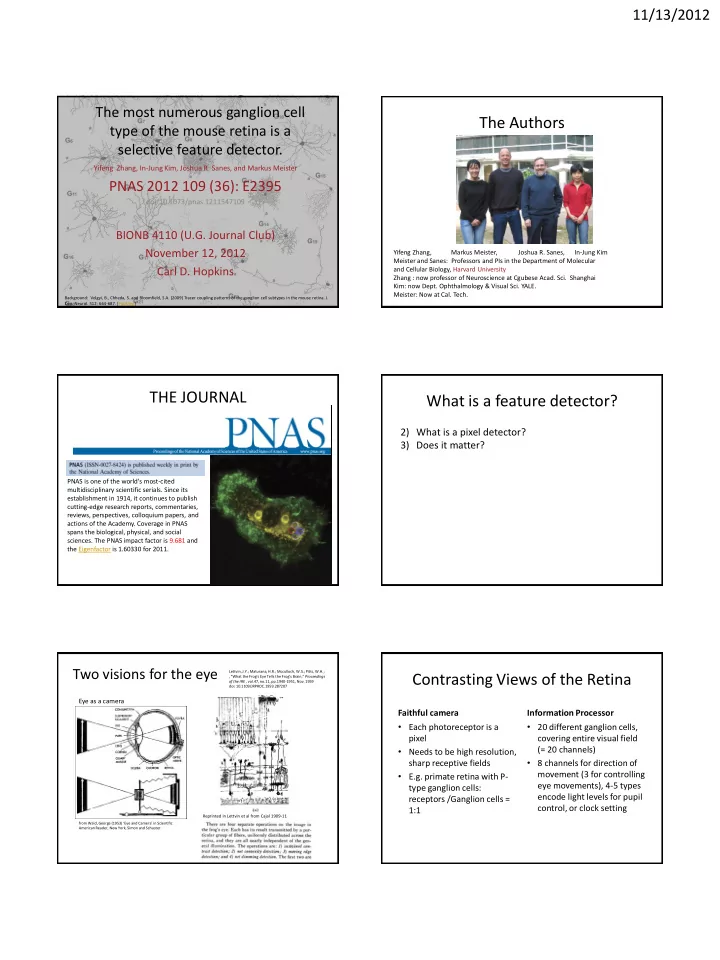
The Authors type of the mouse retina is a selective feature - - PDF document

the authors
SMART_READER_LITE
LIVE PREVIEW

The Authors type of the mouse retina is a selective feature - - PDF document

11/13/2012 The most numerous ganglion cell The Authors type of the mouse retina is a selective feature detector. Yifeng Zhang, In-Jung Kim, Joshua R. Sanes, and Markus Meister PNAS 2012 109 (36): E2395 doi/10.1073/pnas.1211547109 BIONB 4110


slide-1
SLIDE 1

11/13/2012 The most numerous ganglion cell type of the mouse retina is a selective feature detector.

Yifeng Zhang, In-Jung Kim, Joshua R. Sanes, and Markus Meister

PNAS 2012 109 (36): E2395

doi/10.1073/pnas.1211547109

BIONB 4110 (U.G. Journal Club) November 12, 2012 Carl D. Hopkins

Background: Volgyi, B., Chheda, S. and Bloomfield, S.A. (2009) Tracer coupling patterns of the ganglion cell subtypes in the mouse retina. J.

  • Cop. Neurol. 512: 664-687. [PubMed]

The Authors

Yifeng Zhang, Markus Meister, Joshua R. Sanes, In-Jung Kim Meister and Sanes: Professors and PIs in the Department of Molecular and Cellular Biology, Harvard University Zhang : now professor of Neuroscience at Cgubese Acad. Sci. Shanghai Kim: now Dept. Ophthalmology & Visual Sci. YALE. Meister: Now at Cal. Tech.

THE JOURNAL

PNAS is one of the world's most-cited multidisciplinary scientific serials. Since its establishment in 1914, it continues to publish cutting-edge research reports, commentaries, reviews, perspectives, colloquium papers, and actions of the Academy. Coverage in PNAS spans the biological, physical, and social

  • sciences. The PNAS impact factor is 9.681 and

the Eigenfactor is 1.60330 for 2011.

What is a feature detector?

2) What is a pixel detector? 3) Does it matter?

Two visions for the eye

from Wald, George (1953) ‘Eye and Camera’ in Scientific American Reader, New York, Simon and Schuster.

Eye as a camera

Lettvin, J.Y.; Maturana, H.R.; Mcculloch, W.S.; Pitts, W.H.; , "What the Frog's Eye Tells the Frog's Brain," Proceedings

  • f the IRE , vol.47, no.11, pp.1940-1951, Nov. 1959

doi: 10.1109/JRPROC.1959.287207 Reprinted in Lettvin et al from Cajal 1909-11

Contrasting Views of the Retina

Faithful camera

  • Each photoreceptor is a

pixel

  • Needs to be high resolution,

sharp receptive fields

  • E.g. primate retina with P-

type ganglion cells: receptors /Ganglion cells = 1:1 Information Processor

  • 20 different ganglion cells,

covering entire visual field (= 20 channels)

  • 8 channels for direction of

movement (3 for controlling eye movements), 4-5 types encode light levels for pupil control, or clock setting

slide-2
SLIDE 2

11/13/2012

The retina of has over 50 known cell types belonging to the 5 traditional classes (receptors, horizontal, bipolar, amacrine, ganglion) - mostly from rabbit

From Masland (2001) Nature Neuroscience; reprinted in Gollisch and Meister Neuron, Volume 65, Issue 2, 150-164, 28 January 2010 hotoreceptor

  • rizontal

ipolar macrine anglion

Mouse Retina

Volgyi, B., Chheda, S. and Bloomfield, S.A. (2009) Tracer coupling patterns of the ganglion cell subtypes in the mouse retina. J. Cop. Neurol. 512: 664-687. [PubMed]

5 major cell types

5 major cell types Principal Cells: the Ganglion cells (projection cells) axons go to

  • Supra-chiasmatic nucleus

(circadian rhythms)

  • Pre-tectal nucleus (controls

pupil size)

  • Superior colliculus (orients

eye and head movements)

  • Lateral geniculate (form

vision and movement)

slide-3
SLIDE 3

11/13/2012

How are the authors able to visualize only the W3 retinal ganglion cell so that they can create a map of all of the W3 neurons in the retina?

Transgenic mouse lines permits selective labeling of RGC subtypes. Here, RGC W3

Transgenic mice

  • Th

Thy-1 is a surface protein , a thymocyte antigen, used for marking stem cells, including axon processes of neurons.

Characteristics of W3 RGC

  • Numerous
  • Small RF
  • High spatial resolution
  • Candidate pixel detector

W3 expressing neurons in a mouse retina whole mount. Greater density in ventral retina. cells/mm2 Left: vertical section of the inner plexiform layer. Red: ChAT label of amacrine cells (Choline acetyl transferase) Green: YFP label of W3 cells Blue: cell bodies (Nisl) Note: the dendrites of W3 are sandwiched between two bands of ChAT-positive bands in the IPL. Density of cells in the central retina Dashed- randomly spaced Red: hexagonal array

slide-4
SLIDE 4

11/13/2012

From Kim, Zhang, Meister, Sanes (2010) J. Neurosci. 30:1452 The diameter of the dendritic arbor of W3 neurons is very small compared to other ganglion cells in the retina. The cell body is also small Coverage factor is 4.5 in densest region of retina (i.e 4 to 5 cells cover each point in space) Spatial patterns can be: W3 neurons are of a single cell type, with a relatively regular distribution.

  • The density recovery profile (density of W3 neurons versus their average spacing)

indicates repulsion at close range; close fit to hexagonal packing. Expected if random Expected if hexagonal “Together, these results provide strong evidence that W3-RGCs are a single cell type that represents the smallest-field and highest density RGCs in the mouse retina. Hence one expects this population to sample the visual scene at the highest spatial resolution.”

By using transgenic lines of mice containing YFP gene inserted into gene Thy1 get yellow fluorescence in subset of W3 RGC.

slide-5
SLIDE 5

11/13/2012

Whole cell patch electrode records from one cell Whole cell patch clamp from RGCs, some from W3 (guided by strong fluorescent label)

  • thers from non W3. Response to natural scene movies from “rat-cam”.

Non-W3 RGCs respond to rat-cam movie; W3 cells are generally silent. Even though film shows a predatory bird flying nearby, the W3 neuron is silent, unless it’s receptive field is looking at the edge of the bird. How possible? – W3 does not encode common visual events from moving or stationary objects. Whole cell patch clamp from RGCs, some from W3 (guided by strong fluorescent label)

  • thers from non W3. Response to natural scene movies from “rat-cam”.

Non-W3 RGCs respond to rat-cam movie; W3 cells are generally silent.

Natural stimuli

  • Recorded via head-mounted video (rat cam)
  • Contains significant pan motion due to angular

and linear head movement – turning, walking

  • Presented to W3 cells – no response
  • For mouse in nature, head movements would be

compensated by counter eye movement (VOR) but normal stimuli should contain significant

  • ptical flow patterns.
  • What about when freezing?

Even though film shows a predatory bird flying nearby with a stationary background, the W3 neuron is silent, unless it’s receptive field is looking at the edge of the bird. How possible? – W3 does not encode common visual events from moving or stationary objects.

The authors conclude that W3 neurons in the retina respond both to lights turning "on" and lights turning "off". How might this be possible, given that cones all respond to lights turning on with hyperpolarization?

slide-6
SLIDE 6

11/13/2012

W3 Receptive Fields

A. Shows the receptive field of the RGC overlaps with that of the dendritic arbor. Recording from W3, stimulate with\light, cell fires spikes on “ON” and on “OFF”. Averate spike rate for on vs. off responses plotted as a function of time. Note that the on response is delayed compared to the off

  • response. WHY do you think this might be?

B. Directionality of a moving bar stimulus. In each direction the cell fires on both edges of the bar (on, then off). Restricted receptive field area. C. Stimulus is a bnar of light and dark bands each fluctuating in intensity from light to dark. The spike-triggered stimulus average is determined, subjected to PCA, and represented as a two dimensional plot. The dots fall into two categories. Using PC1, the spike triggered reverse average is either excitatory followed yby inhibitory, or reversel The inhibition is faster and stronger. Spike triggered average, sorted by position in cluster shows that some spikes are driven by

  • n, others by off.

D. Model of the W3 ganglion cell is a single neuron with inputs from one On bipolar and

  • ne off bipolar, each is a rectifying synapse.

On-bipolar cells and off-bipolar cells terminate in different depths of the inner plexiform layer

Voltage clamp data from W3 cell shows a series of responses at each holding potential. Global motion produced a large conductance increase, but note that the reversal potential is -61. Differential motion produced a weaker conductance incrase but the reversal potential is excitatory. Motion of the center grading alone produced a strong excitation, no inhibition.

The authors conclude that W3 retinal ganglion cells are "feature detectors" for arial predators. Make a list of characteristics of stimuli that cause the cells to fire that would lead to this conclusion.

slide-7
SLIDE 7

11/13/2012

Response of W3 neuron to small dark objects such as a dark outline of a hawk flying

  • verhead on a bright background. Small objects, about the size of the W3 receptive field

evoke the strongest response, independent of trace. No directional preference.

Summary

A small, numerous, RGC, W3 is found over the entire retina. It has a small cell body, small, dense thorny dendritic field. W3 cells are a candidate for pixel detector in the retina. Transgenic lines selectively label W3 neurons with strong YFP signals. W3 neurons are silent to most stationary, and moving stimuli. W3 respond both to on and to off stimuli. Appear to receive both on and off bipolar inputs. Both are rectifying, and do not cancel each other out. In response to natural movie with head movements, cells do not respond. Other RGCs fire significantly. In response to moving stimuli appear to be strongly inhibited by peripheral movement. Inhibition is spike-dependent, from Amacrine cells. W3 neurons act as feature detectors for small dark objects on light background moving slowly.