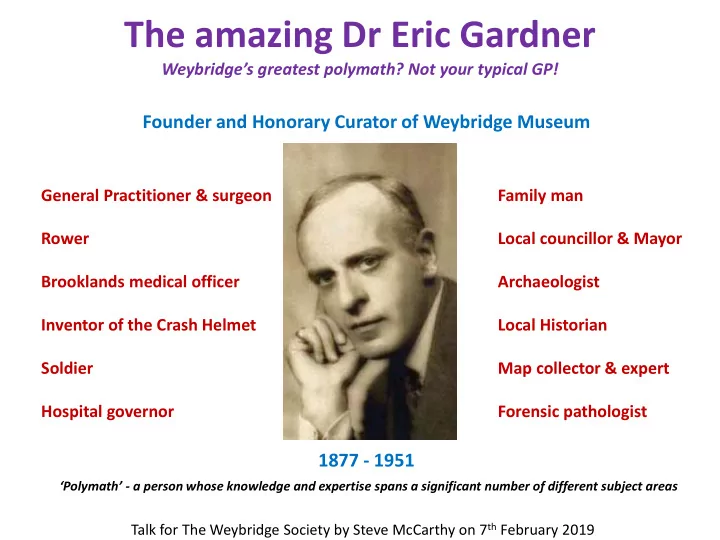
SLIDE 1 The amazing Dr Eric Gardner
Weybridge’s greatest polymath? Not your typical GP! General Practitioner & surgeon Rower Brooklands medical officer Inventor of the Crash Helmet Soldier Hospital governor
Founder and Honorary Curator of Weybridge Museum
Family man Local councillor & Mayor Archaeologist Local Historian Map collector & expert Forensic pathologist
‘Polymath’ - a person whose knowledge and expertise spans a significant number of different subject areas
1877 - 1951
Talk for The Weybridge Society by Steve McCarthy on 7th February 2019
SLIDE 2
www.elmbridgehundred.org.uk
SLIDE 3
What was he like?
Member of the Medico-Legal Society - the professional body for forensic pathologists
SLIDE 4 Early Life
- Born November 6th 1877, at Hackney
- Youngest of three children who survived infancy
- Son of George Gardner, Hay merchant
- Educated at Merchant Taylors’ School, and Caius
College Cambridge
– ‘prominent oarsman and stroked his First May Boat’ – a Sergeant in the Volunteer Corps
SLIDE 5
- One of the Twelve Great Livery Companies in
the City of London.
- Charitable work
- Gardner male family tradition
- Eric was a Liveryman all his life
SLIDE 6
SLIDE 7
Quote from his son John
“Eric made up his mind to be a doctor at a very early age, and his youthful interest in anatomy is shown in the collection of animal skulls, made when he was only 10, which is still preserved. It includes a horse’s skull which to the great discomfort of his family, he boiled in the kitchen copper!”
SLIDE 8
Cambridge Alumni Records
SLIDE 9 Medical Training
- Cambridge University
- The London Hospital in
1900
– Surgery, Pathology – Qualified 1904
Ormond Street Hospital
SLIDE 10 Great Ormond Street 1905
Eric by the fireplace
SLIDE 11 Early Life in Weybridge
- Aged 29, in 1906 moved to Weybridge to be a GP
– when Brooklands was being built – it opened in 1907
- Marriage to Dora Constance (nee Smith) in 1907, d.1955
- Children - 3 sons
– John Soanes – George Oakley (Pickles) d. 13/12/1942 , Pilot at El Alamein, buried Bari, Italy – James Willis, Major b. 28/2/1915 m. 1958 d.1997
- Weybridge Urban District Council
– Councillor and Mayor in 1909 – Chairman in 1913, aged 36
SLIDE 12
Wedding – 1907
SLIDE 13 Three Sons
- John, Jim & Pickles
- Probably in the 1920’s
- John had two
daughters, Kate Finlay + ano
Georgopulos, William & Alexia
SLIDE 14 Major James Willis Gardner
- From his son William Patrick - gardner@un.org :
- Major James Willis Gardner MBE - No.1 Commando
- No.331 on the No.1 Commando panorama photo is Major James Willis Gardner
born Weybridge, UK 28/02/1915, died Rome, Italy 11/11/1997. Following the war he worked for Procter and Gamble in Newcastle and left for Lausanne, Switzerland in 1952 to start up company operations in continental Europe.
- He retired from the company in 1980 as
administrator of the Italian branch and lived out his retirement in the 'Castelli Romani' a renowned wine region of central Italy.
- He married Leila Tusgioglu from the
island of Rhodes and had three children Marina, William and Alexia. His grandchildren live in three continents, with one niece married to a 'James' working for P&G and in Weybridge(!)
SLIDE 15 Portmore House, Weybridge
- The Gardner home for many years
- Built in 1822 on site of earlier house. Part of it was an inn,
the Portmore Arms till 1832.
SLIDE 16 Offices Today
- Notable listed building
- Staff believe it is haunted by a White Lady!
SLIDE 17 GP Practice for 30 years
- 1906 - G.P. in Weybridge at practice of Dr.
Chapple
- 1922 - Started a practice with Dr. Sam Beare
& others
- Worked from his Portmore House home
- July 1936 retired as a GP
– working with Drs Barkley, Beare & Whitehurst, Weybridge Park House, Hanger Hill
SLIDE 18 Medical Practice
- Did almost all his own surgery
– Big wooden operating table in Portmore House – Expertise in saving damaged limbs, later with the assistance of Dr Sam Beare from 1922
- Well known as a gynaecologist/obstretician
– near the end of his career as a GP upset when he lost his first and only baby in 30 years
- Worked at the Cottage Hospital (now Locke King House)
- Later the new Weybridge Hospital
SLIDE 19 Local Folk Medicine & Folklore
– ‘Doing the bridges’ - take the child across one bridge and return by another bridge – Give the child a skinned and fried mouse to eat
– Use the oil from boiling an adder
- Midwive’s expression, ‘The lions have
whelped’ - when a run of boys were born
SLIDE 20 Weybridge Rowing Club
– a club ‘for tradesmen and watermen’
- Dormant for a period & resurrected in September 1907
- 1908/9 - the club calls for support of local ex-Varsity rowers
- Eric offers help - made coach for the Senior members
- 1909/10 – very successful years for his Senior Four crew
- 1912 – Captain of the club for the year
- 1915 & 1916 – President of the club
Source: Weybridge Rowing Club 1880s – 1980s, Nigel Burton
SLIDE 21
WRC Coxed Four
SLIDE 22 The Locke Kings
- Hugh and Ethel Locke King, owners
- f the Brooklands estate and
builders of the race track
- Eric was the Medical Officer at
Brooklands from 1907
professionally and socially
- Ethel was godmother to at least
John Soanes Gardner
- Eric was their personal physician
- Attended Hugh when he died in
1926 and was at the funeral service
SLIDE 23 Brooklands Race Track
- 1907 – 1930s Brooklands Medical Officer
– After WW1 given the power to stop any driver racing
- Car and motorcycle accidents
– Head injuries and concussion – No helmets worn
- Flying accidents
- Amateur archaeology – found Roman coins &
donated to British Museum
SLIDE 24
Testimonial from Lord Ridley
SLIDE 25
Brooklands – Eric at the track
SLIDE 26
Brooklands – Eric’s photos
The Fork - the start of the Finishing Straight
SLIDE 27 Flying Accidents at Brooklands
- Flight Magazine, May 1912
– Flanders F.3 monoplane of E. V. B. Fisher – Fisher & passenger killed – Medical report by Dr Gardner
SLIDE 28
Flanders F.3 of Fisher
SLIDE 29 Flying Accidents at Brooklands (2)
- Flight Magazine, June 1913
– Pilot injured, passenger killed – Pilot taken to Weybridge Cottage Hospital
SLIDE 30 Inventor of the motorcycle helmet
- 1907 - Speed limit for motor cycles was 20mph
- Brooklands – Speeds were up to 90mph
– he saw motor cyclists with head injuries about every 2 weeks
- Got Mr Moss of Bethnal Green to make linen and shellac helmets
– stiff enough to stand a heavy blow and smooth enough to glance off any projections, with no visor
- Auto-Cycle Union - compulsory for the 1914 Isle of Man TT races
- Took 94 helmets to the Isle of Man, and one rider hit a gate with a
glancing blow and was saved by the helmet.
– Isle of Man medical officer said after the T.T. they normally had "several interesting concussion cases" but that in 1914 there were none
- The ACU made the helmets made compulsory in 1922
- Used at Brooklands from 1920 for 16 years and only 2 hospital
cases in that period
- Became known as ‘Skid Lids’
- Eric’s sons probably wished he had patented it…
SLIDE 31 Helmets
- For sale at Brookland’s auto jumble, July 2016
- £200
SLIDE 32
- Shellac and linen composition shell, leather side
and neck protection and cloth lined interior
- Worn by Brooklands car drivers in the 1930s
SLIDE 33 Head Injuries in Motor-cyclists
- Letter in the BMJ, 1941
- In response to a paper
- n ‘Head Injuries in
Motor-cyclists’ by Prof. Hugh Cairns
years earlier !
SLIDE 34 Founder of Weybridge Museum
- Elmbridge Museum (from 1991)
‘The Museum opened on 23 June 1909 as the Museum for Weybridge in a single room of Aberdeen House on Church Street. Dr Eric Gardner, a local doctor and history enthusiast with a special interest in archaeology was appointed honorary curator. He held this post until his death in 1951.’
SLIDE 35 Original Weybridge Museum
- June 1909 - a room in the Council building
SLIDE 36 Local History Writings & Lectures
From ‘Weybridge Past’ published 1999, by the Museum Manager
- 1910 – wrote about village life in Weybridge based on a document
- f 1340....
- 1911 – wrote ‘A Short History of Oatlands, 1505 – 1909’
- 1912 – ‘Major Travers reminds me that some 20 years ago a dug-
- ut canoe was found in the roadway opposite Dorney House, at
the bottom of Thames Street....’
- 1921 – ‘fires on Weybridge Heath had cleared undergrowth and
had revealed the remains of old iron workings, where ironstone was obtained locally...’
- Wrote about local history from 600BC onwards...??
- Wrote about Oatlands Palace, including it ‘bore a remarkable
resemblance to the old part of St John’s College at Cambridge....’
SLIDE 37
SLIDE 38
Sanitary Committee
SLIDE 39 Archaeology
- Surrey Archaeological Society
– joined 1909, on Council 1912, Vice-President 1945 – Honorary Local Secretary for Weybridge
- Fellow of the Society of Antiquaries
- 1920’s – excavated the site of Oatlands Palace
when the Old Palace Gardens housing estate was being constructed
- 1934 – discovered a Tile Kiln at Chertsey Abbey
– gave a paper to the Society of Antiquaries
SLIDE 40
Report
Local Secretary
SLIDE 41 St George’s Hill Excavation
- Gained permission from Mr Egerton, before Tarrant
started building houses
- 1911 – published a report in SAS journal
- Article based on it in the Spectator, December 1911
SLIDE 43 St George’s Camp, 1914 OS Map
“British Camp Occupied by Caesar before the crossing of the Thames at the Cowey Stakes”
support this Swiss Cottage
SLIDE 44
Swiss Cottage & Deadman’s Pond
SLIDE 45 Papers and work for SAS
- 1913
- Manuscript Catalogue Of Known
Bronze Age “Finds” in Surrey
- “Bronze Age Urns in Surrey”
- “Triple Banked Enclosure on
Chobham Common”
SLIDE 46 Iron Age & Medieval excavation site
Discovered by Dr Eric Gardner
highest area near river
- Iron smelting
- 600BC to 100AD
- Ore from St
Georges Hill
plus later Medieval house
SLIDE 47
Excavations
sewage works
Library
SLIDE 48
Medieval house – 1150 to 1325
SLIDE 49
Chertsey Abbey
Journal of the British Archaeological Association 1954 Elmbridge Museum has a poster advertising a lantern lecture by Dr Gardner on the “Romance Tiles of Chertsey Abbey”, April 20th 1923
SLIDE 50 From a book about the Abbey
Eric’s 1934 excavations revealed :
- a kiln which had been used to produce Chertsey
tiles
- an oven to the west of Colonel's Lane
- in total five separate ovens or kilns
- medieval walls, and a hearth
- remains of steps and part of a tiled floor
‘The excavator described the results as 'disappointing’ but ‘most people would think it more than reasonable return for two weeks' work’
SLIDE 51 World War One Activities
- RFC (later RAF) took over Brooklands in 1914
– Developed the means for selecting and assessing the medical and psychological fitness and suitability of pilots for flying
- Member of the British Red Cross local committee
– In charge of the Rest Station at Weybridge to service the Territorials – Medical Officer for the Auxillary Hospitals, Brooklands House & Caenshill
- Called up April 1917 for service with the Royal Army Medical
Corps
– Macedonia campaign – aiding Serbia against Germany & Austria – Initially a Lieutenant and then promoted to Captain – Mentioned in despatches
- Early 1919, ran an Ambulance Train from Baku to Batumi in the
Caucasus, during the abortive fighting against the Soviets
SLIDE 52
Macedonia - Salonika Campaign
SLIDE 53 Macedonia - Amphipolis
- Amphipolis – ancient Archaic-
Hellenistic Greek cemetery
- Eric took treasures found at
Amphipolis and ‘donated’ them to the British Museum in 1918
- Controversy in October 2014
- ‘Amphipolis: British Museum
responds to looting accusations’
‘The objects donated by Eric Gardner to the British Museum are consistent with a modest burial of around the sixth century BC. As such they cannot be associated with the later fourth century tomb currently being excavated at the Kasta tumulus’
SLIDE 54 Some of EG’s British Museum items
- Gold mouth piece with repoussé
decoration
- Bronze spiral finger-ring
- Silver plaque with dotted repoussé
decoration
- Hair pin, terracotta figure, bottle
SLIDE 55 Weybridge Cottage Hospital
- Built 1889, on Balfour Road
- 1912 photo & 1914 map
Portmore House
SLIDE 56 New Hospital
- 1923 decision made to find a site for
a new hospital
- Building Committee set up a Fund
for public subscriptions
- Eric chaired the Building Committee
and discussed with Hugh Locke King
- HLK offered Vigo House on Church
Street for free
- Building completed in 1927
- Officially opened by Princess
Beatrice in 1928
- Eric was on the Board of Governors
- Chairman of the Contributory
Scheme till the NHS was created in 1948
SLIDE 57 Vigo House Site – 1900
Vigo House
SLIDE 58
New Hospital Funding Appeal
SLIDE 59
?
SLIDE 60
SLIDE 61 Pathologist
- 1936 – Pathologist to Surrey Coroner, aged 59
– Horrified to find mortuary attendants were dissecting bodies before he arrived
Dr Eric Gardner, pathologist: VOLUME OF POST MORTEM EXAMINATIONS post mortem reports (1 vol) 1939-46
- Worked with Professor Keith Simpsom, one the
UK’s most eminent forensic pathologists
- Friend of Sir Bernard Spilsbury, the top Home
Office pathologist
- The most interesting cases were murders
SLIDE 62 A Weybridge Murder
- Molly Lefebure was Simpson’s secretary
- Wrote a book on her experiences
- Her 1st murder was of Miss Salmon who
lived at ‘The Nook’, Weybridge
- Killed by her drunken lodger, early
1940s
- Eric worked with Dr Simpson on it
- Post mortem performed ‘in a pretty
little mortuary surrounded by great scarlet dahlias and drowsy September bees’
- Book made into a TV Series in 2013 on
ITV
SLIDE 63 The Wigwam Girl
From a 2005 book:
- Eric again worked with Dr
Simpson
SLIDE 64 The discovery of the body
- On an Army training ground
- National news item
SLIDE 65 The Chalk Pit Murder 1946
- Body in a chalk pit in Woldingham
- Initially Police thought it was suicide
- Eric not convinced, “spent long hours
in the Chalk Pit in cold weather, without proper meals”
- Vindicated when his evidence led to the
conviction of the murderer at the Old Bailey Eric’s most famous case but also the cause of his own later ill health & eventual demise
SLIDE 66 Dead bodies floating
From his letter to the BMJ, Nov 1950 ‘I have lived most of my life
- n the banks of the Thames,
and my many riverside friends, boat-builders, lock- keepers, and the like, all tell me that a woman after death floats face downward, but a man floats on his back’
SLIDE 67 Map Collector
- John Speed – "our English Mercator“
– A renowned historian & cartographer (1552 – 1629)
- Eric - world authority on Speed atlases
- Owned a large collection
- Donated 41 rare maps of Surrey (1575 – 1806) to
the Surrey Archaeological Society, including 17 by Speed
- His finest Speed atlas was bought by Cambridge
University
SLIDE 68
SLIDE 69 Book Review
- ‘County atlases of the British Isles, 1579-
1850’
- 5 Volume book by R.A. Skelton , 1970
- “Skelton singles out Eric Gardner, to
whose memory the volume is dedicated, and who added so much to the study of Speed’s atlases”
SLIDE 70
‘Theatre of the Empire of Great Britaine’ - 1611
SLIDE 71
Speed’s Map of Surrey
SLIDE 72 The most precious Atlas
- John Speed’s Theatre of the Empire of Great Britaine - one
- f the world’s great cartographic treasures
- Head of the Map Department at the Cambridge University
Library, said: “Although the Library holds several copies of the published atlas – including a first edition – it is the hand-coloured set of proofs produced between 1603 and 1611 that is one of its greatest treasures.”
- “It was bought by the University Library in 1968 after the
government refused an export licence for the proofs to be sold abroad. We know it as the Gardner copy after its previous owner (Eric Gardner). It really is a rare and delightful item.”
SLIDE 73 Theatre of the World Atlas
- Eric’s maps, atlases and books were sold by
his sons
- Four were held back after plea by Jim’s wife
- She sold Speed’s Theatre of the World in
2013
SLIDE 74 Illness and Decline
- During 1947 Eric fell ill with tuberculosis
– brought on by the Chalk Pit case
- Stayed at the Montana Hall, an English
Sanatorium for British Patients in Switzerland
- Whilst there he wrote an 11 page letter
about his ‘reminiscences of Weybridge Hospital’
– Included in a booklet on the history of the hospital
SLIDE 75
Weybridge Cemetery
1951 - Resting place of Eric and Dora