The ALICE Facility @ Daresbury Status & Plans Peter McIntosh - - PowerPoint PPT Presentation

the alice facility daresbury
SMART_READER_LITE
LIVE PREVIEW

The ALICE Facility @ Daresbury Status & Plans Peter McIntosh - - PowerPoint PPT Presentation

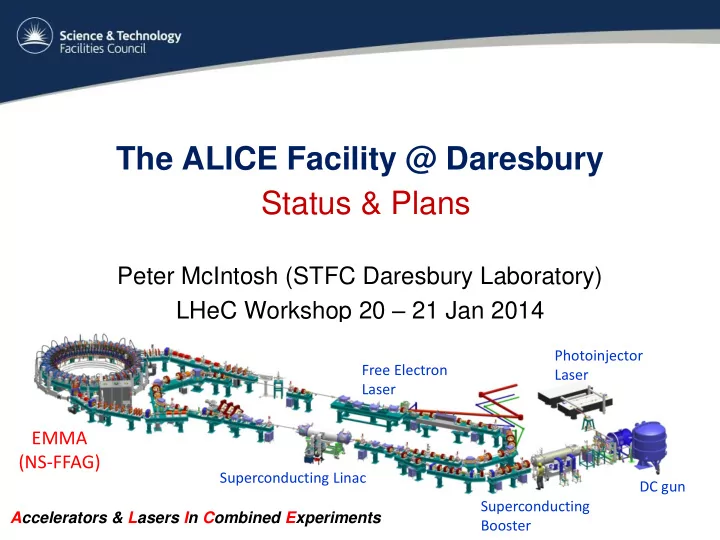
The ALICE Facility @ Daresbury Status & Plans Peter McIntosh (STFC Daresbury Laboratory) LHeC Workshop 20 21 Jan 2014 Photoinjector Free Electron Laser Laser EMMA (NS-FFAG) Superconducting Linac DC gun Superconducting


slide-1
SLIDE 1

The ALICE Facility @ Daresbury

Peter McIntosh (STFC Daresbury Laboratory) LHeC Workshop 20 – 21 Jan 2014

Status & Plans

EMMA (NS-FFAG)

Superconducting Linac DC gun Photoinjector Laser Free Electron Laser Superconducting Booster Accelerators & Lasers In Combined Experiments

slide-2
SLIDE 2

ALICE Machine Overview

DC Gun + Photo Injector Laser 325 kV GaAs cathode; QE=2.5-3.0% Up to 100 pC bunch charge Up to 81.25 MHz rep rate RF System Superconducting booster + linac 2 x 9-cell cavities. 1.3 GHz, ~10 MV/m. Pulsed up to 10 Hz, 100 μS bunch trains Beam transport system. Triple bend achromatic arcs. First arc isochronous Bunch compression chicane ~1ps bunches Diagnostics YAG/OTR screens BPMs (stripline / button) Slits Energy spectrometers Electro-optic bunch profile monitor

Undulator Oscillator type FEL. Variable gap

TW laser For Compton Backscattering and EO ~70 fS duration, 10 Hz Ti Sapphire

325 keV 6.5 MeV 26.0 MeV Operating since Dec 2008

slide-3
SLIDE 3

ALICE Parameters (Current)

Parameter Operating Value Comments

Injector Energy 6.5 MeV Limited only by the required ratio of full/injector beam energies Total beam energy 12.0 – 26.0 (27.5) MeV Various setups; upper value limited by FE in the main linac cavities. RF frequency 1.3 GHZ Bunch repetition frequency up to 81.25 MHz (variable) Use of burst generator in PI laser system; Train Length 0 - 100 µs Train repetition frequency 1 - 20 Hz Compressed bunch length <1 ps rms Measured with EO technique Bunch charge (standard) 40 pC @ 81.25MHz, 60pC @ 16MHz and 40MHz Limited by beam loading; Q=60pC is a standard bunch charge for FEL and THz operation. Bunch charge (potential) ~200pC Allowed by achievable QE of 2.5-3.0%; requires digital LLRF with feed-forward ability in buncher/booster systems Energy Recovery Rate >99% Measured

slide-4
SLIDE 4

Historical ALICE Achievements

http://stfc.ac.uk/ASTeC/Programmes/Alice/General/36020.aspx Milestone Date First ALICE (ERLP) meeting held May 2003 500kV DC HVPS delivered Dec 2003 4K cryoplant commissioning starts Apr 2006 First gun operation starts Jun 2006 SRF cryomodules arrive Jun 2006 First electron beam generated Aug 2006 2K cryoplant commissioning starts Sept 2006 SRF cryomodules cooled to 2K Nov 2006 SRF cryomodules accepted Oct 2007 First energy recovery demonstrated Dec 2008 First THz radiation produced Feb 2009 First Compton Backscatter Radiation produced Nov 2009 First experiments with cell exposure to THz radiation Apr 2010 First IR FEL radiation produced Oct 2010 First EMMA acceleration demonstrated Apr 2011

slide-5
SLIDE 5
  • Last main accelerator physics and science programme on ALICE was

successfully completed at the end of 2012. Scanning Near-Field Optical Microscopy (SNOM) with IR FEL applied to cancer research

7.0mm 7.3mm (protein) 8.05mm (DNA)

Current tuning range of Alice FEL 5.5 – 11 mm covers most of the “fingerprint” region in molecular spectroscopy. Spatial resolution ~0.1um With sufficient intensity from FEL can get below the diffraction limit at which conventional IR microscopes on SR sources operate. Peter Weightman (Liverpool Univ) leads a programme using SNOM on ALICE FEL to study oesophageal & prostate cancers, Ref: A D Smith et al, Appl. Phys. Lett, 102, 053701 (2013)

ALICE Current Status

Cancerous Non Cancerous

slide-6
SLIDE 6

Photon Beam Exploitation

IR/THz from ALICE

  • CSR generated in THz

Region as bunch length ~1 ps.

  • Output enhanced by

many orders of magnitude.

  • Dedicated tissue culture

laboratory.

  • Effect of IR/THz on

living cells being studied.

  • Source has very high

peak intensities but very low average power: – no thermal effects!

Tissue Culture Facility

slide-7
SLIDE 7
  • New grant for using ALICE IR FEL in cancer diagnostic studies has been

received - SCANCAN (Critical Mass Award from EPSRC):

  • June 2013 – May 2016
  • SNOM based programme led by Liverpool University:

"Towards disease diagnosis through spectrochemical imaging

  • f tissue architecture"
  • The grant allows ALICE operation for 3 years (three months per year).
  • Opportunity for other project applications to increase the length of ALICE
  • peration.

SNOM: Modes of Operation

Sample Fiber tip Transmission Reflection Collection

ALICE in 2014 & Beyond

slide-8
SLIDE 8

ALICE Near Term Developments

  • New feedback system to ensure stability of FEL wavelength during

SNOM scans.

  • Improved diagnostic system for ALICE orbit monitoring and correction.
  • Upgrade of the LLRF system to improve short-term and long-term

machine stability.

  • Efforts to extend the IR wavelengths range towards longer ~20µm

wavelength:

  • Opens up more opportunities.
  • Upgrade IR FEL transport beamline to improve efficiency at longer

wavelengths.

  • New SRF cryomodule is expected to allow ALICE operation at higher

beam energy of up to 35 MeV:

  • Extension to shorter IR FEL wavelengths range.
slide-9
SLIDE 9

Accelerator and Lasers in Combined Experiment

  • Dimensioned to fit on the ALICE

ERL facility at Daresbury: – Same cryomodule footprint. – Same cryo/RF interconnects. – ‘Plug Compatible’ with existing cryomodule.

New SRF Cryomodule Integration on ALICE

slide-10
SLIDE 10

New SRF Cryomodule

Parameter ALICE Target Frequency (GHz) 1.3 1.3 Number of cavities 2 2 Number of Cells per Cavity 9 7 Cavity Length (m) 1.038 0.807 Cryomodule Length (m) 3.6 3.6 R/Q (Ω) 1036 762 Eacc (MV/m) 12 - 15 >20 CM Energy Gain (MeV) 26 >32 Qo <5 x10⁹ >1x10¹⁰ Qext 4 x 10⁶ 4 x10⁶ – 108 Max Cavity Fwd Power (kW) 10 SW 20 SW

Original Cryomodule on ALICE New ERL Cryomodule

slide-11
SLIDE 11

Cryomodule Integration

Cavity Tuner HOM Absorber String Integration Offline Testing FPC

slide-12
SLIDE 12

Cryomodule Implementation on ALICE

slide-13
SLIDE 13

CM Static Heat Load at 2K

  • Static heat load

measured with all the input valves closed to ensure that only the boil off from the cryostat is measured.

  • 0.6 g/S total mass flow

Linac + Booster.  0.3 g/S per module.  ~6.2 W per cryomodule

slide-14
SLIDE 14

Parameter Unit Spec Measured Value Base temperature K 2.0 2.0 Static heat load W 15 6.2 Single shot mode at 2K Static base heat load g/S 1.5 2.5 With flash gas (additional heat leak from external components) Pressure stability mbar ±1.0 ±0.05 at 2K HOM Intercepts K < 20 13.5 < T < 15.5 CKT -1 at GHe 2.0 barA HOM Intercepts K < 90 89 < T < 99 CKT -2 at GHe 2.0 barA Shield K < 90 89 < T < 99 CKT -2 at GHe 2.0 barA Cavity Frequency GHz 1.3 1.3 Tuning range KHz ±350 ±350 Dynamic performance to be measured

Static performance similar to original ALICE LINAC

Cryogenic Performance

slide-15
SLIDE 15

Cavity Conditioning

  • Qext set to original Linac settings:

– LC1 – 6.4 x 10⁶ – LC2 – 8.3 x 10⁶

  • Initial conditioning reached:

– LC1 – 10.8 MV/m – LC2 – 12.5 MV/m

  • 16 MV/m min gradient required
  • Microphonic issues discovered with analogue

LLRF:

– Phase set limit of 60⁰ reached at low gradients – 71Hz oscillation seen on the phase set under CW conditions

Pink – Phase set Green – Phase measure Blue – Gradient set Yellow – Gradient measure

LC1 Gradient ~0.8MV/m Phase set 40⁰ LC2 Gradient 7MV/m Phase set 60⁰ LC1 (CW) Gradient ~0.8MV/m 71Hz oscillation

No FE radiation observed!
slide-16
SLIDE 16

Microphonic Analysis – LC1 and LC2

71 Hz 71 Hz

slide-17
SLIDE 17

Seismic Ground Tests

  • Seismic measurements performed next to

the Linac and 2K pump platform.

  • Greater than an order of magnitude

degradation seen for modes >20 Hz (including 71Hz):

– 2013 – Vertical displacement 10-6µm2/Hz – 2005 – Vertical displacement <10-7µm2/Hz

10

  • 2

10

  • 1

10 10

1

10

2

10

  • 15

10

  • 10

10

  • 5

10 Displacement Power Spectral Density Frequency (Hz) Displacement (µm2/Hz) 10

  • 2

10

  • 1

10 10

1

10

2

10

  • 15

10

  • 10

10

  • 5

10 10

5

Displacement Power Spectral Density Frequency (Hz) Displacement (µm2/Hz)

Horizontal measurements 2013 Vertical measurements 2013 Vertical measurements 2005

slide-18
SLIDE 18

Accelerometer Measurements

  • Accelerometer

measurements of the 2K pump system:

 Confirmed the source of the 71Hz vibrations from the backing pumps.  Cryo roots pumps not the source.

Accelerometer located on pump mount

Roots pump Backing pump

2K cryo backing pumps OFF 2K cryo backing pumps ON

slide-19
SLIDE 19

ALICE Cryogenic Pump Configuration

LINAC BOOSTER 2K BOX 2K Pumps

slide-20
SLIDE 20

Damaged platform shock absorbers Undamaged platform shock absorbers

Pump Investigations

  • Low pressure in pump frame

shock absorbers:

– Pressure had reduced to 4 Bar  Increased to max – 6 Bar

  • Distortion of platform shock

absorbers observed:

– Absorbers nearest the Linac had deformed likely due to radiation damage.  Presently being replaced.

slide-21
SLIDE 21

Pump Investigation (Cont)

  • Investigation of pumps revealed

a horizontal vibration due to backing pumps.  Bearings have been replaced:

  • Pump bearings
  • Pulley bearings
  • Motor bearings
  • Pump system appears to be

much quieter.

  • Seismic and accelerometer

measurements to be repeated

  • nce the system has been

returned to a full operational status.

  • Cryomodule retesting

expected to restart this week.

slide-22
SLIDE 22

Summary

  • ALICE remains Europe’s only operating ERL test facility,

employing:

– DC photo-injector – SRF linacs – IR-FEL

  • Facility has recently secured a new ‘lease of life’, with a 3-

year grant award for cancer diagnostic studies.

  • Beam stability improvements being made to improve FEL

capability.

  • New SRF cryomodule undergoing validation, to increase

beam energy, efficiency and operability. As a dedicated ERL test facility, ALICE maintains a unique capability globally for ERL scientific and technology R&D.

slide-23
SLIDE 23

LHeC R&D Opportunities Using ALICE

  • DC HV gun based injector physics:
  • Photocathode development
  • Low energy beam transport optimisation
  • Energy recovery with various energy spreads and spectra:
  • Emulate e-beam disruption at IP
  • Beam halo effects and mitigation
  • Synchronisation R&D:
  • DLLRF systems
  • Optical distribution system
  • BBU studies:
  • Induce BBU with small time constant ~ 10 -100us
  • Instrumentation and beam diagnostics development:
  • EO profile monitors
  • Beam arrival monitors
  • Beam phase and position monitors