The 67-Year-Old Stiff Knee: More Than 20 Years of Experience I Can - - PowerPoint PPT Presentation

the 67 year old stiff knee more than 20 years of
SMART_READER_LITE
LIVE PREVIEW

The 67-Year-Old Stiff Knee: More Than 20 Years of Experience I Can - - PowerPoint PPT Presentation

The 67-Year-Old Stiff Knee: More Than 20 Years of Experience I Can Solve It! John J. Callaghan, M.D. The Lawrence & Marilyn Dorr Chair University of Iowa Iowa City, IA Orthopaedic Summit December 2017 Disclosures Consultant and

slide-1
SLIDE 1

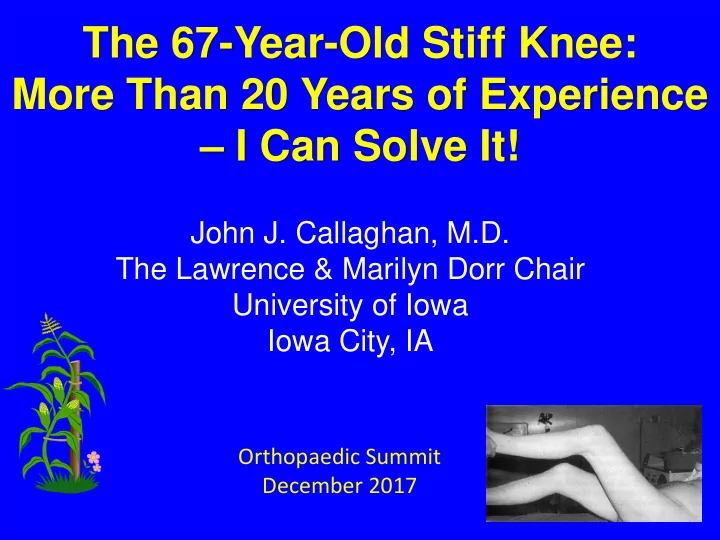
The 67-Year-Old Stiff Knee: More Than 20 Years of Experience – I Can Solve It!

John J. Callaghan, M.D. The Lawrence & Marilyn Dorr Chair University of Iowa Iowa City, IA

Orthopaedic Summit December 2017

slide-2
SLIDE 2
  • Consultant and Royalties (DePuy) for

intellectual property transfer for hip & knee implant designs.

  • Royalties (Wolters Kluwer) for books edited.
  • Board Membership

– Journal of Arthroplasty – International Hip Society – OREF (Orthopaedic Research and Education Foundation) – Knee Society

Disclosures

slide-3
SLIDE 3

67 Year Old Man with Stiff Knee status post TKA (3 years ago)

Severe pain active ROM 30-80 degrees

slide-4
SLIDE 4

Prevention Better Than Treatment

Pre-Operative Considerations:

  • Proper indications:

– Not just “arthroscopic arthritis” – Poor preoperative motion – Realistic expectations

slide-5
SLIDE 5

Prevention Better Than Treatment

Intra-Operative Considerations:

  • Appropriate soft tissue releases and
  • steophyte resection
  • Avoidances:

– Over stuffing the patella femoral joint – Over stuffing the flexion or extension gap, or both

slide-6
SLIDE 6

Post-Operative Considerations:

  • Aggressive pain reduction protocols

– Oxycontin – Anti-inflammatory Pre-op – Tylenol

  • Injections intra op
  • Post op blocks

– Splints for extension – Anti-depressants

  • Manipulate if necessary

Prevention Better Than Treatment

slide-7
SLIDE 7

Treatment for Stiff TKA

  • Manipulation:

– 2-4 months post op

  • Arthroscopic debridement:

– limited indications in the first year or 2 post op

  • Revision of components
slide-8
SLIDE 8
  • Recommend performing by 3 months post op
  • Rates vary from 1.8% to 6%

– Probably related to indications for manipulation

  • Improvement in motion ranges from 22-40

degrees

  • Young age and females higher rates
  • Obesity protective

Treatment for Stiff TKA: Manipulation (2-4 months)

slide-9
SLIDE 9
  • PCL release (Windsor et al, CORR 1996)

– Pre op motion: 4-70 degrees – Post op motion: 1.3-112 degrees – Most successful if patient comes to full extension pre-operatively

  • Global debridement (Windsor et al, JOA 1996)

– Results: 42% good, 19% fair, 40% poor

Treatment for Stiff TKA: Arthroscopic Debridement

slide-10
SLIDE 10

Patient work up history, looking for supratentorial issues

  • Multiple arthroscopies prior to TKR
  • Pre-operative radiographs with minimal if any arthritis
  • Workman’s compensation
  • Psychological issues

– (“How high a squirrel count”) – Dorr (JOA 1990). Poor results

  • Patella baja
  • Keloid formation
  • More than 4 surgeries
  • PS TKA

Treatment for Stiff TKA: Revision of Components

slide-11
SLIDE 11

Exclude or Identify Extrinsic Sources of Knee Stiffness

  • Causes

– Severe OA of ipsilateral hip – Muscle rigidity (from neurologic injury) – Tight quadriceps/hamstrings from injury – Heterotopic Ossification

  • Revision TKA unlikely to have favorable
  • utcome without correction of Extrinsic

Problem

slide-12
SLIDE 12

Intrinsic Causes of Knee Stiffness Following TKA

  • Overstuffing of the patellofemoral

articulation

  • Excessively tight flexion and/or

extension gap

  • Tight posterior cruciate ligament
  • Femoral and/or tibial malrotation
  • Arthrofibrosis
  • Infection
slide-13
SLIDE 13

Overstuffing of the Patellofemoral Articulation

  • Anterior displacement of anterior flange of

the femoral component

– Due to oversizing of the femoral component – From anterior translation of an appropriately sized femoral component

  • After patellar resurfacing if patellar

component composite thickness is increased

slide-14
SLIDE 14

Excessively Tight Flexion and/or Extension Gap

  • Decreased Flexion (tight flexion gap)

– Amount of posterior femoral condylar bone resected is less than thickness of the posterior condyles of the femoral component (increasing offset) – Femoral component oversized or placed posteriorly – Tibial component placed in neutral or anterior slope

  • Decreased Extension (tight extension gap)

– Distal femoral resection is too distal – Tibial insert is too thick – Inadequate tibial resection (tightens flexion and extension gap)

slide-15
SLIDE 15

Malrotation

  • Femoral and/or Tibial Malalignment
  • r Malrotation may lead to

pathologic tightness of soft tissue structures

  • Malalignment

– Asymmetry of the extension gap

  • Malrotation

– Asymmetry of the flexion gap – Patellar tracking problems

slide-16
SLIDE 16

Arthrofibrosis

  • Excessive pathologic postoperative

scarring inhibiting flexion and/or extension

  • One of most unresponsive causes of

stiffness

slide-17
SLIDE 17

Evaluation

  • Is patella too thick?
  • Was adequate bone removed?
  • Is femoral component too large?
  • Was tibial insert too thick?
  • Are components well aligned?

– Appropriate femoral components sizing, offset restored? – Rotation correct? – Tibial and femoral resection appropriate? – Is tibial component slope correct?

slide-18
SLIDE 18

30-80 degrees flexion preop

  • CR knee
  • No posterior

tibial slope

  • Stuffed

patellofemoral joint

  • Limited distal

femoral resection

slide-19
SLIDE 19

Patella

  • Prefer patellar

subluxation over eversion

– Less risk of patellar avulsion

  • If patella cannot be

mobilized laterally

– Lateral retinacular release – Quadriceps snip

slide-20
SLIDE 20

Surgery

  • Thin patella
  • Undersize femoral component
  • Elevate joint line if necessary
  • Use TC3 if loose flexion gap
  • Substitute PCL
slide-21
SLIDE 21
slide-22
SLIDE 22

5-110 degrees flexion post op

slide-23
SLIDE 23

30-70 degrees flexion

slide-24
SLIDE 24

0-120 degrees flexion

slide-25
SLIDE 25

Post Op

  • Aggressive pain reduction protocols

– Oxycontin – Anti-inflammatory Pre-op – Tylenol

  • Injections intra op
  • Post op blocks

– Splints for extension – Anti-depressants

  • Manipulate if necessary
slide-26
SLIDE 26

Haidukewych et al Dorr et al Christensen et al Lotke et al

  • 1.3% of TKRs
  • KSS

38 86

  • KSS function

40 58 pts

  • KSS pain

15 47 pts

  • Mean motion

54 82°

  • Flexion

66 85°

  • Extension

11 3°

slide-27
SLIDE 27
  • 42 knees
  • 47 month avg f/u
  • Flexion contracture 9.7 2.3
  • Flexion 81 94
  • ROM 72 92
  • KS Functional Score 48 70
  • Pain improved 73%
slide-28
SLIDE 28

Stiff TKR: Discussion

  • Avoidance better than treatment
  • Realistic expectations (motivated patients do

best)

  • Revise only if you see something you can fix
slide-29
SLIDE 29

Thank You