SLIDE 1
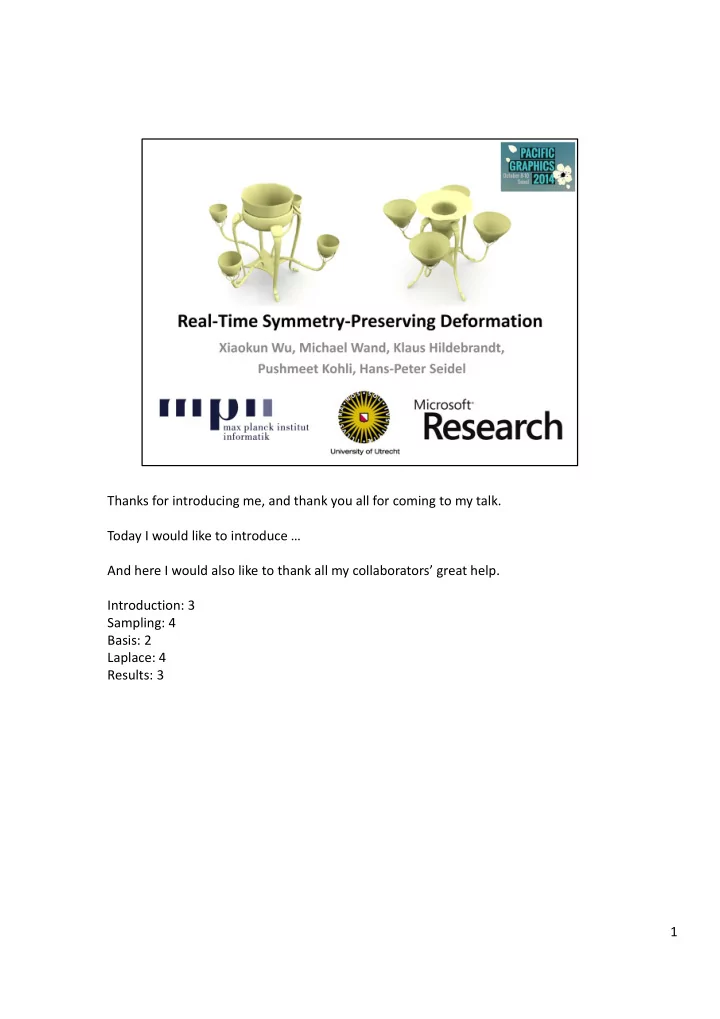
Thanks for introducing me, and thank you all for coming to my talk. Today I would like to introduce … And here I would also like to thank all my collaborators’ great help. Introduction: 3 Sampling: 4 Basis: 2 Laplace: 4 Results: 3 1
SLIDE 2
Our work is targeted at the problem of content creation, which is an important step for providing wide variety of artistic data. For creating new data, people normally start from a exist template shape. Such as these bottles, they look different, but all of the left three are derived from the right most neutral shape. That relates to human’s ability of abstracting structures, and infer new variance in the mean while. 2
SLIDE 3
Structural organization is a very natural way for people to understand the shape. So it is no coincidence that man‐made shapes tend to have some prominent structure. One rigorous mathematical study of shape structure is symmetry group, which in 3D space basically means invariance to 3D transformations. We adopt this notion in our work, and use symmetries as our structure representation. 3
SLIDE 4
So back to our content creation problem, we need a modeling tool that can understand the symmetry structure of target shape. And make use of this important information. 4
SLIDE 5
Modern modelling software has greatly improved productivity. For example, in this FFD application, a selected segment can be easily manipulated by very few control points. But for models with complex symmetry structure, how can we formulate symmetric editing? 5
SLIDE 6
Before going into the details of our construction, we would like to list some closely related work in recent years. The first element is symmetry detection, which provides the input to our pipeline. And then there are also some seminal works in the direction of editing while keeping certain geometric constraints. The last is about speed, especially those techniques for achieving intractive edting. Our goal is to combine all these ingredients, and propose a generic editing framework. The first element is …, which provides the input to our pipeline. Organized in a hierarchical way for better understanding very complex shape composition. Symmetry groups are studied in a very detailed classification philosophy. Our work uses the results provided by … Seminal work from … uses a feature based description of shape structure, and can keep certain Euclidean invariance through optimization. Another recent work by ... Builds symmetric mapping from a template shape to the target scan data. 6
SLIDE 7
For achieving interactive editing, one line of research resort to sub‐space method, which restrict the deformation on a pre‐determined sub‐set of variables, then propogates the motion to the entire mesh. For example, ... Builds a coarse control mesh around the original mesh, and ... Control points can be disconnected. Our goal is to combine all these ingredients, and propose a generic editing framework. IWIRES: preserving characteristic features and global structure. Bounded flat surface assumption, specific to constant curvature surfaces. Limited by the feature descriptions, example: twisted box, rotational symmetry, sample on the surface. Euclidean invariance instead of systematic symmetry structure analysis, so have to resort to greedy propagation algorithm to resolve conflictions. Kurz: focused on matching, soft constraints. Wang: symmetry detection and hierarchical organization. Bokeloh: translational symmetries, least‐squares with user chosen constraints; dense bases produced by SVD. Huang: builds a coarse control mesh around the original mesh. Jacobson: solve the optimization problem on a low‐frequency subspace and subsequently transfer the result to a high‐resolution mesh. Lipman: use spectral method to determine the space spanned by symmetry‐invariant functions. 6
SLIDE 8
One of the most important technique for reducing computation cost is the subspace method. Taking this airplane model for example, 7
SLIDE 9
These methods construct basis functions on low frequency samples, and restrict computations onto a subspace spanned by those basis. Here we show a simple random sampling on the surface, 8
SLIDE 10
For evaluation on the original mesh, those methods just propagate local computations through a convex combination. So each sample is associated with a compact support weighting function. we use Gaussian kernel in our implimentation. 9
SLIDE 11
The problem of this random sampling is, for example, if we want to make the wing longer by dragging one sample on one side, there will be only single sided deformation. But this is clearly not what we expect: what we want is a symmetric deformation, which means both of the wings should look the same after the operations. The reason is this sampling is not aware of symmetry structure, so there is no correlations between its symmetric parts. 10
SLIDE 12
By saying symmetry struction, while, in this case we mean the central symmetry plane, and both wings are reflective to each other. Then how could we use this information to make sure these two parts move symmetrically? (click) While, first of all, from theoretic aspect, in our paper we have prooved Which means it is possible to construct symmetrc deformation subspace, by putting basis functions on symmetric samples. So there are two elements in our sampling pipeline: symmetric sampling and symmetric basis construction. 11
SLIDE 13
We start with symmetric sampling: if we put a sample ... 12
SLIDE 14
Then its symmetric counterpart is also added. Here we consider rigid discrete transformations, and in this case it is the reflection generated by this central symmetry plane. 13
SLIDE 15
After a pair of samples are generated, we invalidate their local neibor candidates within a provided radius. In this way the sampling density can be easily controlled. 14
SLIDE 16
This process is repeated until ... 15
SLIDE 17
Here is a sampling result of the airplane model. Which has two separate symmetries. Of course this example is not hard to handle, 16
SLIDE 18
But our work can also handle the case of more complicated symmetry structure. Details can be found in our paper. 17
SLIDE 19
Now comes to our question: how to construct symmetric basis on those samples? (click) Let’s start with one pair of symmetric samples, 18
SLIDE 20
In our algorithm, first we Fix one degree of freedom, which means if move the left sample upwards, the right sample should also move upwards in the same amount. 19
SLIDE 21
Then we add all other orthogonal directions, which completes a local coordinate frame for each sample. Notice that these frames should be symmetric to the reflective plane. 20
SLIDE 22
We do the same for ... This shows the complete set of our symmetric basis. 21
SLIDE 23
By this construction, we can see that symmetric editing on the samples is enforced inherently. In this case, if we ... Then … 22
SLIDE 24
Here is an example, and you can see if we only edit one side, the other side deforms accordingly. 23
SLIDE 25
Next I would like to introduce the deformation part. For producing a plausible looking deformation, we adopt ... As the backend. The benefit is fast, and details of shape are maintained. 24
SLIDE 26
Also, for achieving more natural looking, we iteratively update local rotations. Which looks comparable to expensive non‐linear methods. We re‐estimate Laplace coordinates by iteratively (typically 5) applying a rotation matrix in the local frame of samples. 25
SLIDE 27
For laplace editin, basically we have this evergy function formulation, Which has one part for measuring deviation from Laplace coordinates And another part for measuring violation of handle constraints 26
SLIDE 28 Then for symmetry constaints, we apply ... To ... As in the ordinary constraint
One thing we want to mension, for faster computation, is the null‐space method. Which has the property that, if we form another linear system by projecting variables
- nto the ... Then these two systems have the same optimal solution. But the benefit
is the number of variables is greatly reduced. The problem of this formulation is, computation cost of the null‐space is normally
- high. But in our paper we have prooved the symmetric basis constructed in our
algorithm span exactly the same null‐space of constraints. So we can achieve this computation reducing at no cost. (example click) To show some concrete examples, Here we measure the number of variables to solve. And show the difference by applying null‐space projection. Less than one third. 27
SLIDE 29
Another complex model with more symmetry struture, ... Reduced dramatically NLN’ – positive definite, L – full row rank 27
SLIDE 30 Then for symmetry constaints, we apply ... To ... As in the ordinary constraint
One thing we want to mension, for faster computation, is the null‐space method. Which has the property that, if we form another linear system by projecting variables
- nto the ... Then these two systems have the same optimal solution. But the benefit
is the number of variables is greatly reduced. The problem of this formulation is, computation cost of the null‐space is normally
- high. But the symmetric basis constructed in our algorithm span exactly the same
null‐space of constraints. So we can achieve this computation reducing at no cost. 28
SLIDE 31
To show some concrete examples, Here we measure the number of variables to solve. And show the difference by applying null‐space projection. Less than one third. Another complex model with more symmetry struture, ... Reduced dramatically 29
SLIDE 32
NLN’ – positive definite, L – full row rank 29
SLIDE 33 Then for symmetry constaints, we apply ... To ... One thing we want to mension, for faster computation, is the null‐space method. Which has the property that, if we form another linear system by projecting variables
- nto the ... Then these two systems have the same optimal solution. But the benefit
is the DoF is greatly reduced. The difficulty with this formulation is, null‐space is normally hard to compute. But in
- ur paper we have prooved the symmetric basis constructed in our algorithm span
exactly the null‐space of constraints. So we can achieve this computation reduction at no cost. The number of variables to solve. Less than one third. Another complex model with more symmetry struture, ... 30
SLIDE 34
NLN’ – positive definite, L – full row rank 30
SLIDE 35
We start with an example of less complexity. 31
SLIDE 36
Much more complex symmetry structure, including this hierarchical symmetry links the four bowls. You can see all the detail editing is very easy through our method. The handles are put at user specified locations. More examples could be found in our paper, and result video. 32
SLIDE 37
33
SLIDE 38
34
SLIDE 39
35
SLIDE 40
36
SLIDE 41
37
SLIDE 42
38
SLIDE 43
39
SLIDE 44
Rigid discrete transformations In our work, we introduced the …, which act simultaneously on some symmetric control points on the surface. This is a very intuitive natural … 40
SLIDE 45
41
SLIDE 46
42
SLIDE 47
43
SLIDE 48
Most expensive computation in our pipeline, gpu accelarated. 44
SLIDE 49
45
SLIDE 50
NLN’ – positive definite, L – full row rank 46
SLIDE 51
47
SLIDE 52
48
SLIDE 53
49
SLIDE 54
50
SLIDE 55
51
SLIDE 56
52