th Transportation L The 50 ansportation Law I w Institute stitute - - PDF document

th transportation l the 50 ansportation law i w institute
SMART_READER_LITE
LIVE PREVIEW

th Transportation L The 50 ansportation Law I w Institute stitute - - PDF document

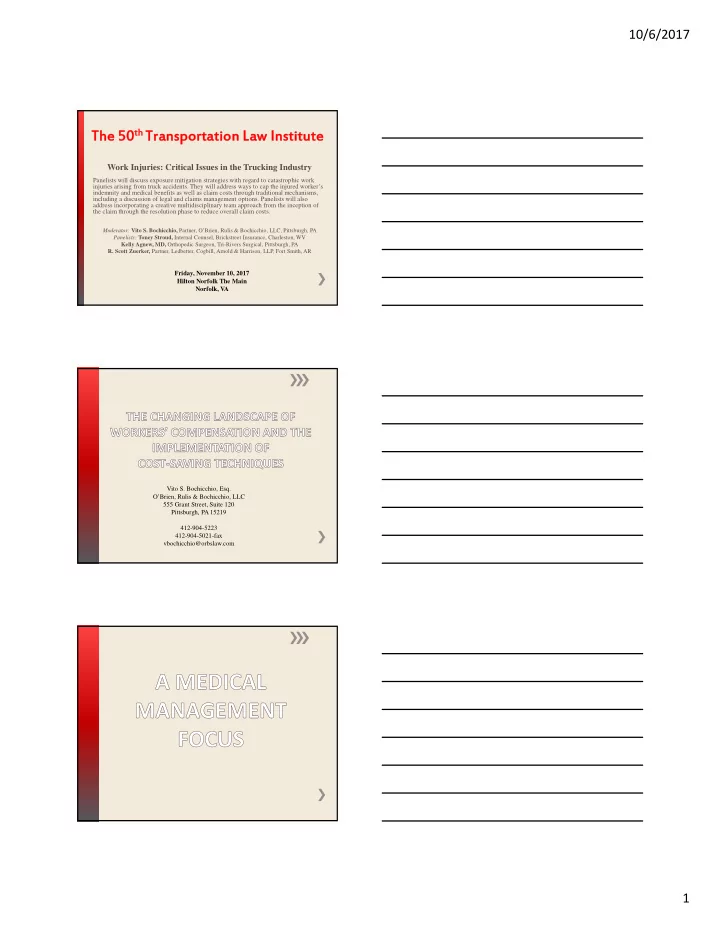
10/6/2017 The 50 th th Transportation L The 50 ansportation Law I w Institute stitute Work Injuries: Critical Issues in the Trucking Industry Panelists will discuss exposure mitigation strategies with regard to catastrophic work injuries


slide-1
SLIDE 1

10/6/2017 1

Work Injuries: Critical Issues in the Trucking Industry

Panelists will discuss exposure mitigation strategies with regard to catastrophic work injuries arising from truck accidents. They will address ways to cap the injured worker’s indemnity and medical benefits as well as claim costs through traditional mechanisms, including a discussion of legal and claims management options. Panelists will also address incorporating a creative multidisciplinary team approach from the inception of the claim through the resolution phase to reduce overall claim costs.

Moderator: Vito S. Bochicchio, Partner, O’Brien, Rulis & Bochicchio, LLC, Pittsburgh, PA Panelists: Toney Stroud, Internal Counsel, Brickstreet Insurance, Charleston, WV Kelly Agnew, MD, Orthopedic Surgeon, Tri-Rivers Surgical, Pittsburgh, PA

  • R. Scott Zuerker, Partner, Ledbetter, Cogbill, Arnold & Harrison, LLP, Fort Smith, AR

The 50 The 50th

th Transportation L

ansportation Law I w Institute stitute

Friday, November 10, 2017 Hilton Norfolk The Main Norfolk, VA Vito S. Bochicchio, Esq. O’Brien, Rulis & Bochicchio, LLC 555 Grant Street, Suite 120 Pittsburgh, PA 15219 412-904-5223 412-904-5021-fax vbochicchio@orbslaw.com

slide-2
SLIDE 2

10/6/2017 2

INTRODUCTION

Since 2008, the U.S. experienced an unparalleled downturn in the economy not seen since the Great

  • Depression. As a result, the following are factors that

impacted employer’s workers’ compensation programs:

  • Increased Claim Costs
  • Tighter Budgets for Self-Insureds and Insurance Carriers
  • Increased claim costs per claim are going up as well as

increased costs of 3% to 5% for programs

Workers Compensation Benefits & Costs

WHAT’S HAPPENING WITH EMPLOYERS’ COSTS?

  • Employer costs such as insurance premiums, deductibles, and

administrative costs are RISING. $1.25 $1.35 (2010) (2014) (per $100 of payroll) ARE BENEFITS PAID GOING UP OR DOWN?

  • DOWN. Employee benefits as a share of payroll are at a historic low.

$1.01 $0.91 (2010) (2014) (per $100 of payroll)

THE QUESTION BECOMES: Q:

What do we as an industry focus on to reduce costs?

A:

Medical Management

slide-3
SLIDE 3

10/6/2017 3

MEDICAL COSTS SHARE OF TOTAL COST IS INCREASING STEADILY

1986 1996 2006

Source: NCCI (based on states where NCCI provides ratemaking services)

WC MEDICAL COSTS WILL EQUAL 70% OF TOTAL BY 2016 IF TRENDS HOLD

WC med costs could equal 70% of system costs by 2016. This means that claims severity will accelerate and claims management will become progressively more difficult and complex.

2016 Estimate

Source: Insurance Information Institute

WC Medical Claims Costs are 6.8x Higher for the Most Obese Workers

$7,109 $13,338 $19,661 $3,924 $5,396 $13,569 $34,293 $7,503 $51,091 $23,373 $23,633 $59,178

$0 $10,000 $20,000 $30,000 $40,000 $50,000 $60,000 $70,000

BMI <18.5 (Underweight) 18.5-24.9 (Healthy Weight) 25-29.9 (Overweight) 30-34.9 (Obese Class I) 35-39.9 (Obese Class II) 40+ (Obese Class II)

Medical Claims Costs Indemnity Claims Costs Source: Ostbye, T., et al, “Obesity and Workers Compensation,” J. of the American Medical Association, April 23, 2007.

Indemnity costs are 11 times higher for the most obese workers than for healthy‐ weight workers.

Comorbid Impact

slide-4
SLIDE 4

10/6/2017 4

Example: Obesity Obesity is the most important risk factor for sleep apnea.

Source: Hypertension (2003)

There is a correlation between weight loss and reduction in AHI (Apnea Hypopnea Index).

Source: Journal of Respiratory and Critical Care Medicine (2002)

Data suggests that obesity is higher among the commercial driving population than the general population in the United States.

Source: Atlas Ergonomic Study (2009)

Example: Obesity

  • Obesity has been linked to sleep apnea in truck drivers
  • 2.4 Million to 3.9 Million licensed commerical drivers “are

expected to” suffer from sleep apnea according to a recent Harvard study

  • Data suggests that sleep apnea accounts for thousands of

motor vehicle accidents per year

Source: Journal of Occupational and Environmental Medicine, March 2009

Although there have not been in‐depth studies done in the airline and railroad industries, the risk associated with sleep apnea is recognized as a important factor with regard to human error in relationship to accidents.

Trucking, Rail, Air and Beyond……

slide-5
SLIDE 5

10/6/2017 5

PREVENTING INJURY WELLNESS PROGRAMS

“Health Management efforts…are essential especially in light of the workforce characteristics and economic challenges faced by the trucking industry today.” – Dr. Khan, Medical National Director, Concentra Total Care

  • Screening (identifying the health issues and risk factors for your work

force/employees)

  • Getting employees to the appropriate medical professional for treatment
  • Educating/coaching employees on how to make lifestyle changes
  • Utilizing effective incentives

Source: Concentra Newsroom “Fit to Drive” (2009)

PREVENTING INJURY WELLNESS PROGRAMS

  • Savings in Traditional Healthcare Costs
  • Example: Effective treatment for sleep apnea for commercial

motor vehicle poplution (Decrease in Health Costs)

  • 1. $2,700 the first year
  • 2. $3,100 the second year
  • 3. No cost savings for untreated drivers
  • The savings on workers’ compensation programs

incalculable

Source: Journal of Occupational and Environmental Medicine (2010)

MEDICAL MANAGEMENT POST INJURY

  • The treating physician directly impacts the duration of lost time and

the utilization of health care resources

  • Effective loss control must have the ability to alter physician

behavior

  • Nurse Case Management and/or Physician to Physician interaction

can reduce the interaction cost by 25%

slide-6
SLIDE 6

10/6/2017 6

AVERAGE COST SAVINGS WITH PHYSICIAN TO PHYSICIAN MODEL

  • Savings:
  • Workers’ Compensation - 25%

HOW?

  • 1. Getting injured workers back to work quickly

reducing indemnity exposure

  • 2. Prudent utilization of health care resources

Source: IMC, a Highmark Company

Litigation Considerations

  • Obtain all PCP records
  • Obtain a thorough past medical history
  • Investigate for pre-existing conditions
  • Utilize hospital canvas searches
  • Obtain ISO Reports on each case
  • Obtain pre-employment physical
  • Make sure that the insurance carrier or TPA have

Injured Worker Questionnaires that are comprehensive so this information can be obtained at the initial investigative level prior to a determination of whether

  • r not to accept the workers’ compensation claim as

being compensable. (See Example)