Th The Fo Food Indust ndustry ry Post Post-Brexi Brexit Tim - - PowerPoint PPT Presentation

th the fo food indust ndustry ry post post brexi brexit
SMART_READER_LITE
LIVE PREVIEW

Th The Fo Food Indust ndustry ry Post Post-Brexi Brexit Tim - - PowerPoint PPT Presentation

Th The Fo Food Indust ndustry ry Post Post-Brexi Brexit Tim Rycroft @TimRycroft_FDF fdf.org.uk The Food and Drink k Feder Federat ation on If you cant feed a country then you havent got a country. Ian Wright CBE


slide-1
SLIDE 1

Tim Rycroft

@TimRycroft_FDF fdf.org.uk
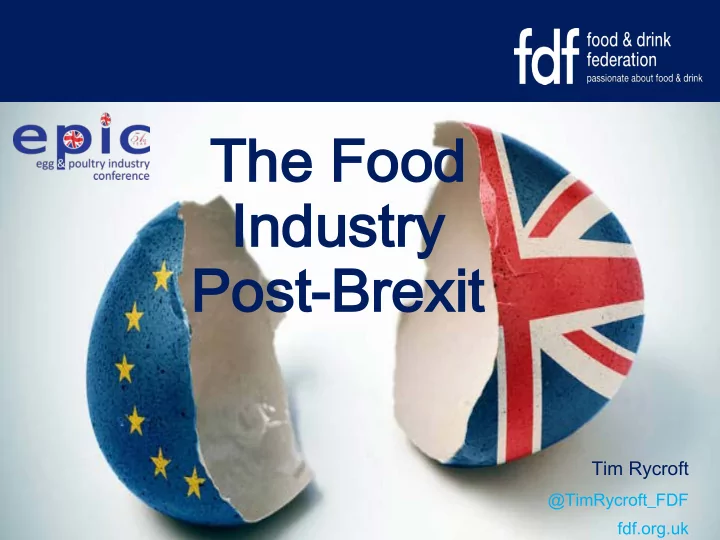
Th The Fo Food Indust ndustry ry Post Post-Brexi Brexit

slide-2
SLIDE 2

The Food and Drink k Feder Federat ation

  • n
slide-3
SLIDE 3

Ian Wright CBE Director-General, FDF

“If you can’t feed a country then you haven’t got a country.”

slide-4
SLIDE 4

What food and drink k must st get from Brexi xit

1. Access to EU workers 2. Easy future trade with the EU 3. Certainty over future food regulation – and the same safety and quality standards for consumers 4. An open border in Ireland (‘frictionless trade’) 5. A status quo transition for as long as needed 6. Clarity – very soon – over transition 7. New opportunities for growth

@TimRycroft_FDF

slide-5
SLIDE 5

Access to workers Access to workers

  • 400,000 employed in UK food manufacture;
  • 30% of whom are EU nationals; at all skill

levels

  • 60% within the poultry meat sector
  • 31% of companies report that some of their

EU nationals have already left

  • 33% of companies report difficulty in filling

vacancies

What would be the effect on your business of no longer having access to EU workers?

17%: “would relocate overseas” 36%: “business would become unviable”

@TimRycroft_FDF

slide-6
SLIDE 6

Fu Futu ture re tra trade with with th the EU EU

  • 61% of our food and drink exports go to the EU. UK is
  • nly 60% self-sufficient in food; 70% of what we import

comes from the EU.

  • We import 2 million eggs a year (15% of consumption)
  • WTO agricultural tariffs average 22%.
  • There are 13,608 separate tariffs on biscuits, chocolate, bakery goods

and confectionery alone.

  • Food is part of our critical national infrastructure. Just in

Time (JIT) supply chains mean empty shelves in four days or fewer if supply is delayed or interrupted.

  • Most food has a limited shelf life and some is highly
  • perishable. Retailers expect a guaranteed minimum shelf

life from suppliers.

  • Agricultural products are subject to complex Rules of

Origin and sanitary/phytosanitary checks

@TimRycroft_FDF

slide-7
SLIDE 7

The ‘oranges’ example The ‘oranges’ example

EU import duties on oranges are designed to reduce imports at harvest time and avoid prices falling as Mediterranean orange growers put their produce on the market.

  • they have two components: a percentage of the price plus an

amount in euros per tonne

  • they change every few weeks or months
  • oranges also have a tariff quota

The list of orange tariffs in an internal EU regulation from 2001 covers almost seven pages. From February to April, part of the period with the highest normal duty: a tariff quota allowing 20,000 tonnes of “high quality” sweet oranges to be charged only 10% duty. After April 2019, the UK will need to agree what tariffs if any it applies to EU orange imports and what access, if any, it grants to non-EU orange producers. EU orange-producing countries will of course want to see their producers protected.

Information by kind permission of Peter Ungphakorn

https://tradebetablog.wordpress.com/

slide-8
SLIDE 8

Future food sa safety y and se secu curity y regul regulati ation

  • n
  • Our food regulation – covering production,

safety, security, movements, labelling etc – has come mostly from Europe for 40 years.

  • British Lion scheme a huge success;

Fipronil shows the dangers where standards slip.

  • FDF has called for:
  • Continuity at the point of departure
  • Carefully planned divergence – where

appropriate - taking into account the effect on trade

  • Caution about intra-UK divergence
  • Government has committed to no reduction

in food safety/quality standards for consumers, or in animal welfare standards.

@TimRycroft_FDF

slide-9
SLIDE 9

Ir Ireland eland

  • The UK is the destination for 37% of all

Irish food and drink exports.

  • Ireland imports almost €2.8 billion of food

and drink from the UK. 45% of all UK live exports go to Ireland.

  • Island of Ireland treated as a single

territory.

  • Workers, raw materials, part-finished and

finished goods cross the border, sometimes several times.

  • Ireland is a critical test case for future trade

arrangements.

  • We have offered to facilitate an industry /

government task force to resolve these issues

@TimRycroft_FDF

slide-10
SLIDE 10

Transition Transition

  • We just need to know precisely

what happens on 30th March 2019.

  • We want the status quo.
  • We need to know for how long any

interim arrangements will last (ideally as long as is necessary to prepare).

  • We need to be sure there will only

be ONE change of circumstances to adapt to.

  • And we need to know by

Christmas.

@TimRycroft_FDF

slide-11
SLIDE 11

Some Important Truths s about Brexi xit

1. This will be a political, not an economic, negotiation. There are deeply-held principles - and some deep distrust of compromise - on both sides.

  • Some in the UK think it is worth some bearing economic pain to be

free of the EU

  • Some in the EU think it is worth bearing some economic pain to

show that leaving the EU is not a desirable thing for other members states to do

2. The government will struggle to get its Brexit legislation passed, particularly in the House of Lords (no majority and no standing orders). 3. Resolving future trade with the EU – particularly around food and agriculture - is 100 times more complicated than most people realise. Not insoluble... just very difficult.

@TimRycroft_FDF

slide-12
SLIDE 12

Important Truths about Brexit Important Truths about Brexit

  • 4. Stating a desired outcome from the negotiations is not

the same as securing that outcome (for both sides).

  • 5. We have just over a year to agree everything before any

deal goes to the EU27 member states for ratification (and parts of it to their regional assemblies too).

  • 6. This will be an asymmetric negotiation (‘you don’t get a

deal on cars unless I get a deal on free movement’…)

  • 7. Nothing is agreed until everything is agreed. There will

be bumps in the road.

@TimRycroft_FDF

slide-13
SLIDE 13

Causes for optimism Causes for optimism

  • We can surely design a better system of agricultural support than CAP.
  • The UK is a significant economic player and many countries will want to

strike trade deals with us.

  • Many EU businesses sell to the UK and will want that to continue

unhindered.

  • British produce is in demand and we could turbocharge exports
  • Import substitution might help us fill gaps
  • Business people are resilient and adaptable and will always make the

best of prevailing circumstances.

  • ‘No deal’ will hurt many EU countries as it will us; and they are as

unprepared for it as we are

  • Brexit has brought the UK food chain closer together and raised its

profile.

@TimRycroft_FDF

slide-14
SLIDE 14

Causes for pessimism Causes for pessimism

  • Time is very short.
  • We are not ready for ‘no deal’ and no sign of us getting

ready.

  • Agriculture is different from cars. Higher tariffs and more

fragile, time-sensitive supply chains.

  • Additional 2 min delay = 17 miles of tailbacks to Dover.
  • The customs issue must be resolved very very soon if we

are to avoid very bad consequences.

  • The political dimension means that common sense may

not always prevail.

@TimRycroft_FDF

slide-15
SLIDE 15

The food indust stry y after Brexi xit… … hopef hopeful ully

  • Still seamlessly connected to its biggest export/import markets.
  • New opportunities to access high quality ingredients / raw

materials.

  • The UK still a beacon for providing consumers with a wide

range of high quality, safe, affordable food at all price points.

  • Driven by talented people from wherever, operating at all skill

levels.

  • Fantastic local and regional specialties from across the UK are

being sold across the world, with appropriate promotion, under appropriate IP protection.

  • Free to operate and innovate without undue regulatory

burdens.

@TimRycroft_FDF

slide-16
SLIDE 16

Thank you!