Ternary system (Fo-An-SiO 2 ) with intermediate compound - - PowerPoint PPT Presentation

ternary system fo an sio 2 with intermediate compound
SMART_READER_LITE
LIVE PREVIEW

Ternary system (Fo-An-SiO 2 ) with intermediate compound - - PowerPoint PPT Presentation

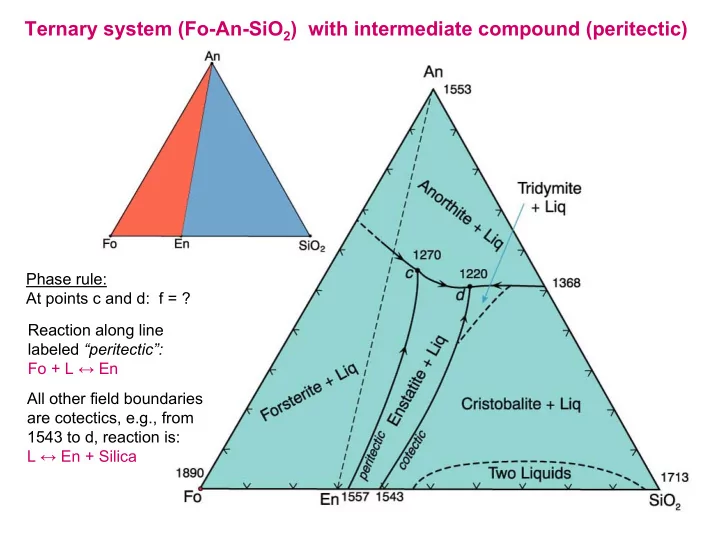
Ternary system (Fo-An-SiO 2 ) with intermediate compound (peritectic) Phase rule: At points c and d: f = ? Reaction along line labeled peritectic: Fo + L En All other field boundaries are cotectics, e.g., from 1543 to d, reaction


slide-1
SLIDE 1

Ternary system (Fo-An-SiO2) with intermediate compound (peritectic)

Phase rule: At points c and d: f = ? Reaction along line labeled “peritectic”: Fo + L ↔ En All other field boundaries are cotectics, e.g., from 1543 to d, reaction is: L ↔ En + Silica

slide-2
SLIDE 2

Ternary system (Fo-An-SiO2) with intermediate compound (peritectic)

Note: Fields of crystallization

  • f An, Fo, En and silica

Eqm Xtln of compn a: a-b: Fo b-c: Fo + L↔En c: Fo + L↔En + An d e g f d' Eqm Xtln of compn d: d-e: Fo e-f: Fo + L ↔ En f-g: En g-d': En + An at d': En + An + Silica: (at d': L ↔ En + An + Silica)

Recall: tangent rule and how to determine nature of reactions along univariant boundaries and at invariant points

slide-3
SLIDE 3

Ternary system (Fo-An-SiO2) with intermediate compound (peritectic)

Fractional crystallization of composition a: a - b: Forsterite b - e: Enstatite e - d: En + An For melting of a solid assemblage of bulk composition a, what would be the first liquid produced? What differences are there between equilibrium melting and fractional melting of composition a?

slide-4
SLIDE 4

Important systems with more than 3 components

1. “Granite” system (Ab-Or-Qz-H2O) This 4 component (Quaternary) system has been studied extensively since the publication of the classic memoir in 1958 by Tuttle and Bowen (GSA Memoir 74). There are 4 ternary sub-systems (Ab-Or-Qz; Ab-Or-H2O; Ab-Qz-H2O; Or-Qz-H2O) and 6 binary sub-systems. We have discussed the phase equilibria in the Ab-Or-H2O system. Time does not permit an extensive discussion of all the ternary systems so we will just focus on some of the key results at P = 5 kbars To represent the phase equilibria in the quaternary (“granite”) system, the phase relations obtained under water-saturated conditions are projected from the water apex on to the triangular base of the tetrahedron, e.g., point a within the tetrahedron projects to a' on the base

H2O Ab Qz H2O Or Qz L + V Ab+L Qz+L Or+L Qz+L L+V a (690) b (730) Qz Ab Or Qz+L Afs+L m(~1000) M: minimum on liquidus

a: L(Ab,Qz,V) b: L(Or,Qz,V)

Ab Or Qz H2O

a a'

V V 756 1100 1130 1065 875 1100 1065 1130

slide-5
SLIDE 5

“Granite” System at 5 kb

H2O Qz Ab Or

690 645 730 701

1065 1130

V L+V L+V

L(Orss,Abss,Qz,V)

a b c d e f g

Schematic perspective projection of the H20-saturated liquidus surface in the Ab-Or-Qz-H2O system at 5 kb This surface is labeled a-b-c-d-e-f-g and the numbers correspond to the temperatures in ºC at each point Heavy lines show the location

  • f liquid compositions in

equlilibrium with various crystalline assemblages f(690ºC) – g(645ºC): L(Abss,Qz,V) f(730ºC) – g(645ºC): L(Orss,Qz,V) b(730ºC) – g(645ºC): L(Orss,Abss,V) g(645ºC): L(Abss,Orss,Qz,V) Light lines (below the V-satd surface are water present but V- undersatd equilibria, e.g., 690ºC- 1130ºC line represents L(Ab,Qz) Fluid compositions lie close to H2O apex At 5 kb, H2O-satd liquids contain ~10 wt% H2O

slide-6
SLIDE 6

“Granite” [Ab-Or-Qz-H2O] System at 2 kb and 10 kb (water saturated)

Note: There is no ternary eutectic at PH2O =

  • 2kb. Instead, there is a minimum at 680ºC in

the field boundary separating the fields of quartz and alkali feldspar. Recall the Ab-Or system which shows that the solidus has not intersected the solvus at low P. At PH2O = 10 kb, there is a ternary eutectic at T = 635ºC and the fields of Abss, Orss and quartz are distinct. Basically, the solvus and the solidus have intersected. Phase Rule: variance at the eutectic? Crystallization and melting behavior?

slide-7
SLIDE 7

Solidus in “Granite” [Ab-Or-Qz-H2O] System to 20kb (water saturated)

Note: Curve shows the water saturated solidus in the “granite” system as a function of P. The diagonal line shows the one feldspar—two feldspar boundary (in effect the P and T of the crest

  • f the solvus)

The inset diagram shows the composition of the minima (at 1 and 2 kb) and the eutectic (at 5, 10 and 20 kb). At pressures above ~16 kb, albite is unstable and breaks down to jadeite + quartz. This produces an invariant point. What phases at present at the invariant point? The shaded area show the composition of most natural granites plotted on this diagram.