Telemedicine Requirements for Licensing, Scope of Practice and - - PowerPoint PPT Presentation

telemedicine requirements for licensing scope of practice
SMART_READER_LITE
LIVE PREVIEW

Telemedicine Requirements for Licensing, Scope of Practice and - - PowerPoint PPT Presentation

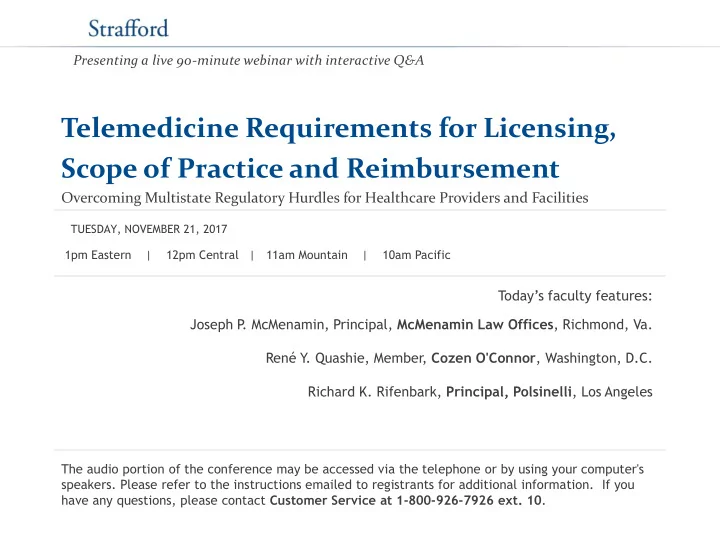
Presenting a live 90-minute webinar with interactive Q&A Telemedicine Requirements for Licensing, Scope of Practice and Reimbursement Overcoming Multistate Regulatory Hurdles for Healthcare Providers and Facilities TUESDAY, NOVEMBER 21, 2017


slide-1
SLIDE 1

The audio portion of the conference may be accessed via the telephone or by using your computer's

  • speakers. Please refer to the instructions emailed to registrants for additional information. If you

have any questions, please contact Customer Service at 1-800-926-7926 ext. 10.

Presenting a live 90-minute webinar with interactive Q&A

Telemedicine Requirements for Licensing, Scope of Practice and Reimbursement

Overcoming Multistate Regulatory Hurdles for Healthcare Providers and Facilities

Today’s faculty features:

1pm Eastern | 12pm Central | 11am Mountain | 10am Pacific TUESDAY, NOVEMBER 21, 2017

Joseph P . McMenamin, Principal, McMenamin Law Offices, Richmond, Va. René Y . Quashie, Member, Cozen O'Connor, Washington, D.C. Richard K. Rifenbark, Principal, Polsinelli, Los Angeles

slide-2
SLIDE 2

Tips for Optimal Quality

Sound Quality If you are listening via your computer speakers, please note that the quality

  • f your sound will vary depending on the speed and quality of your internet

connection. If the sound quality is not satisfactory, you may listen via the phone: dial 1-866-819-0113 and enter your PIN when prompted. Otherwise, please send us a chat or e-mail sound@straffordpub.com immediately so we can address the problem. If you dialed in and have any difficulties during the call, press *0 for assistance. Viewing Quality To maximize your screen, press the F11 key on your keyboard. To exit full screen, press the F11 key again.

FOR LIVE EVENT ONLY

slide-3
SLIDE 3

Continuing Education Credits

In order for us to process your continuing education credit, you must confirm your participation in this webinar by completing and submitting the Attendance Affirmation/Evaluation after the webinar. A link to the Attendance Affirmation/Evaluation will be in the thank you email that you will receive immediately following the program. For additional information about continuing education, call us at 1-800-926-7926

  • ext. 35.

FOR LIVE EVENT ONLY

slide-4
SLIDE 4

4

Telehealth Licensing & Scope of Practice Issues

Joseph P. McMenamin

McMenamin Law Offices

slide-5
SLIDE 5

5

The Practice of Medicine

 Defining the practice of medicine: state law issue

 Holding oneself out as a doctor to the public  Charging for medical services  Providing a medical consult  Issuing orders (labs, imaging studies)  Making a diagnosis  Recommending treatment  Writing prescriptions  Performing treatments/surgery

\

slide-6
SLIDE 6

6

Telemedicine and Licensing

■ Licensure is States’ primary means of regulating providers ■ MD offering care via telemedicine may be subject to licensure rules of: ■ The state in which the patient is physically located at the time of the consult; ■ The state where the physician is located/licensed

\

slide-7
SLIDE 7

7

Telemedicine and Licensing, 2

■ Received wisdom: Governing law is that of patient’s state

 Some states: law or guidance  Others: include diagnosing or treating through “electronic

  • r other means” in definition of the practice of medicine

 Others: silent  An opportunity to challenge the received wisdom?

slide-8
SLIDE 8

8

Challenging Convention

 D radiologist interpreted images sent from Berks County,

  • Pa. in Philadelphia, so venue proper there

 Wentzel v. Cammarano, 2017 Pa. Super. 223

 Care was provided in Houston, where lab located, and to

which specimens were shipped, not in La., where the patients were and where samples were collected  Quest Diagnostics Clinical Labs., Inc. v. Barfield, No. 2015-

0926 (La. App. 1 Cir. 9/9/16)

 Medicare place of service codes: telemedical care is

provided at the health care professional’s site

 Apportioning unrelated business income of tax-exempt

hospitals providing distance care: provider’s location is a relevant consideration

slide-9
SLIDE 9

9

Physician Licensing Exceptions

Consultation

  • Unlicensed

MD may consult peer to peer with MD licensed in the state

  • Available in

most states; significant variances in scope

  • So, requires

state-by- state analysis Bordering State

  • MD

licensed in bordering state may practice in state

  • A few

states only

Special License or Registration

  • Abbreviated

license or registration for telemedicine

  • only care
  • Offered in

several states

Follow-Up Care

  • MD may

provide follow-up care to patient (post-op, e.g.)

Endorsement

  • Physician

licensed in another state can,

  • n that

basis, more quickly

  • btain in-

state license

slide-10
SLIDE 10

10

Consultation Exception

■ MD unlicensed in state may offer consults to MDs licensed

there

■ Peer-to-peer: local MD retains control of dx, tx

■ Unlike consultant, interacts with patient ■ State board retains control of its licensee

■ Example: Arizona

− “This [licensing statute] does not apply to… (1) A doctor of

medicine residing in another jurisdiction who is authorized to practice medicine in that jurisdiction, if the doctor engages in actual single or infrequent consultation with a doctor of medicine licensed in this state and if the consultation regards a specific patient or patients.” (emphasis added) − Ariz. Rev. Stat. § 32-1421

slide-11
SLIDE 11

11

Consultation Exception, 2

■ Highly variable:

− Frequency of consults − Free v. for compensation − In-state office or location to meet − Primary vs. secondary diagnosis − Contractual arrangement or regular contacts

slide-12
SLIDE 12

12

Bordering State Exception

■ Out-of-state physician licensed in a bordering state

■ Example: Maryland

− “Subject to the rules, regulations, and orders of the

Board, the following individuals may practice medicine without a license… A physician who resides in and is authorized to practice medicine by any state adjoining this State and whose practice extends into this State, if:

  • (i) The physician does not have an office or other

regularly appointed place in this State to meet patients; and

  • (ii) The same privileges are extended to licensed

physicians of this State by the adjoining state.”

  • Md. Health Occ. Code § 14-302 (emphasis added)
slide-13
SLIDE 13

13

Special Telehealth License

■ Abbreviated license or registration for telemedicine-only care

provided to state residents

■ Nine states offer special telehealth licenses

slide-14
SLIDE 14

14

Special Telehealth License, 2

■ Example: Minnesota

− “(a) A physician not licensed to practice medicine in this state may

provide medical services to a patient located in this state through interstate telemedicine if the following conditions are met:

  • (1) the physician is licensed without restriction to practice medicine in the

state from which the physician provides telemedicine services;

  • (2) the physician has not had a license to practice medicine revoked or

restricted in any state or jurisdiction;

  • (3) the physician does not open an office in this state, does not meet with

patients in this state, and does not receive calls in this state from patients; and

  • (4) the physician annually registers with the board, on a form provided by

the board.”

  • Minn. Stat. Ann. § 147.032 (emphasis added)
slide-15
SLIDE 15

15

Follow-Up Care Exception

 MD may provide follow-up care (post-op, e.g.)  Example: Indiana

 “In addition to the exceptions described in section 2 [IC

25-22.5-1-2] of this chapter, a nonresident physician who is located outside Indiana does not practice medicine or

  • steopathy in Indiana by providing … treatment services

to a patient in Indiana following medical care originally provided to the patient while outside Indiana.”

− Ind. Code Ann. § 25-22.5-1-1.1 (emphasis added)

slide-16
SLIDE 16

16

Endorsement

■ Based on his out-of-state credentials, physician

licensed elsewhere can obtain in-state license faster

■ Example: New Mexico

− “The board may grant a license by endorsement to an

applicant who: (1) has graduated from an accredited U.S. or Canadian medical school; (2) is board certified in a specialty recognized by the American Board of Medical Specialties; (3) has been a licensed physician in the U.S. or Canada and has practiced medicine in the U.S. or Canada immediately preceding the application for at least three years; (4) holds an unrestricted license in another state or Canada; and (5) was not the subject of a disciplinary action in a state or province.”

− N.M. Stat. Ann. § 61-6-13 (emphasis added)

slide-17
SLIDE 17

17

Licensing Compacts

■ Interstate Medical License Compact ■ Nurse Licensure Compact and APRN Compact ■ Psychology Interjurisdictional Compact ■ Physical Therapy Licensure Compact ■ No others on the horizon at present

slide-18
SLIDE 18

18

Interstate Medical License Compact

■ Additional licensure approach for physicians in

Compact-participating states

■ Physician licensure portability and practice of cross-

border services

■ Complements existing licensing and regulatory

authority of state medical boards

■ Must still become fully licensed in each state ■ Must still pay fees

■ Twenty-two states have joined (as of 11/17)

slide-19
SLIDE 19

19

Nurse Licensure Compact

■ Permits nurse to practice in own state and other

Compact states

■ If a Compact state is the primary state of residence,

the license automatically becomes a Compact/multistate license

■ 25 states have adopted the Compact to date ■ National Council for State Boards of Nursing

approved APRN Compact (5/4/15)

slide-20
SLIDE 20

20

Psychology Interjurisdictional Compact

 Association of State and Provincial Psychology Boards approved

(2/15)

 Goal: facilitate telehealth and temporary, in-person, face-to-

face [not defined] practice of psychology across state lines

 Became operative after seven states adopted the Compact

 At present, no provision for Provinces  Three states have adopted to date: Arizona, Utah, and Nevada

slide-21
SLIDE 21

21

Physical Therapy Licensure Compact

 From Federation of State Boards of Physical Therapy

 Enacted 5/15/17

 Purpose: increase access to PT services by reducing

regulatory barriers to cross–state practice

 To date, fourteen states have adopted the Compact

  • Public comment has closed, rules were voted upon
  • n 11/5/17
  • Results not publicly available as of 14 Nov. 2017
  • Compact expected to be up and running in early ‘18
slide-22
SLIDE 22

22

Federation of State Medical Boards Telemedicine Policy

■ Adopted in 2014 ■ Provides TM guidance to state medical boards ■ Topics:

− Physician licensure − Establishment of physician-patient relationship − Evaluation and treatment of patient − Informed consent − Continuity of care

slide-23
SLIDE 23

23

Federation of State Medical Boards Telemedicine Policy, 2

■ Topics, cont’d

− Medical records − Privacy and security − Disclosures and functionality of online services − Prescribing − Referrals for emergency services

slide-24
SLIDE 24

24

Telehealth Informed Consent

 30 states expressly require informed consent for telehealth

services  Not necessarily applicable to all telehealth; may apply to

Medicaid only or to identified specialties

■ Example: California

■ “Prior to the delivery of health care via telehealth, the health care

provider initiating the use of telehealth shall inform the patient about the use of telehealth and obtain verbal or written consent from the patient for the use of telehealth as an acceptable mode of delivering health care services and public health. The consent shall be documented.” ■

  • Cal. Bus. & Prof. Code 2290.5(b) (emphasis added)

■ Future?

slide-25
SLIDE 25

25

Telehealth Malpractice Considerations

■ Few claims

■ Many are not med mal at all, but 42 USC 1983 cases

■ Standard negligence analysis

■ This renegade’s view: Beware clinical practice guidelines

■ Many states: Standard is the same as that for in-person care

■ With videoconferencing, practitioner may inspect and (sometimes)

auscultate;

■ can neither percuss nor palpate ■ Rx: Decline to offer telemedicine where full PE needed

slide-26
SLIDE 26

26

Telemedicine Credentialing

■ CMS Conditions of Participation for Hospitals

− Hospital must have a credentialing and privileging process for

practitioners providing services to its patients − Includes those who provide services via telehealth

− CMS permits hospital receiving telehealth services to rely on the

privileging and credentialing decisions of hospital or entity providing them, if certain requirements are met

− Hospital must have a written agreement with the distant-site

hospital/telehealth entity − 42 C.F.R. 482.12(a)(8), (a)(9)

slide-27
SLIDE 27

27

Speaker Information

Joseph P. (“Joe”) McMenamin McMenamin Law Offices, PLLC mcmenamin@medicalawfirm.com 804.921.4856 Special thanks to Rick Rifenbark, Foley

slide-28
SLIDE 28

28

Telehealth Compliance Issues

Rick Rifenbark Principal, Polsinelli LLP

November 21, 2017

slide-29
SLIDE 29

29

Telehealth Compliance Issues

  • Review of the following:

– Corporate practice of medicine doctrine – Anti-kickback & fee splitting laws – State insurance laws

  • Telehealth action items
slide-30
SLIDE 30

30

Corporate Practice of Medicine

  • A number of states prohibit the “corporate practice of

medicine” (CPOM) to varying degrees

  • The CPOM is generally defined as a prohibition on the
  • peration of a medical practice, or the employment of

physicians or other licensed professionals, by entities that are not themselves licensed to practice medicine

slide-31
SLIDE 31

31

Corporate Practice of Medicine

  • Rationale for CPOM:

– Protects independent judgment of physicians – Limits commercialization of the profession – Unlicensed corporate entities are not subject to the same professional standards and regulatory control

  • Most states have some form of the CPOM doctrine,

but key states include CA, TX, SC, NY, TN, WA, IL

slide-32
SLIDE 32

32

Corporate Practice of Medicine

Sources of the CPOM doctrine include:

  • State statutes and regulations

– Example: Cal. Bus. & Prof. Code § 2400: “Corporations and

  • ther artificial legal entities shall have no professional

rights, privileges, or powers….”

  • Cal. Bus. & Prof. Code § 2052: "Any person who practices
  • r attempts to practice, or who holds himself or herself
  • ut as practicing...[medicine] without having at the time
  • f so doing a valid, unrevoked, or unsuspended

certificate...is guilty of a public offense.” – Example: Colo. Rev. Stat. Ann. § 12-36-134(7)(a): “Corporations shall not practice medicine.”

slide-33
SLIDE 33

33

Corporate Practice of Medicine

  • Case law

– Example: State Farm Mutual Automobile Insurance Co. v. Mallela, 175 F. Supp. 2d 401, 414 (E.D. N.Y. 2001): “[W]hen a professional health services corporation is owned by an unlicensed individual, ‘there is a danger that the doctor, knowing that he or she had to split his or her fees with one who did not render medical services, might be hesitant to provide proper services to a patient.’” (internal citation

  • mitted)

– Example: Garcia v. Texas State Board of Medical Examiners, 384 F. Supp. 434, 437 (W.D. Tex. 1974): “Texas courts have held that when a corporation employs a licensed physician to treat patients and itself receives a fee, the corporation is unlawfully engaged in the practice of medicine.”

slide-34
SLIDE 34

34

Corporate Practice of Medicine

  • Attorney General opinions

– Example: N.C. Atty. Gen. Op. (Sept. 3, 1999): A dental practice management company would be deemed to be practicing dentistry if payment to the management company were based on the revenues of the dental practice – Example: Mich. Atty. Gen. Op. 6592 (July 10, 1989): A domestic corporation formed under the Business Corporation Act may not engage in activities which may only be performed by one of the learned professions

slide-35
SLIDE 35

35

Corporate Practice of Medicine

  • Medical Board guidance

– Example: The Medical Board of California

  • The CA Medical Board views the following as health care

decisions that should be made by a physician: – Determining what diagnostic tests are appropriate for a particular condition – Determining the need for referrals to, or consultation with, another physician/specialist – Responsibility for the ultimate overall care of the patient, including treatment options available to the patient – Determining how many patients a physician must see in a given period of time or how many hours a physician must work available to the patient

slide-36
SLIDE 36

36

Corporate Practice of Medicine

  • Medical Board guidance (continued)

– Example: The Medical Board of California

  • The following “business” or “management” decisions

should be made by a licensed physician:

– Ownership is an indicator of control of a patient's medical records, including determining the contents thereof, and should be retained by a California-licensed physician – Selection, hiring/firing (as it relates to clinical competency or proficiency) of physicians, allied health staff and medical assistants – Setting the parameters under which the physician will enter into contractual relationships with third-party payers. – Decisions regarding coding and billing procedures for patient care services – Approving of the selection of medical equipment and medical supplies for the medical practice

slide-37
SLIDE 37

37

Corporate Practice of Medicine

  • Medical Board guidance (continued)

– Example: The Medical Board of California

  • The following structures are prohibited:

– Non-physicians owning or operating a business that

  • ffers patient evaluation, diagnosis, care and/or

treatment – Physician(s) operating a medical practice as a limited liability company, a limited liability partnership, or a general corporation – MSOs arranging for, advertising, or providing medical services rather than only providing administrative staff and services for a physician's medical practice – A physician acting as "medical director" when the physician does not own the practice

http://www.mbc.ca.gov/Licensees/Corporate_Practice.aspx

slide-38
SLIDE 38

38

Corporate Practice of Medicine

  • Common CPOM exceptions (state specific):

– Professional corporations – HMOs – Public hospitals – Certain other licensed health care facilities

  • Penalties for violating the CPOM doctrine include:

– Enforcement action by state AG – Enforcement action by applicable professional board – Debarment of the professional – Civil, criminal penalties, injunctive relief

slide-39
SLIDE 39

39

Corporate Practice of Medicine

  • How do telehealth arrangements implicate the CPOM?

– Non physician investment in medical practices – Multistate arrangements – Management company services and compensation – Employment of licensed professionals by non-professional entities

slide-40
SLIDE 40

40

Corporate Practice of Medicine

  • What should I do to evaluate whether I have a CPOM issue?

– Where are you operating? One state or multiple states? – Determine whether you are operating in a state (or states) with a CPOM doctrine. If yes, do any exceptions apply? – Evaluate who is providing the medical care (MDs, PAs, MFTs, NPs) – Who owns the entity that employs or contracts with the licensed professionals? – Who manages the medical practice? How is that entity paid?

slide-41
SLIDE 41

41

Anti-Kickback Laws

  • Federal Anti-Kickback Statute, 42 U.S.C. § 1320a-7b(b)
  • Federal criminal statute, also civil penalties
  • Intent-based statute
  • Covers all types of arrangements & individuals
  • Safe harbors (provide immunity for certain arrangements; not

required)

  • OIG Advisory Opinions
slide-42
SLIDE 42

42

Anti-Kickback Laws

  • A violation requires three elements:

– “Remuneration,” which means anything of value, in cash or in kind – The remuneration must be made “knowingly and willfully” – The remuneration must be made with intent to induce referrals or business; according to certain federal courts, a violation may be found if only one purpose of the remuneration is to induce referrals, even if there are also legitimate reasons for the payment

slide-43
SLIDE 43

43

Anti-Kickback Laws

  • Liability under the Anti-Kickback Statute applies to the offeror

and recipient of the kickback

  • June 2015 OIG Fraud Alert: “Physician Compensation

Arrangements May Result in Significant Liability” – OIG cautioned physicians to “…carefully consider the terms and conditions of medical directorships and other compensation arrangements before entering into them” – Fraud alert discussed 12 settlements involving physicians

  • Compensation was above FMV
  • Services not actually provided
  • Payments took into account referrals
  • Health care entities paid for office staff
slide-44
SLIDE 44

44

Anti-Kickback Laws

  • Potential penalties for Anti-Kickback Statute violations

include: – Up to $25,000 per offense – Up to five years imprisonment per offense – Mandatory exclusion from federal health programs – Civil monetary penalties – Liability under the FCA

slide-45
SLIDE 45

45

Anti-Kickback Laws

  • Common safe harbors for telehealth arrangements

– Personal services and management contracts – Space rental – Equipment rental – Employees – EHR donations – Small entity investments

slide-46
SLIDE 46

46

Anti-Kickback Laws

  • OIG Advisory Opinions

– OIG Adv. Op. 11-12 (telehealth stroke arrangement) – OIG Adv. Op. 99-14 (rural telehealth arrangement funded with federal grants) – Advisory opinions provide certainty for parties, but:

  • All material facts must be presented
  • Only apply to parties who submitted the opinion request
  • Time consuming process
slide-47
SLIDE 47

47

Anti-Kickback Laws

  • Watch out for state anti-kickback statutes and fee

splitting prohibitions!

  • Some form of state anti-kickback law and/or fee

splitting prohibition exists in most states

  • Types of state anti-kickback laws:

– All payer – Insurance – Medicaid

slide-48
SLIDE 48

48

Anti-Kickback Laws

  • Example: Cal. Bus.& Prof. Code § 650:
  • “…. the offer, delivery, receipt, or acceptance by any person licensed

under this division or the Chiropractic Initiative Act of any rebate, refund, commission, preference, patronage dividend, discount, or other consideration, whether in the form of money or otherwise, as compensation or inducement for referring patients, clients, or customers to any person, irrespective of any membership, proprietary interest, or coownership in or with any person to whom these patients, clients, or customers are referred is unlawful.”

  • Important exception: The payment or receipt of consideration for

services other than the referral of patients which is based on a percentage of gross revenue or similar type of contractual arrangement shall not be unlawful if the consideration is commensurate with the value of the services furnished or with the fair rental value of any premises or equipment leased or provided by the recipient to the payer

slide-49
SLIDE 49

49

Anti-Kickback Laws

  • Example: 225 Ill. Comp. Stat. 60/22.2
  • “A licensee under this Act may not directly or indirectly

divide, share or split any professional fee or other form of compensation for professional services with anyone in exchange for a referral or otherwise, other than as provided in this Section 22.2”

  • Includes payments to a company for the marketing or

management of the medical practice

  • Exception exists for FMV payments to billing company
slide-50
SLIDE 50

50

Anti-Kickback Laws

  • Example: Epic Medical Management v. Paquette,

244 Cal.App.4th 504 (2015) – Dispute over MSO compensation and services – Services provided by MSO:

  • Lease office space to physician
  • Lease all equipment to physician
  • Provide support services
  • Provide non-physician personnel
  • Establish and implement a marketing plan
  • Conduct billing and collections
  • Perform accounting services
slide-51
SLIDE 51

51

Anti-Kickback Laws

  • MSO compensation

– 50% of office medical services – 25% of surgical services – 75% of pharmaceutical expenses

  • Physician argued that because some of the fees were for

marketing services, the payments were illegal kickbacks for referred patients (and the MSO did refer patients to the practice)

slide-52
SLIDE 52

52

Anti-Kickback Laws

  • Holdings

– No state anti-kickback statute violation: No evidence that the amount the MSO received was for referrals – No CPOM violation: the Court found a strict delineation between non-medical services provided by the MSO and medical services provided by the practice

slide-53
SLIDE 53

53

Anti-Kickback Laws

  • How do telehealth arrangements implicate federal or state anti-

kickback and fee-splitting laws? – Payments for referrals – Payments for services that are above-FMV – Payments among providers

  • What should I do to determine if I have an anti-kickback statute or

fee-splitting issue with my telehealth arrangement? – Review financial arrangements with referral sources – Evaluate payment sources (e.g., Medicare, private insurance, etc.) – Do the states in which you operate have state anti-kickback laws

  • r fee-splitting statutes?

– Evaluate whether financial arrangements fall within safe harbors – Critically review the purpose of the payments

slide-54
SLIDE 54

54

State Insurance Laws

  • Some telehealth models can implicate state health

insurance laws (e.g., subscription models)

  • For example, California’s Knox-Keene Health Care Service

Plan Act of 1975 regulates “health care service plans,” which are generally defined as: – “Any person who undertakes to arrange for the provision of health care services to subscribers or enrollees, or to pay for or to reimburse any part of the cost for those services, in return for a prepaid or periodic charge paid by or on behalf of the subscribers

  • r enrollees.” Cal. Health & Safety Code § 1345(f)(1).
slide-55
SLIDE 55

55

State Insurance Laws

  • How do telehealth arrangements implicate state insurance

laws? – Payment structures can sometimes implicate insurance statutes if the provider is “at risk” for payment – For example, a subscription model in which a patient pays $100 per month for all the telehealth consults he/she needs

  • What can I do to evaluate whether my telehealth arrangement

implicates state insurance laws? – Review payment structures – What services are being provided for the payments? – Who is at risk and for what? – Review state insurance/HMO laws

slide-56
SLIDE 56

56

Contact Information

  • Rick Rifenbark, Polsinelli LLP

– Principal – Los Angeles, CA – 310-203-5321 – rrifenbark@polsinelli.com

slide-57
SLIDE 57

RENÉ QUASHIE

MEMBER COZEN O’CONNOR

rq u a s h i e @ coze n . co m 2 0 2 - 9 1 2 - 4 8 8 4

slide-58
SLIDE 58

58

slide-59
SLIDE 59

59

slide-60
SLIDE 60

60

slide-61
SLIDE 61

61

slide-62
SLIDE 62

62

slide-63
SLIDE 63

63

slide-64
SLIDE 64

64

slide-65
SLIDE 65

65

slide-66
SLIDE 66

66

slide-67
SLIDE 67

67

slide-68
SLIDE 68

68

slide-69
SLIDE 69

69

slide-70
SLIDE 70

70

slide-71
SLIDE 71

71

slide-72
SLIDE 72

72

slide-73
SLIDE 73

73

slide-74
SLIDE 74

74

slide-75
SLIDE 75

75

slide-76
SLIDE 76

76

slide-77
SLIDE 77

77

slide-78
SLIDE 78

78

slide-79
SLIDE 79

79

slide-80
SLIDE 80

80

slide-81
SLIDE 81

81

slide-82
SLIDE 82

82

slide-83
SLIDE 83

83

slide-84
SLIDE 84

84

slide-85
SLIDE 85

85