SLIDE 1
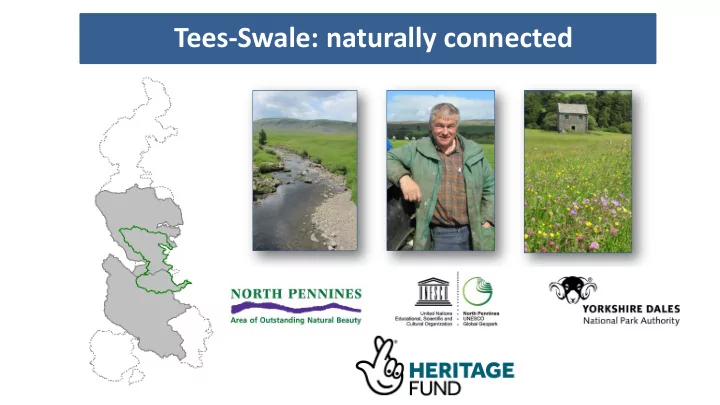
Tees-Swale: naturally connected
SLIDE 2
Project area
Tees-Swale project area 829 sq km
SLIDE 3
Project rationale
“More, bigger, better and joined up” “The first priority is to enhance the quality of remaining wildlife habitat”
SLIDE 4 Project rationale
The northern Pennines have the lowest levels of habitat fragmentation/ highest levels of habitat connectivity in England
Planning for Biodiversity – opportunity mapping and habitat networks in
- practice. Catchpole. 2006
SLIDE 5 Project area
Priority habitat – 502 sq km (61%) Blanket Bog & Valley Mire – 400 sq km (48%) Upland & Lowland Hay Meadows – 14 sq km (2%)
NB: the ‘white’ areas support important populations of breeding birds, including priority species such as curlew, lapwing & black grouse
SLIDE 6 Project area
SSSI – 67% of project area (553 sq km) 86% Priority habitat inside SSSI (431 sq km) 14% Priority habitat outside SSSI (70 sq km)
SLIDE 7
Project rationale
HNV farming is critical for upland habitats / biodiversity Farming community is central to Tees-Swale Trying to create transformation and lasting change
SLIDE 8
Project themes
Nature Improvement Training and Skills Access and Engagement
SLIDE 9 Nature Improvement – habitat works
Peatland restoration 500ha Hay meadow restoration 200ha Rush management 2000ha Wetland creation 40 sites Diffuse metal mitigation 300km of watercourse River enhancement 1 location currently Woodland creation 200ha
SLIDE 10
Nature Improvement
100 farmers / landowners directly engaged 1 to 1 1/3 of the farmers in the project area
SLIDE 11
SLIDE 12
Farmer areas of interest
SLIDE 13 Events and Cluster Development
- Demonstration events
- Cluster development
- Facilitation Fund group
SLIDE 14
SLIDE 15 Identifying and costing habitat works
- Working with farmers to agree
works for years 1 and 2
- Opportunities for further work
in years 3+ also identified.
Habitat Year 1 Year 2 Year 3+ Species rich grassland >65ha >65ha >50ha Rush control >180ha >100ha >60ha Wetlands/scrapes ~12 ~9 Woodland creation >50ha >40ha >40ha
SLIDE 16
SLIDE 17
- Originally outside of the
boundary.
- Sue and Ray are interested in
farming for wildlife and habitats
- Hit by the floods at the end of
July.
Kexwith
SLIDE 18 Hawes Auction mart 18th Sept 2018
SLIDE 19 Species-rich meadows
- Five ‘Yorkshire Fog meadows’
surveyed
meadow put forward for restoration
restored in the future.
SLIDE 20 Rush pasture and scrape creation
- Good habitat for breeding waders.
- Farmer to install scrape with guidance from team and RSPB.
- May need rush management in the future, year 3?
SLIDE 21 Woodland planting
- Interested in some woodland planting
- Will support with under-planting in Lockey Wood
- Choice of funding, could be Countryside Stewardship and Tees-Swale
combination or solely funded by Tees-Swale.
SLIDE 22 Hill Gill, Charlie & Gina Parker
- Initial farmer interview in February 2019
- Has native breed cattle, sheep, goats and ponies
- View themselves as “temporary custodians” and aim to “leave land in better
health than when they came there”
SLIDE 23
Habitat Works
SLIDE 24
Training and Skills
Farmer/conservationist knowledge-exchange Farmer-led habitat assessment Alternatives to intensification Contractor training Volunteer training
SLIDE 25
Training and Skills
16 Traineeships
SLIDE 26
Access and Engagement
Engaging with groups around the area, generating new audiences 19 new routes and trails / enhancements Interpretation Community-led art in the landscape New partnership with outdoor education centres e.g. Marrick Priory
SLIDE 27
SLIDE 28
Delivery phase staffing
1 Project Manager 3 Land Management Facilitators*1 2 Engagement Officers*1 0.6 Access Officer 0.5 Comms Support 0.5 Interpretation 1 Finance Officer (p/t) 1 Admin Officer (p/t)
SLIDE 29
Timescale
Submission 2nd March 2020 Decision – Late June 2020 Delivery to mid 2025
SLIDE 30
Tees-Swale: naturally connected