Technical Sessions, Tuesday 5/23/2017, 1:20 3:00 PM Advances in - - PowerPoint PPT Presentation

technical sessions tuesday 5 23 2017 1 20 3 00 pm
SMART_READER_LITE
LIVE PREVIEW

Technical Sessions, Tuesday 5/23/2017, 1:20 3:00 PM Advances in - - PowerPoint PPT Presentation

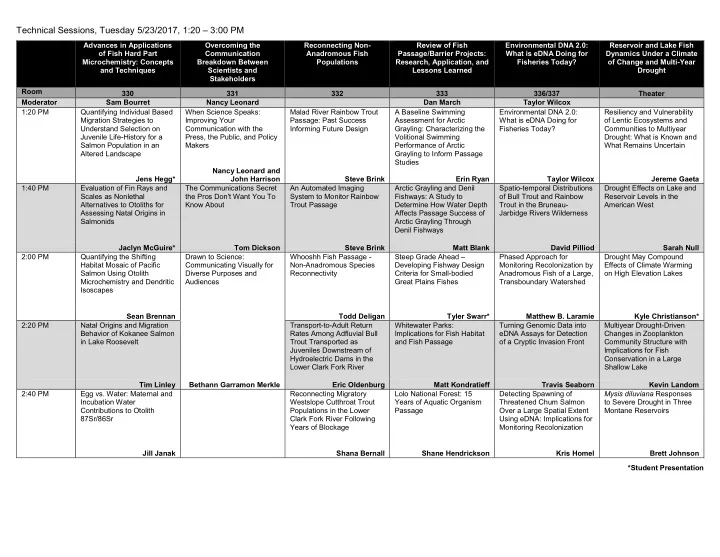
Technical Sessions, Tuesday 5/23/2017, 1:20 3:00 PM Advances in Applications Overcoming the Reconnecting Non- Review of Fish Environmental DNA 2.0: Reservoir and Lake Fish of Fish Hard Part Communication Anadromous Fish Passage/Barrier


slide-1
SLIDE 1

Technical Sessions, Tuesday 5/23/2017, 1:20 – 3:00 PM

Advances in Applications

  • f Fish Hard Part

Microchemistry: Concepts and Techniques Overcoming the Communication Breakdown Between Scientists and Stakeholders Reconnecting Non- Anadromous Fish Populations Review of Fish Passage/Barrier Projects: Research, Application, and Lessons Learned Environmental DNA 2.0: What is eDNA Doing for Fisheries Today? Reservoir and Lake Fish Dynamics Under a Climate

  • f Change and Multi-Year

Drought Room 330 331 332 333 336/337 Theater Moderator Sam Bourret Nancy Leonard Dan March Taylor Wilcox 1:20 PM Quantifying Individual Based Migration Strategies to Understand Selection on Juvenile Life-History for a Salmon Population in an Altered Landscape When Science Speaks: Improving Your Communication with the Press, the Public, and Policy Makers Malad River Rainbow Trout Passage: Past Success Informing Future Design A Baseline Swimming Assessment for Arctic Grayling: Characterizing the Volitional Swimming Performance of Arctic Grayling to Inform Passage Studies Environmental DNA 2.0: What is eDNA Doing for Fisheries Today? Resiliency and Vulnerability

  • f Lentic Ecosystems and

Communities to Multiyear Drought: What is Known and What Remains Uncertain Jens Hegg* Nancy Leonard and John Harrison Steve Brink Erin Ryan Taylor Wilcox Jereme Gaeta 1:40 PM Evaluation of Fin Rays and Scales as Nonlethal Alternatives to Otoliths for Assessing Natal Origins in Salmonids The Communications Secret the Pros Don't Want You To Know About An Automated Imaging System to Monitor Rainbow Trout Passage Arctic Grayling and Denil Fishways: A Study to Determine How Water Depth Affects Passage Success of Arctic Grayling Through Denil Fishways Spatio-temporal Distributions

  • f Bull Trout and Rainbow

Trout in the Bruneau- Jarbidge Rivers Wilderness Drought Effects on Lake and Reservoir Levels in the American West Jaclyn McGuire* Tom Dickson Steve Brink Matt Blank David Pilliod Sarah Null 2:00 PM Quantifying the Shifting Habitat Mosaic of Pacific Salmon Using Otolith Microchemistry and Dendritic Isoscapes Drawn to Science: Communicating Visually for Diverse Purposes and Audiences Whooshh Fish Passage - Non-Anadromous Species Reconnectivity Steep Grade Ahead – Developing Fishway Design Criteria for Small-bodied Great Plains Fishes Phased Approach for Monitoring Recolonization by Anadromous Fish of a Large, Transboundary Watershed Drought May Compound Effects of Climate Warming

  • n High Elevation Lakes

Sean Brennan Todd Deligan Tyler Swarr* Matthew B. Laramie Kyle Christianson* 2:20 PM Natal Origins and Migration Behavior of Kokanee Salmon in Lake Roosevelt Transport-to-Adult Return Rates Among Adfluvial Bull Trout Transported as Juveniles Downstream of Hydroelectric Dams in the Lower Clark Fork River Whitewater Parks: Implications for Fish Habitat and Fish Passage Turning Genomic Data into eDNA Assays for Detection

  • f a Cryptic Invasion Front

Multiyear Drought-Driven Changes in Zooplankton Community Structure with Implications for Fish Conservation in a Large Shallow Lake Tim Linley Bethann Garramon Merkle Eric Oldenburg Matt Kondratieff Travis Seaborn Kevin Landom 2:40 PM Egg vs. Water: Maternal and Incubation Water Contributions to Otolith 87Sr/86Sr Reconnecting Migratory Westslope Cutthroat Trout Populations in the Lower Clark Fork River Following Years of Blockage Lolo National Forest: 15 Years of Aquatic Organism Passage Detecting Spawning of Threatened Chum Salmon Over a Large Spatial Extent Using eDNA: Implications for Monitoring Recolonization Mysis diluviana Responses to Severe Drought in Three Montane Reservoirs Jill Janak Shana Bernall Shane Hendrickson Kris Homel Brett Johnson *Student Presentation

slide-2
SLIDE 2

Technical Sessions, Tuesday 5/23/2017, 3:20 – 5:40 PM

Advances in Applications

  • f Fish Hard Part

Microchemistry: Concepts and Techniques Overcoming the Communication Breakdown Between Scientists and Stakeholders Reconnecting Non- Anadromous Fish Populations Review of Fish Passage/Barrier Projects: Research, Application, and Lessons Learned Environmental DNA 2.0: What is eDNA Doing for Fisheries Today? Reservoir and Lake Fish Dynamics Under a Climate of Change and Multi-Year Drought Room 330 331 332 333 336/337 Theater Moderator Sam Bourret Nancy Leonard Erin Ryan Taylor Wilcox 3:20 PM The Influence of Rainbow Trout Hybridization on Natal Site Fidelity What Reporters Look For Conservation of Bull Trout in the Lower Clark Fork River: Evaluating the Effects of Passage, Nonnative Trout Suppression, and Habitat Restoration Swimming Performance of Sauger in Relation to Fish Passage Monitoring Pacific Lamprey Distribution and Re- introduction in the Wenatchee River: an eDNA Pilot Study The Effect of Multiyear Drought

  • n Habitat Availability and

Tributary Connectivity with Implications for Bear Lake Sculpin & Bonneville Cutthroat Trout Samuel L Bourret Robert Chaney Douglas Peterson Kevin Kappenman Ann Grote Hayley Glassic* 3:40 PM Quantifying Hypoxia Exposure in Fishes Using Redox-Sensitive Chemical Markers in Otoliths How to Talk about Science so that People Want to Listen and Get Involved An Evaluation of Variables Influencing Cutthroat Trout Colonization and Abundance in Newly Accessible Habitats Above Previously Blocking Road Culverts Design and Construction Considerations for Remote Fish Barriers Using Environmental DNA to Evaluate Invasive Species Eradication Efforts The Effect of Lake Level on Forage and Lahonton Cutthroat Trout in Pyramid Lake, Nevada Benjamin Walther Patrick Ortmeyer Travis Schill Dan March Adam Sepulveda Gary Thiede 4:00 PM The Use of Strontium Isotope Ratios 87Sr:86Sr in Otoliths and Fin Rays to Inform Ecology, Conservation, and Management of Fishes in California Four Secrets to Help Non- scientists Understand (or at least appreciate) the Science Behind the Issue Restoration of a Legacy Fish Passage Barrier in the Upper Salmon River Drainage, Idaho No Fish Left Behind: Environmental DNA Sampling to Ensure Successful Fish Eradication Water Clarity, Drought and Length-Weight Relationships of the Endangered June Sucker and Sport Fishes in a Highly Eutrophic Utah Lake Jim Hobbs Jennifer Anders Chad Wiseman Kellie Carim Ryan Dillingham 4:20 PM Estimating Behavioral Diversity of Salmonids in the Upper North Platte River Using Otolith Microchemistry Meet and Engage with AFS Leadership - Featuring Doug Austen, Joe Margraf, and Others Fish Passage at Remote Natural Barriers At the Forefront: Evidence of the Applicability of Using Environmental DNA to Quantify the Abundance of Fish Populations in Natural Lentic Waters Do Reservoirs Trophic Niche Spaces Become More Crowded Under a Warmer, Drier Climate? Lindsy Ciepiela* Shaun Bevan Stephen Klobucar* Phaedra Budy 4:40 PM Stable Isotope Analyses on Otoliths of Pacific Salmon Harmony Ditch Diversion, It's Not Always Harmony The Promise and Pitfalls of Fish Enumeration Using eDNA: Spatiotemporal Dynamics of Salmon DNA in a Spawning Stream Finding a Way to Create Robust Fisheries in a Changing Environment Yongwen Gao Erin Leonetti Michael Tillotson* Craig Walker 5:00 PM Regulatory Considerations for New Fish Passage Technologies The Range-wide, eDNA- Based Inventory of Bull Trout: Early Results and an Ongoing Invitation Round Table Discussion - Organization of a "Fisheries" Perspective Article Alison Colotelo Michael Young 5:20 PM Perspectives on Restoring Connectivity and Anadromy Upstream of Impassable Dams in the Elwha and Skokomish Systems, Washington The Aquatic eDNAtlas for the American West: All Species, All Streams Through Crowd- sourcing and One Interagency Database Kathryn Sutton Dan Isaak *Student Presentation

slide-3
SLIDE 3

Technical Sessions, Wednesday, 5/24/2017, 8:00 – 10:00 AM

Transformation of the Upper Clark Fork River Basin: a Story of Success, Challenges, and the Collaboration that is Making It Happen! Contributed Presentations: Inland Fisheries Ecology and Management The Human Element of Aquatic Restoration: Working with Stakeholders to Plan and Implement Restoration Invasive Species and Fishery Management - an Examination of Current Issues Fifty Years of Fisheries Genetics: Allozymes to Genomes The Yellowstone River: A Lot Can Change in 692 Miles Room 330 331 332 333 336/337 Theater Moderator Vicki Watson Mike Meeuwig Tracy Wendt Bruce Farling Fred Allendorf 8:00 AM 2017 State of the Salmonids: Fish in Hot Water A Collaborative Approach to Restoration and Flood Recovery on the Big Thompson River Invasive Species and Fisheries Management: an Examination of Current Issues Fifty Years of Fisheries Genetics: Allozymes to Genomes An Introduction to the Yellowstone River Patrick Samuel Tracy Wendt Leah Elwell Fred Allendorf Leanne Roulson 8:20 AM Temporal Variability in the Distribution and Abundance

  • f a Desert Trout Associated

with Stream Drying Collaborating to Develop a Watershed Action Plan Western Lake Trout Woes - Revisited Some Neat Stuff in Fishery Genetics I Have Stumbled Across Over the Years Mountain Whitefish Kill and Proliferative Kidney Disease in the Yellowstone River, Montana Mike Meeuwig David Ward Wade Fredenberg Scott Opitz 8:40 AM Symposium Introduction The Salmonid Population Viability Project: Modelling Trout Viability in a Desert Landscape Culture Clash and Partnership? Challenges of Implementing Watershed Restoration for Threatened and Endangered Species in Culturally-Significant Areas Evaluation of Suppression Methods Targeting Non- native Lake Trout Embryos in Yellowstone Lake Aquatic Ecological Diversity Shifts Along the Yellowstone River Continuum from Trout to Sturgeon Vicki Watson Doug Leasure Rob Lawler Nathan Thomas* Robin Waples David Stagliano 9:00 AM The Upper Clark Fork River: A History of Use, Abuse and Reuse How Many Fish Live in that River Network? A Scalable Population Estimator that uses Spatial Stream Network Models and Nonrandom Fish Density Datasets Implementing Process- Based Restoration in Harvey Creek, Washington, USA The Northern Pike Minnow, You Should be Very Afraid...Be Very Afraid Use of Local Westslope Cutthroat Trout Stocks for Genetic Conservation Yellowstone River Channel Migration Easement Program Matt Vincent Dan Isaak Eric Berntsen Joe Maroney Matthew C. Boyer Wendy Weaver 9:20 AM Remediation/Restoration of the Upper Clark Fork River Basin: Uncertainty, Challenges, and Successes Describing Interactions Between Bull Trout and Lake Trout in Priest Lake, Idaho Stream Restoration on Medicine Lodge Creek, Wyoming Invasive Northern Pike are Associated with Range Contractions of Three Native Cyprinids Playing God with Guppies: Testing Whether Genetic Rescue Works Using a Model Experimental System Yellowstone River: A Tale of Two Spills Derek Entz* Laura Burckhardt Allison Stringer*

  • W. Chris Funk

Alicia Stickney 9:40 AM Are Brown Trout Negatively Impacting Yellowstone Cutthroat Trout? O'Dell Springs Creek and Wetland Restoration: 13 Years of Successful Partnerships and Collaboration Non-Native Trout as Invasive Species Affecting Native Fish Species The Genomics of Adaptation: Lessons from Threespine Stickleback Competing Interests on the Yellowstone: Pallid Sturgeon and the Intake Diversion Dam Douglas Martin Robert Al-Chokhachy John Muhlfeld Bradley Shepard Paul Hohenlohe Aaron Hall *Student Presentation

slide-4
SLIDE 4

Technical Sessions, Wednesday, 5/24/2017, 10:20 AM – 12:00 PM

Transformation of the Upper Clark Fork River Basin: a Story of Success, Challenges, and the Collaboration that is Making It Happen! Contributed Presentations: Inland Fisheries Ecology and Management The Human Element of Aquatic Restoration: Working with Stakeholders to Plan and Implement Restoration Invasive Species and Fishery Management - an Examination of Current Issues Fifty Years of Fisheries Genetics: Allozymes to Genomes The Yellowstone River: A Lot Can Change in 692 Miles Room 330 331 332 333 336/337 Theater Moderator Vicki Watson Mike Meeuwig Eric Bernsten Bruce Farling and Bob Wiltshire Fred Allendorf 10:20 AM Fisheries Response to Remediation and Restoration Actions in the Upper Clark Fork Basin Fish Movement Patterns in the Smith River Watershed in Central Montana. Create, Visualize, and Share 3D Models Using UAS Technology for River Restoration Forecasting With a Mechanistic Model the Invasion and the Management of Brown Trout in the Logan River, Utah Selection Against Rainbow Trout Admixture Across Populations, Environments, and the Genome Shape of a River Jason Lindstrom Michael Lance* Ryan Richardson Christophe Laplanche Ryan Kovach Video 10:40 AM Scale and Permanence: Fish Response to the Removal of Milltown Dam, MT Results from Acoustic Tracking of Redband Trout Tagged in Lake Roosevelt Tributaries Reach-Scale Restoration on Nevada Creek: Balancing Habitat Improvments With Traditional Agriculture in the Blackfoot Valley Montana Illegal Fish Introductions in Montana Using Genomic Data for Conservation: Range-Wide Demographic and Genetic Structure of Longfin Smelt David Schmetterling Bryan Witte* Ron Pierce Jim Vashro Mandi Finger 11:00 AM Monitoring Fisheries Responses to Restoration in the Upper Clark Fork River Basin Rufus Woods Rainbow Trout Supplementation: A Six Year Overview of Creel Monitoring and Evaluation Montana Stream Permitting Guide Moderated Discussion on Invasive Fish Issues Patterns of Rainbow Trout/Westslope Cutthroat Trout Hybridization in Montana and Northern Idaho Nathan Cook Jeff Caisman Bruce Anderson Bruce Farling Kevin McKelvey 11:20 AM Floodplain Remediation and Restoration in the Upper Clark Fork River Basin, Montana Using Hypolimnetic Oxygenation to Enhance a Mesotrophic Lake Coldwater Fishery Stream Restoration to Improve Human Overwintering and Rearing Habitat What's the Deal with Invasive Crayfish in the West? A Case Study of Rusty Crayfish Legacy Introductions and Climatic Variation Explain Spatiotemporal Patterns of Invasive Hybridization in a Native Trout Amy Sacry Benjamin Cross Warren Colyer Mathis Messager* Clint Muhlfeld 11:40 AM Changes in Climate, Flows and Algae Levels in the Clark Fork River Examining the Drivers of Cold-Water Refuges in a Large Impounded River The Dolores River Restoration Partnership; Reflecting on Seven Years of Watershed Restoration and Collaboration Introduced American Bullfrog Spread in the Yellowstone River Duplicate Loci and Gene Mapping in Fisheries Genetics: Allozymes to Next- Generation Sequencing Vicki Watson Francine Mejia Mike Wight Adam Sepulveda Garrett McKinney *Student Presenter

slide-5
SLIDE 5

Technical Sessions, Wednesday, 5/24/2017, 1:20 – 3:00 PM

Contributed Presentations: Emerging Technologies Contributed Presentations: Habitat and Restoration Invasive Species and Fishery Management - an Examination of Current Issues Fifty Years of Fisheries Genetics: Allozymes to Genomes Montana Chapter AFS – 50th Anniversary Symposium Room 331 332 333 336/337 Theater Moderator Leo Rosenthal Lora Tennant Bob Wiltshire and Leah Elwell Ryan Kovach 1:20 PM Whooshh Fish Passage - Results from 2016 Studies Distinctions in Vegetation and Fish Assemblages Among Wetland Types According to Dominant Features in Large, Shallow Lakes Flowering Rush Facilitation of Northern Pike Saving the Spandrels? Adaptive Genomic Variation in Conservation and Fisheries Management Introductory Remarks, Session Overview, and Reflections on the Formation of the Chapter Todd Deligan Leo Bodensteiner Peter Rice Leslie Nyce, Craig Barfoot, William Gould 1:40 PM Evaluation of an Electric Fish Barrier on an Irrigation Canal on the Lower Gunnison River, Colorado Recovery of Fish Populations and Physical Channel Characteristics in Streams Impacted by Catastrophic Debris Flows Everything You Wanted to Know About Rock Snot. A Brief History of Didymosphenia geminata Early Years of the Chapter Dan Kowalski Jason Walter Leah Elwell Devon Pearse Ron Marcoux 2:00 PM When Tiny Bubbles Cause Big Problems: A Systematic-Type Review of Gas Bubble Trauma in Freshwater Fishes Fish Out of Water - Regulating and Restoring Floodplain Function Phosphorus Enrichment as a Management Strategy for Didymo Nuisance Mats in the Kootenai River, Libby, MT Experimental Test of Genetic Rescue in Isolated Populations of Brook Trout Not Easy Being Native: The Fine Line Between Fish Icon and Cut Bait Naomi Pleizier* Marjorie Wolfe Katie Vivian Zachary Robinson* Wade Fredenberg 2:20 PM Sustainable Agro-based Earthen Pond Integrated Carp Fish Farming in Pakistan: Prospects of Transfer

  • f American Fish Feed

Technologies Deer Creek Floodplain Enhancement Project: A Modern Approach to Process Based Ecosystem Restoration Montana's Response to Invasive Mussel Detections Parentage Based Tagging of a Natural Coho Salmon Population to Assess Hatchery Influence MCAFS Advocacy Through the Years Muhammad Naeem Khan Kate Meyer Patrick Saffel Hayley Nuetzel* Chris Hunter 2:40 PM Development of a Fully-Integrated Field eDNA Sampling and Detection System Riparian Vegetation, Instream Habitat, and Aquatic Biota Differences within Riparian Grazing Exclosures Dreissenid Prevention Across the Pacific Northwest Two Million Genotyped Fish and Counting: What We've Learned About Genetic Stock Identification in Salmon Advocacy on the Ground and in the Water Austen Thomas Daniel Dauwalter Stephen Phillips Lisa Seeb Pat Clancey *Student Presenter

slide-6
SLIDE 6

Technical Sessions, Wednesday, 5/24/2017, 3:20 – 5:20 PM

Contributed Presentations: Emerging Technologies Contributed Presentations: Habitat and Restoration Invasive Species and Fishery Management - an Examination of Current Issues Fifty Years of Fisheries Genetics: Allozymes to Genomes Montana Chapter AFS – 50th Anniversary Symposium Room 331 332 333 336/337 Theater Moderator Leo Rosenthal Lora Tennant Leah Elwell Ryan Kovach 3:20 PM A Video Based Electroshocking Platform to Identify Lamprey Ammocoete Habitats: Field Validation and New Discoveries in the Columbia River Basin Montane Meadow Restoration in the Sierra Nevada: Understanding the Potential Impacts to Native Fish Communities Ecotechnology in the Age of Invasive Species Genome Wide Association and FST-Outlier Tests Reveal Candidate Adaptive Loci in a Unique Lacustrine Life History of a Threatened Trout Aquatic Habitat Protection and Stream Access Montana Style, the Role of MCAFS Evan Arntzen Lora Tennant Todd Deligan Helen Neville Larry Peterman and Jerry Wells 3:40 PM Estimating Pallid Sturgeon Larval Drift in the Missouri River Downstream of Fort Peck Dam Using a 3D Hydro-Acoustic River Mapper, River Analyzer Ecological Restoration Along the Kootenai River: Linking Food Web, Wildlife Habitat, and Aquatic Habitat The Efficacy of Using Electrical Waveforms to Kill the Embryos of Invasive Common Carp at Malheur Lake Genetic Monitoring of Reintroduced Spring Chinook Salmon Diversity Within the Chapter Brian Marotz Thomas Parker Will Simpson Kathleen O'Malley Leanne Roulson 4:00 PM Wanted: Dead or Alive. Determining Fish Status from Mobile PIT Antenna Detection Data Kootenai River Pool Ladder: Reach-Scale Habitat Restoration for Native Fish and Wildlife Species Life History Flexibility May Facilitate Colonization of Diverse Habitats by Invasive Brook Stickleback Demography and Genetics of a Salmonid Metapopulation Professional Networking and Team Building: Fear and Loathing at Montana AFS Ben Stout* Matt Daniels Paul Spruell Andrew Whiteley Brad Shepard 4:20 PM Monitoring Natural-Origin Adult Chinook Salmon Escapement using Dual-frequency Identification Sonar in the Secesh River, Idaho Fisheries Habitat Conservation... Montana Fish, Wildlife & Parks' Aquatic Habitat Protection, Mitigation and Restoration/Enhancement Programs and Legacy Domestication and Fitness Decline in Hatchery Steelhead: Why Does it Happen So Fast? Science: It Was Good While It Lasted Clark Watry Bruce Rich Michael Blouin David Schmetterling 4:40 PM Necessity-Driven Changes to Fisheries Monitoring in a Fragile Ecosystem: From Codends to Cameras Isolation, Migration, and Local Recruitment Drive Persistence of Cutthroat Trout in Tributaries near American Falls Reservoir General Reminiscence: Open Mic Session David Ayers Daniel Bingham 5:00 PM Symposium Endnote: Why Has Genome Science Had Such a Profound Effect on the Conservation of Pacific Salmonids? Jim Seeb *Student Presenter

slide-7
SLIDE 7

Technical Sessions, Thursday, 5/25/2017, 8:00 – 10:00 AM

Native Non-Game Fishes: Ecological Insights and Management Approaches Shifting Distributions of Fish Assemblages in Western Rivers: Patterns, Drivers, and Implications Forging Stronger Links Between Freshwater Food Web Ecology and Fisheries Management Climate Vulnerability in Freshwater and Marine Ecosystems of Western North America: Sensitivity, Exposure, and Capacity for Adaptation Environmental Flow: Using Instream Flow and Water Policy to Benefit Western Fisheries Room 330 331 332/333 336/337 Theater Moderator Erik Schoen and Mark Wipfli 8:00 AM Evaluation of Potential Translocation Sites for Hornyhead Chub Shifting Fish Distributions in the Yellowstone River with a Focus on Introduced Smallmouth Bass Can Short-Term Nutrient Additions Lead to Long-Term Recovery of Pacific Salmon? Climate Vulnerability and Salmonids in Alaska: Hind- and Forecasting Freshwater Growth and Phenology Across Species and Habitats Our Future in a Warming, Water- Stressed World Brian Hickerson* Adam Sepulveda Joseph Benjamin Jeff Falke 8:20 AM Taxonomic Revisions for Cutthroat Trout: What Can This Charismatic Sportfish Teach Us to Address Taxonomic Uncertainty in Other Fishes? Range Boundary Dynamics Reveal Drivers and Limits of Smallmouth Bass Distribution in Pacific Northwest Streams Using Food Webs to Guide Conservation Propagation of Pallid Sturgeon A Remote Sensing and Occupancy Estimation Approach to Quantify Spawning Habitat Use by Fall Chum Salmon Along the Chandalar River, Alaska Luke Schultz Erika Rubenson* Addie Dutton* Chelsea Clawson* Robert Glennon 8:40 AM Stonecat Ecology in St. Vrain Creek In Defense of Resident Bull Trout Foraging Ecology and Production of Rio Grande Cutthroat Trout in the Face of Mounting Ecological Pressures Migration Patterns of Adult Chinook Salmon in Two Southeast Alaska Transboundary Rivers An Overview of Water Law for Fisheries Biologists Timothy D'Amico* Chris Clancy Brock Huntsman Kristin Neuneker* 9:00 AM Distribution of and Habitat Use by the Salish Sucker, an Endemic Species West of the North Cascades Wyoming's Powder River Sturgeon Chub: Here, Gone, and Back Again Linking Spatial and Food Web Complexity: Perspectives from a River-Floodplain and Implications for Restoration and Salmonid Conservation Drought and Water Availability in Western Riverscapes James Helfield Bill Bradshaw James Paris* Jason Dunham 9:20 AM Olympic Mudminnow, Where Art Thou? Understanding Multiple Impacts of Hydrologic Alteration on Native Fish Communities in the Rio Grande, Texas and Mexico Growth and Foraging Patterns of Juvenile Chinook and Coho Salmon in Three Geomorphically Distinct Sub-Basins of the Kenai River Climate Warming Rates of Salmon and Trout Rivers in the West: Implications for Conservation and Management Lauren Kuehne Brian Laub Benjamin Meyer* Dan Isaak Tom Annear and Laura Ziemer 9:40 AM Examining Distribution and Habitat Preferences of Native Fishes in a Coastal Basin of Washington State Otolith Microchemistry Reveals Inter-Annual Shifts in the Quality of Juvenile Sockeye Salmon Habitats in a Remote Alaskan Watershed Kootenai River Restoration Opportunities: A Riparian Habitat Suitability Analysis Climatic Variation and Linkages to Patterns of Yellowstone Cutthroat Trout Growth, Condition, and Behavior Squeezing Water from Stones: Developing an Instream Flow Program in Utah. Marie Winkowski Timothy Walsworth Selita Ammondt Robert Al-Chokhachy Paul Burnett *Student Presenter

slide-8
SLIDE 8

Technical Sessions, Thursday, 5/25/2017, 10:20 AM – 12:00 PM

Native Non-Game Fishes: Ecological Insights and Management Approaches Shifting Distributions of Fish Assemblages in Western Rivers: Patterns, Drivers, and Implications Forging Stronger Links Between Freshwater Food Web Ecology and Fisheries Management Climate Vulnerability in Freshwater and Marine Ecosystems of Western North America: Sensitivity, Exposure, and Capacity for Adaptation Environmental Flow: Using Instream Flow and Water Policy to Benefit Western Fisheries Room 330 331 332/333 336/337 Theater Moderator Erik Schoen and Mark Wipfli 10:20 AM Do Spawning and Rearing Habitat Contribute to the Recruitment Bottleneck of Imperiled Bluehead Sucker? Which Fish Species are Most Vulnerable to Warming Stream Temperatures? Can Amphibians Help Conserve Native Fish? Accounting for Adaptive Capacity and Uncertainty in Assessments of Species' Climate Change Vulnerability: Applications to Threatened Salmonids Evaluating the Transferability of Flow-Ecology Relationships Across Space, Time, and Trait Guilds Bryan Maloney* Annika Walters Niall Clancy* Alisa Wade William Chen* 10:40 AM Spatial Positioning in a Desert Tributary Network Affect Larval Growth, Recruitment, and Community Associations of an Imperiled Migratory Catostomid Ecological Tradeoffs Between Commercial Salmon Fisheries and Foraging Opportunities for Trout The 2015 Columbia River Salmon Migration-An Omen for the Future in a Warming World? Restoring Streamflow in Coastal California Nate Cathcart Timothy Cline* Jeff Fryer Matt Clifford 11:00 AM Riverscape Genomics of Speckled Dace Differ by Basin in Western North America Effects of Nonnative Brown Trout

  • n the Foraging Ecology of Rio

Grande Cutthroat Trout Restoring Streamflow in Oregon's Deschutes Basin: Tailoring Tools to Context Steven Mussmann* Quintin J. Dean* Kate Fitzpatrick 11:20 AM Exploring the Isotopic Niche in Rocky Mountain-Great Plains Fish Communities Instream Flow Protection in Washington State: Mitigation Challenges and Opportunities Bryan Maitland* Kiza Gates 11:40 AM Can We Manage Resource Subsidies and Food Webs to Benefit Fishes and Fisheries? Colorado's Water Plan: Stream Management Planning and Watershed Health Mark Wipfli Chris Sturm *Student Presenter

slide-9
SLIDE 9

Technical Sessions, Thursday, 5/25/2017, 1:20 – 4:20 PM

Contributed Presentations: Environmental Biology Contributed Presentations: Salmon and Hatcheries Forging Stronger Links Between Freshwater Food Web Ecology and Fisheries Management Contributed Presentations: Genetics Environmental Flow: Using Instream Flow and Water Policy to Benefit Western Fisheries Room 330 331 332/333 336/337 Theater Moderator Brian Missildine Paul Kusnierz Erik Schoen and Mark Wipfli Matt Boyer 1:20 PM Sound Passages in Migration of Semipelagic Icefish Evaluating the Size Selectivity of Mid-Water Trawls for Sampling Kokanee Future of Alaskan Salmon in the Face of Change: Bringing a Food-Web Perspective to Management and Conservation Ash Meadows Amargosa Pupfish: Genetic Effectiveness Monitoring Environmental Flow Restoration: Perspective from the Trenches Ryszard Traczyk Zachary Klein* Erik Schoen Mary Peacock Jedediah Whiteley 1:40 PM Saving Genetic Material in Growth of the Otolith A Comparative Analysis of the Bristol Bay, Southeast, and Kenai River Fisheries: Tracking Stakeholder Participation over the Last 15 Years Partnering to Preserve Natural Diversity, Ecosystem Health, and Subsistence Fishing Opportunities Across the Yukon River Basin. Juvenile Sampling of Bull Trout for Genetic and Population Monitoring Forecast Informed Reservoir Operations: A Tool to Manage Flows for Fisheries, Water Supply, and Flood Control in California's Russian River Watershed Ryszard Traczyk Meagan Krupa Aaron Martin Stephen Amish David Manning 2:00 PM Changes in Water Chemistry and Biological Communities Associated with Metal Mining in Streams in the North Cascades Spawning Area Residence Related to Freshet Timing in an Ocean-type Chinook Salmon Population Responding Rapidly: Use

  • f Real-Time Genetic

Analysis and Genetic Monitoring to Conserve Bull Trout in the Lower Columbia River. Environmental Streamflow Restoration in the Eastern Cascades through Large Scale Irrigation Improvements and Improved Water Management Brooke Bannerman* Roger Dunlop Brice Adams Aaron Penvose 2:20 PM Mercury, Selenium and Microbial Dynamics in Water and Sediment During High- and Low- Flow, Bighorn Lake, Bighorn National Recreation Area, MT/WY A Potential Success Story

  • f a Conservation Hatchery

Genotype-Environment Interactions Increase Summer Growth of Hybrid Rainbow x Cutthroat Trout in Three Wild Populations Multi-Scale Response of Migratory Native Trout to Irrigation-Based Restoration in the Blackfoot Valley, Montana Elliott Barnhart Jennifer Von Bargen Jeffrey Strait* Ron Pierce 2:40 PM Evaluating the Distribution

  • f Estrogenic Effects

Below Wastewater Treatment Plants: Estrogen Persistence and Fish Movement Columbia River Basin Steelhead Kelt Reconditioning Research Introgression between Native Redband Trout and Coastal Origin Hatchery Rainbow Trout in the Northern Great Basin Total Dissovled Gas Levels Below Foster Dam and Implications for Chinook Salmon and Steelhead Populations Jordan Anderson* Andrew Pierce Patrick DeHaan Ryan Flaherty 3:00 PM Break 3:20 PM Parentage Based Tagging Reveals Overestimation of the Proportion of Natural-

  • rigin Chinook Salmon and

Steelhead in the Columbia River Basin Adaptation to Residency in Rainbow Trout Above Barriers to Migration: Alternative Molecular Pathways Towards a Predictable Phenotype Fine Tuning the Relationship Between Shovelnose Sturgeon Spawning and Discharge in a Tributary to the Missouri River, Montana Daniel J. Hasselman Matthew A. Campbell Anne Tews 3:40 PM Evaluating Minijack Rates in Spring Chinook: Comparing Minijack Rates Based on Spring Plasma 11-ketotestosterone Levels with Rates Based on Fall GSI Maximum Likelihood Estimation of the Proportion of Hatchery- Origin Fish on Spawning Grounds using Coded-Wire and Parentage-Based Tagging Restoring Flow and Rehabilitating Diversion Structures in the Lostine River, Oregon: Benefits to Chinook Salmon Spawning Migration Lea Medeiros Richard Hinrichsen Aaron Maxwell 4:00 PM Monitoring and Evaluation Programs at National Fish Hatcheries in the Columbia River Gorge Democratization of Population Genomics: Microhaplotypes Allow Difficult Inference in Fish Biology by Lower Throughput Research Groups The Yellowstone Concerto and the Hidden History of Film in Environmental Protection Movements Kari Dammerman John Carlos Garza Nick Bergmann 4:20 PM eDNA Detection Sensitivity in Lakes and Streams: a Comparison of High and Low Volume Water Samples Stephen Amish *Student Presenter