SLIDE 1
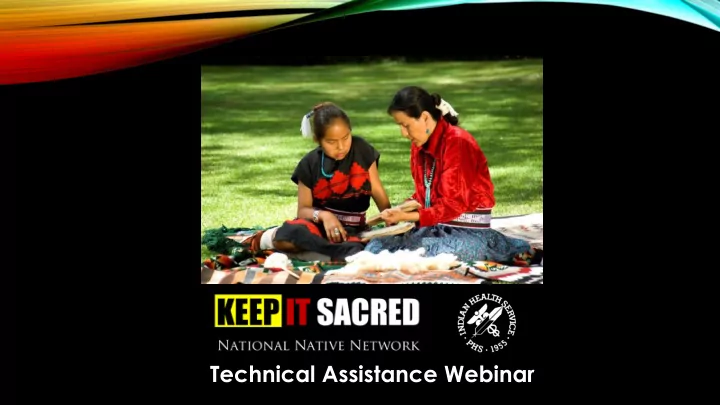
Technical Assistance Webinar
SLIDE 2 Running Medicine: A mind, body and spirit approach to wellness
Anthony Fleg Running Medicine Director, UNM Assoc. Prof. Native Health Initiative 2008 – MD – UNC Chapel Hill 2008 – MPH – UNC Chapel Hill
SLIDE 3 Anthony Fleg Running Medicine Director, UNM Assoc. Prof. Native Health Initiative Anthony is a family physician who believes in the healing power of movement and
- exercise. With this, he created “Running Medicine” in 2016, a unique, culturally-
grounded approach to mind, body, and spirit wellness.
Running Medicine: A mind, body and spirit approach to wellness
SLIDE 4
- Funding for this webinar was made possible by the Centers for
Disease Control and Prevention DP18-1808 Consortium of Networks to Impact Populations Experiencing Tobacco-Related and Cancer Health Disparities grant. Webinar contents do not necessarily represent the official views of the Centers for Disease Control and Prevention.
- No commercial interest support was used to fund this activity.
Faculty Disclosure Statement
SLIDE 5 The Indian Health Service (IHS) Clinical Support Center is accredited by the Accreditation Council for Continuing Medical Education (ACCME) to provide continuing medical education for physicians. The IHS Clinical Support Center designates this live activity for 1 hour of AMA PRA Category 1 Credit™ for each hour of participation. Physicians should claim
- nly the credit commensurate with the extent of their participation in the
activity. The Indian Health Service Clinical Support Center is accredited with distinction as a provider of continuing nursing education by the American Nurses Credentialing Center’s Commission on Accreditation. This activity is designated 1.0 contact hour for each hour of participation.
Accreditation
SLIDE 6
- Continuing Education guidelines require that the attendance
- f all who participate be properly documented.
- To obtain a certificate of continuing education, you must be
registered for the course, participate in the webinar in its entirety, and submit a completed post-webinar survey.
- The post-webinar survey will be emailed to you after the
completion of the course.
- Certificates will be mailed to participants within four weeks by
the Indian Health Service Clinical Support Center.
CE Evaluation and Certificate
SLIDE 7 By the end of this webinar, participants will be able to:
- 1. Employ aspects of a successful walking/running program in Indigenous communities.
- 2. Integrate increased self-efficacy toward getting patients and communities exercising.
Learning Objectives/Outcomes
SLIDE 8
Mind/body/spirit wellness through running and walking
Anthony Fleg, Native Health Initiative afleg@salud.unm.edu
SLIDE 10
SLIDE 11 MY DILEMMA
- I am someone who moves
- I can’t get my patients to move often enough
SLIDE 12 THE BIGGER PICTURE
- We spend far too little time, attention and resources working
- n upstream causes and their solutions when it comes to
chronic disease
SLIDE 13
THE BIGGER PICTURE
Example: Obesity/Overweight and Cancer à Obesity/overweight are significant risks for every type of cancer à Obesity/overweight rates continue to climb in Indian Country and in every state of the United States
SLIDE 14 THE BIGGER PICTURE
- A population-based study using BMI and cancer incidence data from the GLOBOCAN project
estimated that, in 2012 in the United States, about 28,000 new cases of cancer in men (3.5%) and 72,000 in women (9.5%) were due to overweight or obesity. (www.cancer.gov)
- A 2016 study summarizing worldwide estimates of the fractions of different cancers
attributable to overweight/obesity reported that, compared with other countries, the United States had the highest fractions attributable to overweight/obesity for colorectal cancer, pancreatic cancer, and postmenopausal breast cancer. (www.cancer.gov)
SLIDE 15
THE BIGGER PICTURE
Example: Inactivity and Cancer à Strong evidence showing reduced risk of cancer and improved survival for those with cancer with increased activity
SLIDE 16 THE BIGGER PICTURE
- Meta-analyses show that regular physical activity decreased risk of colorectal,
breast and cervical cancer by 12-24%
- A large cohort study found that women who exercised moderately (the
equivalent of walking 3 to 5 hours per week at an average pace) after a breast cancer diagnosis had approximately 40% to 50% lower risks of breast cancer recurrence, death from breast cancer, and death from any cause compared with more sedentary women. (www.cancer.gov)
SLIDE 17 THE BIGGER PICTURE
- With Native American families and communities, many factors
predispose to living sicker and dying younger
SLIDE 18 THE BIGGER PICTURE
- Opportunities for low-cost, family-oriented, and culturally-
tailored exercise in Albuquerque for Native Americans did not exist.
SLIDE 19
* COMMUNITY-DRIVEN PARTNERSHIP ADDRESSING HEALTH INEQUITIES THROUGH LOVING SERVICE * WHEN THE IDEA FOR RUNNING MEDICINE AROSE, IT MADE PERFECT SENSE TO LINK IT WITH NHI, USING OUR LOVE- GROUNDED MODEL FOR IMPROVING HEALTH IN INDIGENOUS COMMUNITIES
SLIDE 20
SLIDE 21 RUNNING MEDICINE CREATION STORY
- 12/8/15 –Vision and birthing process
- 1/13/16 - Living room gathering to create vision for RM
- 2/20/16 – Art contest for RM logo won by Nate Smith (jemez/hopi) Feb 2016
- 3/12/16 – the launch
- 2017 – RM groups begin beyond ABQ
- 2018 – Growth in numbers, locations, funding, partners
- 2019 – 550th RM Celebration in ABQ this Saturday, 9/28/19
Funding: lots of great energy, intention and $0
SLIDE 22
SLIDE 23 RUNNING MEDICINE: THROUGH THE EYES OF PARTICIPANTS/LEADERS
https://www.youtube.com/watch?v=F_m7L5lP1hs
SLIDE 24
RUNNING: A CULTURAL STRENGTH/ASSET
SLIDE 25
“Yes, we have historical trauma…but we also have historical gifts…running is one of those gifts”
SLIDE 26 WHO WE ARE
Running Medicine is based on the understanding that running and exercise are beautiful and potent medicines for mind, body, and
- spirit. Formed as a program of the Native Health Initiative (NHI),
- ur vision is to create a culture of wellness through a supportive,
loving community.
SLIDE 27
WHO WE ARE
“Are you all a disease-prevention program? “No, we are a life-promotion program”
Our focus and vision is about a community and culture of wellness, abundance, and on mind, body and spirit health
SLIDE 28 SOME OF THE WAYS WE DESCRIBE RM
- Building community through running and walking
- A wellness program based in fun, family, fitness and culture
- A place for intergenerational play
- Wellness for mind, body, and spirit
- A program of the Native Health Initiative
SLIDE 29
SLIDE 30
MARCH 12, 2016 – IS ANYONE GONNA SHOW UP?
SLIDE 31
MARCH 12, 2016 – IS ANYONE GONNA SHOW UP?
SLIDE 32
TEAM PIC, SPRING 2016
SLIDE 33
SLIDE 34 RM: THE OUTCOMES/NUMBERS
- 500+ people signed up for spring/summer season in ABQ, with
smaller groups in Farmington, Zuni, Nambe’ and Acoma/Laguna
- Through 150+ partners, we can charge $30 for 12 months, giving
$500-700 of value (shirts, race fees, discounted shoes, etc.) in exchange à THE POWER OF “WE”
SLIDE 35 RM: THE OUTCOMES/NUMBERS
- Greater than 90% of participants state that RM is effective at
improving their mental, physical and spiritual health.
- One of the greatest reasons people report joining RM is for the
social support and our incorporation of Indigenous culture into a wellness program
SLIDE 36
SLIDE 37 CHALLENGES
- Support of the medical community – “You want me to refer patients
to go walk/run???”
- Data collection in Indigenous settings
- Life as a clinician, educator and running/movement activist
SLIDE 38
COMPETITIVE YOUTH RACING
SLIDE 39
FOOD IS MEDICINE 6-WEEK SERIES
SLIDE 40
SUPPORTING TRIBAL COMMUNITIES THROUGH OUTREACH/SUPPORT/MINI-GRANTS
SLIDE 41
2017 NATIONAL AMERICORPS AWARD “BEST NEW PROGRAM”
SLIDE 42
SEPT 10TH, 2019 – ANNALS OF FAMILY MEDICINE ARTICLE
SLIDE 43
SLIDE 44 LESSONS LEARNED FROM OUR WORK
- Movement is medicine
- Running/walking are great ways to get people to the table
- Rediscovering the sacredness of play…kids are the best teachers of this!
SLIDE 45 LESSONS LEARNED FROM OUR WORK
- Creating an inclusive, loving, and fun environment allows great things to happen
- Keeping the sacred, spiritual, and cultural aspects of movement in everything we
do is critical
SLIDE 46
SLIDE 47 WAYS YOU CAN GET INVOLVED
- RM would be happy to serve as a consultant on your community’s efforts to get
families moving together!
- We will post an application in October for new RM groups who would be
applying to start in 2020
- Feel free to contact me with questions:
Anthony Fleg
afleg@salud.unm.edu
SLIDE 48
SLIDE 49 Wednesday, October 2, 3 pm ET
Food is Medicine: Clinic-Led Food Security Initiatives in Navajo Nation
Presenter: Sonya Shin, MD, MPH Karen Bachman-Carter, MPH, RD CDE, CSOWM Executive Director, Public Health Nutritionist/Diabetes Educator Community Outreach & Northern Navajo Medical Center/IHS Patient Empowerment, Inc. Associate Professor, Harvard Medical School Physician, Gallup Indian Medical Center Learning Objectives/Outcomes By the end of the webinar, participants will be able to:
- 1. Utilize the IHS Food Insecurity Screening Questionnaire to identify at-risk populations.
- 2. Apply cross-sectorial initiatives to address food insecurity and improve health outcomes in local community.
- 3. Employ community-clinic inter-professional teams to address health equity through social determinants of health.
Details and registration here: http://keepitsacred.itcmi.org/2019/08/food-is-medicine-clinic-led-food-security-initiatives-in-navajo-nation/
SLIDE 50
Facebook.com/KeepItSacred
Follow National Native Network Online
Twitter.com/KeepItSacred LinkedIn.com/company/KeepItSacred
KeepItSacred.org
Instagram.com/NNNKeepItSacred