Teaching Frankenstein & Brave New World in the Context of - - PowerPoint PPT Presentation

teaching frankenstein amp brave new world in the context
SMART_READER_LITE
LIVE PREVIEW

Teaching Frankenstein & Brave New World in the Context of - - PowerPoint PPT Presentation

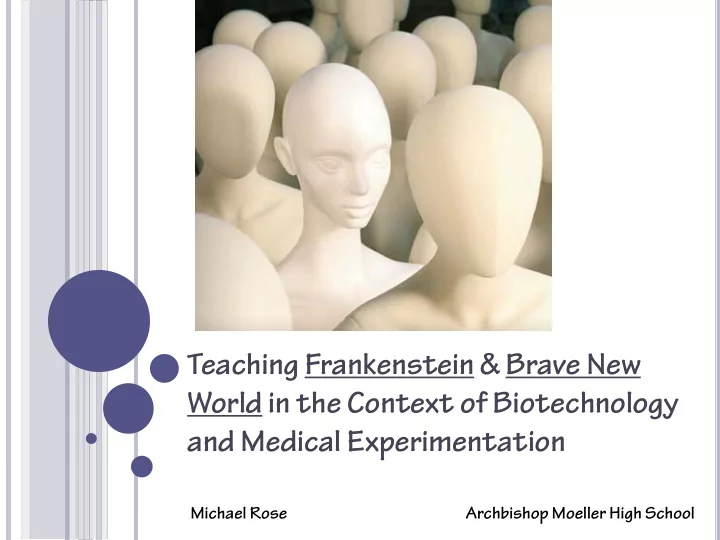
Teaching Frankenstein & Brave New World in the Context of Biotechnology and Medical Experimentation Michael Rose Archbishop Moeller High School C LASS G OALS To understand the literary

slide-1
SLIDE 1

Teaching Frankenstein & Brave New World in the Context of Biotechnology and Medical Experimentation

Michael Rose Archbishop Moeller High School

slide-2
SLIDE 2

CLASS GOALS

1.

To understand the literary themes of these novels.

2.

To make connections between these novels and contemporary issues.

3.

To understand the underlying moral and ethical considerations of contemporary biotechnology and medical experimentation

4.

To learn how to compose an effective argumentative essay

5.

To learn how to synthesize the ideas of others into an effective research paper.

1

slide-3
SLIDE 3

FRANKENSTEIN BY MARY SHELLEY

Known as the first science

fiction novel

One of the first modern

horror novels – monster icon

One of the most famous

Gothic novels – supernatural

An enduring cautionary tale

  • f science gone wrong.

1

slide-4
SLIDE 4

THE MODERN PROMETHEUS

Prometheus: Greek titan

entrusted with the task of moulding mankind out of clay. (Later punished for stealing fire from Zeus to assist his creation – eagle pecks his liver out daily)

Modern parable that man

should not attempt to play God, and should he try, his creations will turn upon him.

1

slide-5
SLIDE 5

VICTOR FRANKENSTEIN

Protagonist and eldest son of

the Swiss Frankensteins

Narrator of most of story Has thirst for knowledge and

“soaring ambition” to leave his mark on human history.

Discovers the “secret to life”

while studying at Ingolstadt

Decides to build a new race of

men – better, faster, stronger

1

slide-6
SLIDE 6

THE DAEMON (MONSTER)

Hideous-looking creature

created by Frankenstein

Originally kind and sensitive, he

wants nothing more than to be loved and accepted.

Rejected by Victor and by

everyone else

Becomes embittered and

embarks on revenge.

Turns against his creator and

destroys him and his family

1

slide-7
SLIDE 7

CENTRAL THEMES

Cautionary Tale: Man should

not attempt to play God; and should he try, his creations will turn upon him.

Actions often have

unintended consequences: Blinded by visions of glory for themselves, both Frankenstein and Walton fail to consider the consequences

  • f their actions

1

slide-8
SLIDE 8

CONTEMPORARY ISSUES

Modern scientific experimentation provides many parallels to Frankenstein. Group research on:

Human Cloning Genetic Engineering & Transgenic Life Forms Test-Tube Babies/Designer Babies Transhumanism & Posthumanism Selective Reduction Eugenics Animal-Human Hybrids (Chimeras) Embryonic Beauty Treatments Organ Harvesting

1

slide-9
SLIDE 9

GROUP RESEARCH CRITERIA

The written, oral, and visual parts address: Definition: Begin by defining exactly what your

issue is, what is involved, and who is involved.

Rationale: explain why researchers, scientists,

doctors (or whoever else) are interested in pursuing this type of Promethean work. In other words, what do they hope to accomplish with their work/research.

Ethics: Explain the ethical, moral, and legal issues

that are involved with your issue. Include what the Catechism of the Catholic Church has to say about your issue – either specifically or in general when dealing with biotechnology or medical research.

1

slide-10
SLIDE 10

GROUP RESEARCH CRITERIA

Pros and Cons: Explain the benefits of your

issue and the drawbacks.

Unintended Consequences: What are some of

unintended consequences that have occurred

  • r some unintended consequences that could

possibly occur due to work on this issue? (Real or imagined)

Your Issue in Literature: How is your issue

related to Frankenstein? Is it the subject of any novels, stories, or plays? Explain!

Your Stance: After doing your research, what

conclusions do you reach about the issue? Is it moral, ethical? Should it be legal? Illegal? Should it be regulated by the government? Should it be abandoned?

1

slide-11
SLIDE 11

BODIES… THE EXHIBITION

1.

Introduction to the “argumentative essay”

2.

Introduction to synthesizing ideas and research of others in support of your claim.

3.

In-class (50 min) prompt: Should the Cincinnati Museum Center host “Bodies… the Exhibition”?

1

slide-12
SLIDE 12

BODIES… THE ESSAY

Display of 20 unidentified corpses – dissected and posed – obtained from China. Sources:

1.

Museum promo brochure: Pro!!!

2.

Editorial: Con – Freak show!!!

3.

Editorial: Con (Fr. Michael Seger) from “respect for the body”perspective

4.

Enquirer editorial: Pro – from “It inspires debate” therefore it is good

1

slide-13
SLIDE 13

BODIES… THE ISSUES (1)

Issues students should have considered:

  • 1. Questionable background:

Who are these people? How did they die? Why were they not given the dignity of burial?

  • 2. Lack of Consent: The people

donate their bodies to science

  • 3. Human Rights Abuses: How

do we know the Chinese aren’t lying?

1

slide-14
SLIDE 14

BODIES… THE ISSUES (2)

  • 4. Irreverence & Voyeurism:

Bodies being put on public display – not only naked, but with their skin peeled away

  • 5. Spiritual/Moral: Do all people

have a right to a decent burial or cremation, or only people who can be “identified” and “claimed”?

  • 6. Education: Since the purpose
  • f the exhibition is to educate,

does that make it okay?

1

slide-15
SLIDE 15

THE ARGUMENTATIVE ESSAY

Essay should take the form of the classical method of structuring an argument:

  • I. Introduction
  • states claim
  • II. Background
  • III. Lines of Argument
  • evidence in support
  • III. Opposing Views
  • w/ Refutation
  • IV. Conclusion

1

slide-16
SLIDE 16

SAMPLE THESIS STATEMENTS

Although “Bodies” may be unethical, immoral, and an

  • ffense against human dignity as some critics claim, the

exhibition should still be hosted by the Museum Center because of its unique educational value.

The Museum Center should not be hosting “Bodies”

because the exhibition is immoral in its treatment of human corpses and there are a number of much less controversial ways of educating the public about human anatomy and health.

1

slide-17
SLIDE 17

FALLACIES FOLLOW-UP

Great opportunity to follow up with a study of fallacies – errors in argumentation, logic, and reasoning EXAMPLE:

Critics who do not agree with the Bodies Exhibition should

not go to the exhibit, and they should leave everyone else alone.

Same as: Women who don’t believe in abortion shouldn’t

have an abortion, and they should leave other women alone.

Same as: If you don’t believe in slavery, then you don’t have

to own a slave, but you should leave everyone else alone to keep slaves if they like.

1

slide-18
SLIDE 18

THE RESEARCH PAPER

Application of the Argumentative Essay to the Research Paper:

Human Cloning Genetic Engineering Test-Tube Babies/Designer

Babies

Transhumanism & Posthumanism Selective Reduction Eugenics Animal-Human Hybrids

(Chimeras)

Embryonic Beauty Treatments Organ Harvesting

1

slide-19
SLIDE 19

THE RESEARCH PAPER

Informs audience of the issue

and controversy

Convinces them of your stance

  • n that issue.

Refutes opposing viewpoints Your Stance: After doing your

research, what conclusions do you reach about the issue? Is it moral, ethical? Should it be legal? Illegal? Should it be regulated by the government? Should it be abandoned?

1

slide-20
SLIDE 20

BRAVE NEW WORLD

1

slide-21
SLIDE 21

GENRE: DYSTOPIA

Utopia: an ideal society possessing a perfect social and political system Dystopia: a society where the condition of life is extremely bad, as from deprivation,

  • ppression, or terror

Often futuristic Often under the guise of being a

utopia

Often totalitarian

1

slide-22
SLIDE 22

POPULAR DYSTOPIAS

20th century popularity Attempts to put utopian ideals into place resulted in real-life

  • dystopias. Huxley provides a

critique of:

Soviet Communism German Nazism Western Consumerism Modernism (break with history) Technological mass production

3

slide-23
SLIDE 23

BRAVE NEW WORLD (1)

Portrays a society that has

been socially engineered for a mindless happiness.

No need for a totalitarian

state because everyone is so “amused” and entertained by sex and drugs.

Technology drives the culture

and takes away one’s humanity

A critique of consumerism,

technology worship, mass media hypnotism

3

slide-24
SLIDE 24

BRAVE NEW WORLD (2)

Human beings are treated like

different model cars trundling

  • ff the Ford assembly line.

Babies are bred in bottles for

designated roles in society comparable

The family is seen as

unnecessary and revolting. What Victor Frankenstein did with “natural science” the BNW government is doing with technology and biotech.

3

slide-25
SLIDE 25

THE CASTE SYSTEM

Seeks to create maximum

happiness for everyone.

Achieved through conditioning.

Everyone is happy to belong to his/her caste.

The caste system is needed to

cover every little part of processes that form the society, to make it one whole.

Conditioning makes every

single person feel happy and thus creates a more efficient society.

5 Alpha, Beta, Gamma, Delta, Epsilon

slide-26
SLIDE 26

DESIGNER BABIES

Babies are not born and have

no “live parents”

Women’s eggs (ova) are

harvested for use in “fertilizing rooms”

Babies are assembly line

products developed to specs

  • f caste in labs.

They are all “decanted” in a

Hatchery and Conditioning Centre.

9

slide-27
SLIDE 27

BNW COMMUNISM

Each individual has no freedom

  • r liberties due to being

“predestined” and “conditioned”

No choice of job, housing,

transportation, social life

Everyone has an “inescapable

social destiny.”

Children brought up in “State

Conditioning Centers” instead

  • f in families.
slide-28
SLIDE 28

THE DYSTOPIAN IMAGINATION

The ultimate target of Huxley’s dystopia was the idea of the good life as instant gratification of sensory desires.

It means: “I get what I want when I want it.” When I am hungry I eat what I want. When I feel ill, I can instantly feel better through drugs. When I want something, I can buy it and get it NOW.

slide-29
SLIDE 29

OVERALL RESULTS

1.

Students learned about literary themes that connect with contemporary concerns.

2.

They learned about the failed utopia movements of the 20th century

3.

They learned that the body and the human person should be respected

4.

They learned that “playing God” leads to harmful unintended consequences.”

5.

They learned HOW to research a topic, to formulate a strong claim, to synthesize material to support it.

1

Critical Thinking