TCEQ 1 TCEQ Path to Air Permit Decision Introductions Acronyms - - PowerPoint PPT Presentation

tceq
SMART_READER_LITE
LIVE PREVIEW

TCEQ 1 TCEQ Path to Air Permit Decision Introductions Acronyms - - PowerPoint PPT Presentation

TCEQs Path to Air Permit Decision Vulcan Citizens TCEQ 1 TCEQ Path to Air Permit Decision Introductions Acronyms Where are we TODAY? Whats Next? SOAH Preliminary Hearing Procedures Legal Representation Call to


slide-1
SLIDE 1

TCEQ’s Path to Air Permit Decision

1
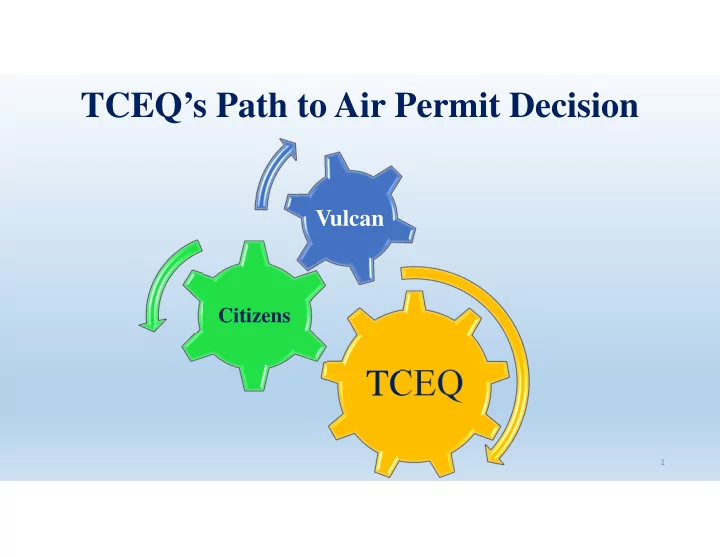
TCEQ

Citizens

Vulcan

slide-2
SLIDE 2

TCEQ Path to Air Permit Decision

  • Introductions
  • Acronyms
  • Where are we TODAY?
  • What’s Next?
  • SOAH Preliminary Hearing Procedures
  • Legal Representation
  • Call to Action & More 1:1 Trainings
  • Definitions
  • Questions and Answers

2

slide-3
SLIDE 3

Acronyms

  • Response to Comments (RTC):
  • Direct Referral
  • Contested Case Hearing (CCH):
  • Affected Persons (AP):
  • Preliminary Hearing
  • State Office of Administrative Hearings (SOAH):
  • Administrative Law Judge (ALJ):
  • Office of Public Interest Council (OPIC)

3

slide-4
SLIDE 4

Where are we NOW? Key ‘Estimated’ Dates

4

As of 8/22/18:

  • Status shows RTC referred to legal on 6/20/18

As of TODAY- 8/23/18

  • RTC mailed to all commenters. This is ONLY an

assumed date for purposes of showing timeframes

  • Daily review of project status
  • September 22nd due date to:
  • Make a CCH request (see template)
  • Request to be named AP (see template)
  • November 28th: TCEQ Commissioner Hearing
  • February 5, 2019: SOAH Preliminary Hearing
  • Week of June 3, 2019. Actual CCH
  • August 2, 2019: SOAH Judge Decision Rendered
  • September 2, 2019: SOAH makes recommendations &

Commissioners issue final decision

slide-5
SLIDE 5

5

slide-6
SLIDE 6

Scenario 1: Applicant DOES NOT file for ‘direct referral’ to SOAH prior to ‘release’ of RTC ALL DATES ARE TENTATIVE AND BASED ON PRESUMPTION THAT ‘RTC’ IS SENT OUT BY 8/23/18

6

slide-7
SLIDE 7

Scenario 2: Applicant DOES file for ‘direct referral’ to SOAH prior to ‘release’ of RTC ALL DATES ARE TENTATIVE AND BASED ON PRESUMPTION THAT ‘RTC’ IS SENT OUT BY 8/23/18

7

slide-8
SLIDE 8

Filing for a CCH and AP status

  • In both scenarios, you and your family need to personally prepare your own

‘personalized’ document requesting a CCH and naming yourselves as AP

  • Do NOT DELAY in preparing. Prepare as if you ONLY have 30 days to make a CCH

and AP request. Start NOW!

  • Requests for contested case hearings must include:
  • the requester’s name, address, and daytime telephone number
  • the permit number (Permit 147392L001) and applicant’s name (Vulcan

Construction Materials)

  • a statement clearly requesting a “contested case hearing”
  • the location of the requester’s home, business, or property that is affected, and its

distance from the proposed facility

  • a detailed explanation of how the requester would be adversely affected by the

proposed facility or activity in a manner not common to the general public

  • a list of all the relevant and material disputed issues of fact, or questions of fact

and law

8

slide-9
SLIDE 9

Filing for a CCH and AP status (cont’d)

  • What is an Affected Party?
  • An affected person is one who has a personal justifiable interest related to a legal right,

duty, privilege, power, or economic interest affected by the application.

  • An interest common to members of the general public does not qualify as a personal

justiciable interest.

  • In determining whether a person is an affected person, all factors shall be considered, including, but

not limited to, the following:

  • (1) whether the interest claimed is one protected by the law under which the application will be

considered;

  • (2) distance restrictions or other limitations imposed by law on the affected interest;
  • (3) whether a reasonable relationship exists between the interest claimed and the activity regulated;
  • (4) likely impact of the regulated activity on the health and safety of the person, and on the use of

property of the person;

  • (5) likely impact of the regulated activity on use of the impacted natural resource by the person;

9

slide-10
SLIDE 10

Filing for a CCH and AP status (cont’d)

  • How do I outline that I am an Affected Party
  • Consider the following: see sample Template
  • Proximity (downstream, within x miles) to applicant’s fence line and rock

crusher

  • Site location on a map and/or using distance markers
  • Address air quality issues and impact on health and quality of life
  • State an interest that is something TCEQ has jurisdiction to protect
  • TCEQ mandated by EPA to follow and enforce permittees to comply with
  • Texas Health and Safety Code
  • Texas Clean Air – Chapter 382
  • Texas Surface Water Quality Standards
  • Check statute and rules applicable to that type of permit (there are

differences)

10

slide-11
SLIDE 11

Filing for a CCH and AP status (cont’d)

  • Identify and discuss any and all ‘nuisance’ factors of the permit which will affect

the use and enjoyment of the property and quality of life of the affected person(s)

  • 24/7 operations
  • Noise due to blasting and back up beepers
  • Night lighting – push for compliance with ‘night skies’
  • Water availability when wells pumped dry and have to redrill deeper
  • Water quality concerns, especially as water is rapidly depleted
  • Flooding as the site is located in 100 yr. floodplain, which will be disrupted due to the

‘sponge’ being removed: Land clearing, blasting of limestone structures, removal of limestone structures.

  • Impact of nuisance factors on your ability to enjoy your property: dust in your swimming

pool, dust in your vegetable garden, yard upkeep and maintenance which will disturb settled dust, impact on your livestock and/or horses/bees if you are a beekeeper, impact

  • n your livelihood
  • If you home school and are close to the quarry and/or your children attend a school

which is in the path of 400+ trucks per day traveling up/down FM 3009

11

slide-12
SLIDE 12

What Happens in a Preliminary SOAH Hearing

  • At the preliminary hearing, the ALJ names the parties to the hearing, issues

an order setting the discovery and procedural schedule for the case, and gives the parties an opportunity to discuss settlement

  • At this hearing, the ALJ has the authority to designate as parties to the case

persons whose hearing requests were initially denied by the TCEQ (as long as those persons filed comments).

  • To be designated as a party, you or your representative must appear at the

preliminary hearing. You will be expected to attend so you can explain how you are affected by the application in a way that is different from the general public

12

slide-13
SLIDE 13

What Happens in a Preliminary SOAH Hearing

13

slide-14
SLIDE 14

CALL TO ACTION

14

YOUR CALL TO ACTION

  • RIGHT NOW…start working on your ‘personalized’ request for a CCH

and Affected Party Status

  • Develop 2 -3 key issues that are germane specifically to you and let us

help you identify science, data, rules or regs with which to back it up

  • Write from the heart. YOU CAN DO THIS!

OUR CALL TO ACTION

  • More Training and Help: 1:1 meetings to help you complete your

CCH and AP requests

  • Bulverde Spring Branch Library, 6 – 7:30 pm.
  • Tuesday, August 28th,
  • Thursday, August 30th
  • Tuesday, September 4th
  • Thursday, September 6th
slide-15
SLIDE 15

Key Info To Look Up Project Status

  • Detail of: Air New Source Permit 147392L001
  • For: ROCK CRUSHING PLANT (RN109829721)
  • FROM INTX OF HIGHWAY 46 & FM RD 3009 SITE IS L
  • Permit Status: PENDING
  • Held by: VULCAN CONSTRUCTION MATERIALS LLC

(CN600355465) View 'Issued To' History

  • OWNER OPERATOR Since 06/27/2017 View Compliance History
  • Mailing Address: PO BOX 791550 SAN ANTONIO, TX 78279 -1550

http://www2.tceq.texas.gov/airperm/index.cfm?fuseaction=airpermits.start

  • County: Comal
  • Region: Region 13
  • Action Status: All
  • Dates: 01/01/2017 to today’s date
  • Order by: Company Name

15

slide-16
SLIDE 16

Questions and Answers

16

slide-17
SLIDE 17

Definitions

  • Response to Comments (RTC): After the public comment period closes, the

TCEQ Executive Director (ED) considers all timely filed comments to determine whether any issues that were raised require changes to the preliminary decision or the proposed permit, and prepares a written response to all relevant comments. The ED’s response and decision are sent to the mailing list, including all commenters. This response provides a final 30 -day period* to request a contested case hearing

  • *there is an ‘exception’ to this that could occur in our case called ‘direct

referral’. It will be discussed.

  • State Office of Administrative Hearings (SOAH): an independent agency that

conducts hearings for state agencies

  • Administrative Law Judge (ALJ): presides over the hearing and will consider

evidence in the form of sworn witness testimony and documents presented as exhibits.

17

slide-18
SLIDE 18

Definitions (cont’d)

  • §55.210 Direct Referral The ED or the applicant may file a request with the chief clerk that the application be

sent directly to State Office of Administrative Hearings (SOAH) for a hearing on the application.

  • Usually occurs PRIOR to issuance of RTC. We are checking permit status daily
  • Benefits the Applicant by:
  • Forgoes public’s opportunity to submit a request to be specifically named an affected party. The TCEQ and applicant make the

decision based on public comments already made by the commenters.

  • Commenters are NOT notified that they have been named an affected party prior to preliminary hearing.
  • You only know that you are named an affected party by showing up at the Preliminary Hearting. You don’t show, you are removed

from the list.

  • If not named an affected party at preliminary hearing, you may be given opportunity to present your case to SOAH judge in 3

minutes

  • A decision will be made prior to preliminary hearing concludes
  • By making request for direct referral, it shaves of ~ 30 – 60 days. This process bypasses ability of commenters to make their own

request to be considered an AP, as well as bypasses a determination by the 3 Commissioners to agree/disagree to a CCH and the ED to weigh in on who should be considered an AP based on their personal interest request vs their public comment.

  • Sample language that will be in the Preliminary Hearing letter: the Applicant filed a request for direct referral

to the State Office of Administrative Hearings (SOAH). Therefore, the chief clerk has referred this application directly to SOAH for a hearing on whether the application complies with all applicable statutory and regulatory requirements.

18

slide-19
SLIDE 19

Definitions (cont’d)

  • §80.105. Preliminary Hearing: After the required notice has been issued, the judge

shall convene a preliminary hearing to consider the jurisdiction of the commission

  • ver the proceeding.
  • After the required notice has been issued, the judge shall convene a preliminary

hearing to consider the jurisdiction of the commission over the proceeding, as well as:

  • name the ‘affected parties”
  • If not
  • establish a docket control order designed to complete the proceeding within the maximum

expected duration set by the commission (180 days). The order should include a discovery and procedural schedule including a mechanism for the timely and expeditious resolution of discovery disputes

  • A proposed schedule will have already been established. Some negotiation allowed.

19

slide-20
SLIDE 20

Definitions (cont’d)

  • §55.251 Contested Case Hearing (CCH):
  • A contested case hearing is a legal proceeding similar to a civil trial in state district
  • court. Hearings are conducted by the State Office of Administrative Hearings , or SOAH,

which is an independent agency that conducts hearings for state agencies

  • Requests for Contested Case Hearing
  • The following may request a contested case hearing under this section:
  • (1) the commission = 3 Commissioners;
  • (2) the executive director;
  • (3) the applicant; and
  • (4) “affected persons”, when authorized by law.
  • To help the TCEQ determine the number and scope of issues to be referred to a

hearing, the requester should, to the extent possible, specify any of the ED’s responses to comments by the (#) shown in the RTC, that the requester disputes and the factual basis of the dispute, and also list any disputed issues of law. It is very important that requesters fully explain—in written comments and responses to briefs—their reasons that an application should not be approved.

20

slide-21
SLIDE 21

Definitions (cont’d)

  • Contested Case Hearing (CCH):
  • When an application is referred for a CCH, the TCEQ sends SOAH the administrative

record, which includes the permit application, the ED’s draft permit, and documentation regarding the review of the application and preparation of the draft permit.

  • These documents establish a “prima facie” case, meaning that the draft permit meets all

state and federal legal and technical requirements, and that the permit, if issued, would protect human health and safety, the environment, and physical property.

  • The prima facie case may be rebutted by evidence that demonstrates that at least part of

the draft permit violates a specifically applicable state or federal requirement. If there is such a rebuttal, the applicant and the ED may present additional evidence to support the draft permit.

21

slide-22
SLIDE 22

Definitions (cont’d)

  • §55.203‘Affected Persons’ (AP): An affected person is one who has a

personal justiciable interest related to a legal right, duty, privilege, power, or economic interest affected by the application. An interest common to members of the general public does not qualify as a personal justiciable interest.

  • In determining whether a person is an affected person, all factors shall be considered,

including, but not limited to, the following:

  • (1) whether the interest claimed is one protected by the law under which the application will be

considered;

  • (2) distance restrictions or other limitations imposed by law on the affected interest;
  • (3) whether a reasonable relationship exists between the interest claimed and the activity regulated;
  • (4) likely impact of the regulated activity on the health and safety of the person, and on the use of

property* of the person; (*nuisance factors which will impact the quality of the use of your property)

  • (5) likely impact of the regulated activity on use of the impacted natural resource by the person;

22

slide-23
SLIDE 23

Definitions (cont’d)

  • Office of Public Interest Council (OPIC): Assigned to ‘represent’ the public interest and is an independent party to all agency
  • proceedings. While this office cannot represent any other party, it can provide information to anyone with questions about the legal aspects
  • f the TCEQ's rules, permitting procedures, contested case hearing procedures, and enforcement proceedings.
  • The office's goal is to ensure that all relevant evidence is developed and made part of the record so that the commission may make

informed decisions and issue permits that are protective of human health and the environment.

  • OPIC considers the following:
  • (1) the extent to which the action may impact human health;
  • (2) the extent to which the action may impact environmental quality;
  • (3) the extent to which the action may impact the use and enjoyment of property;
  • (4) the extent to which the action may impact the general populace as a whole, rather than impact an individual private interest; Texas

Commission on Environmental Quality Page 7 Chapter 80 - Contested Case Hearings

  • (5) the extent and significance of interest expressed in public comment by the commission regarding the action;
  • (6) the extent to which the action promotes economic growth and the interests of citizens in the vicinity most likely to be affected by

the action; For our permit, our OPIC assignee is:

Pranjal M. Mehta, Assistant Public Interest Counsel, Office of Public Interest Counsel Pranjal.Mehta@Tceq.Texas.Gov Texas Commission on Environmental Quality P.O. Box 13087, MC-103 Austin, Texas 78711-3087 Direct: 512.239.0574 Fax: 512.239.6377

23