TACOMA M MIXED US USE C CENTERS S STUD UDY Planning Commission - - PowerPoint PPT Presentation

tacoma m mixed us use c centers s stud udy
SMART_READER_LITE
LIVE PREVIEW

TACOMA M MIXED US USE C CENTERS S STUD UDY Planning Commission - - PowerPoint PPT Presentation

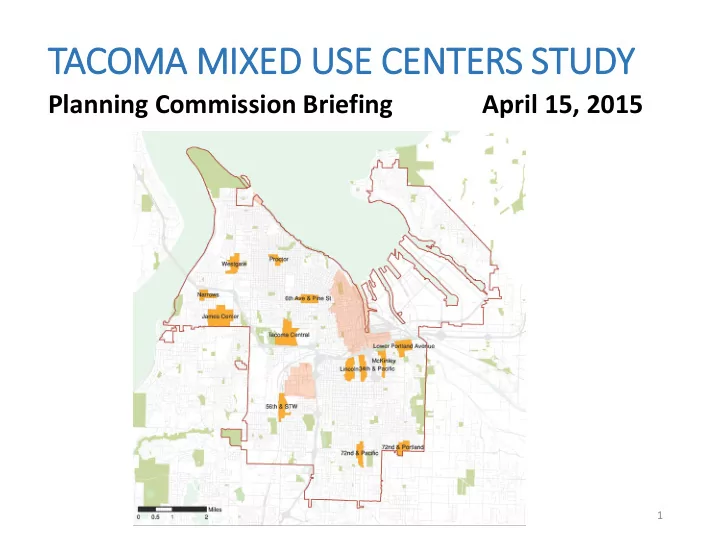
TACOMA M MIXED US USE C CENTERS S STUD UDY Planning Commission Briefing April 15, 2015 1 BAC ACKGROUND ND 2 WHAT IS A MIXED USE CENTER (MUC)? The Comprehensive Plan says: Compact, self-sufficient areas,


slide-1
SLIDE 1

TACOMA M MIXED US USE C CENTERS S STUD UDY

Planning Commission Briefing April 15, 2015

1
slide-2
SLIDE 2

BAC ACKGROUND ND

2

slide-3
SLIDE 3

WHAT IS A “MIXED USE CENTER (MUC)”?

The Comprehensive Plan says:

  • Compact, self-sufficient areas,

identifiable as the focus of the surrounding area

  • Dense, well-integrated variety
  • f development types,

combined in such a way that it is pedestrian-oriented & transit supportive

3

slide-4
SLIDE 4

WHAT MU MUCS ARE WE EVALUATING NG?

4

slide-5
SLIDE 5
  • Neighborhood
  • Crossroads
  • Either one could have a strong

employment component

WHAT KINDS OF MUCS ARE THERE?

5

slide-6
SLIDE 6

Two types of centers NEIGHBORHOOD

Grocery or drug store anchor (Ideally ) community facility or special employment or institutional activity. 3,000 residences w/in ½ mile. As much as 20 acres of commercially zoned land and 200,000 SF of commercial building area. Pedestrian oriented storefronts and streetscape amenities. Safe, comfortable sidewalks Mix of SF and MF residences Oriented on a “main street “ with approx. 7,000 to 10,000 vehicles/day. Good transit service Neighborhood park, school or playground Ideally, at least 12 dwellings/acre to support transit and services

6

slide-7
SLIDE 7

CROSSROADS CENTER

Convenience commercial anchored by grocery/drug and other retail Frequent transit service Larger employer , institutional or entertainment uses Pedestrian friendly new development 64,000 residences w/in 10 minute drive Substantial near-by MF development needed to support transit Good internal & street oriented pedestrian connections Recreational cultural and environmental amenities are critical but often missing Mix of MF & SF residences ¼ mile – 1,000 du with in ½ mile will help support local services if there is a good pedestrian environment 40+ acres of commercial land – 375,000 SF commercial space Arterials with 20,000 + vehicles per day

7

slide-8
SLIDE 8

Why do we care about two categories

  • f centers?
  • To recognize that all centers may not look

alike but they can still function as viable centers.

  • The market, physical conditions, and

development opportunities vary. Therefore redevelopment strategies for the two types vary.

  • To build on the individual assets and

challenges of the individual centers.

8

slide-9
SLIDE 9

EVALUATION

9

slide-10
SLIDE 10

HOW DID WE EVALUATE THE MUCS?

10

slide-11
SLIDE 11

PROF OFILE LE A ANALYSIS R RESULTS S SUM UMMAR ARY

11

slide-12
SLIDE 12

INDIVID IDUAL CENTER RE REDE DEVELOPMENT S STRA RATEGIES

12

slide-13
SLIDE 13

STRATEGIES

STRATEGIES

13

slide-14
SLIDE 14

A THREE PRONGED OVERALL STRATEGY

14

slide-15
SLIDE 15
  • 1. FOCUS ON ONE OR TWO

CENTERS FOR MAXIMUM EFFECT

  • Generally, pick those centers where the

market is emerging and where public efforts would have the most benefit. (old Tier 2 Centers)

  • Lincoln and 56th & South Tacoma Way

have already been selected

  • Think about how to select the next

centers

15

slide-16
SLIDE 16
  • 1. FOCUS ON ONE OR TWO CENTERS

FOR MAXIMUM EFFECT

LINCOLN

16

slide-17
SLIDE 17
  • 1. FOCUS ON ONE OR TWO CENTERS

FOR MAXIMUM EFFECT

  • 1. Initiate a BID or LID to

upgrade streetscapes

  • 2. Revive business promotion

program

  • 3. Initiate residential

neighborhood center program

  • 4. Explore EB-5 funding
  • 5. Extend center east along S

38th St.

LINCOLN

17

slide-18
SLIDE 18
  • 1. FOCUS ON ONE OR TWO CENTERS

FOR MAXIMUM EFFECT

56th & SOUTH TACOMA WAY

18

slide-19
SLIDE 19
  • 1. FOCUS ON ONE OR TWO CENTERS

FOR MAXIMUM EFFECT

  • 1. Install street trees.
  • 2. Improve connections to Star

center.

  • 3. Improve connections to

Multifamily area north of cemetery.

  • 4. Initiate a business

improvement program.

56th & SOUTH TACOMA WAY

Recreation Center Multi-family residences Sounder station Business district Possible connection

¾ Mi

19

slide-20
SLIDE 20
  • 1. FOCUS ON ONE OR TWO CENTERS

FOR MAXIMUM EFFECT

  • 1. According to Council districts
  • 2. Who needs it the most (equity)
  • 3. According to who hasn’t had much attention
  • 4. According to where the $$ would “ have the

most direct and immediate impact on encouraging and achieving the type of development envisioned for the neighborhood centers”.

  • 5. To support local initiatives and investments.

CRITERIA FOR SETTING FUTURE PRIORITIES

20

slide-21
SLIDE 21
  • 2. ADDRESS SPECIAL

OPPORTUNITIES (& NEEDS)

  • Stuff happens that can present special
  • pportunities that make effective use of

public resources.

  • Some MUC’s have special needs that

should be addressed in the short term in

  • rder to build for the long term.
  • Consider MUC’s with special needs.

21

slide-22
SLIDE 22
  • 2. ADDRESS SPECIAL OPPORTUNITIES

34TH & PACIFIC

22

slide-23
SLIDE 23
  • 2. ADDRESS SPECIAL OPPORTUNITIES
  • 1. Improve pedestrian

connections to connect to Lincoln

  • 2. Explore

redevelopment

  • ptions with
  • wners.
  • 3. Ensure that County

building faces

  • utward and

includes a public amenity.

34TH & PACIFIC: Leverage County Const & development opportunities

23

slide-24
SLIDE 24
  • 2. ADDRESS SPECIAL OPPORTUNITIES

JAMES CENTER

24

slide-25
SLIDE 25
  • 2. ADDRESS SPECIAL OPPORTUNITIES
  • 1. Improve

connections to campus.

  • 2. Construct 12th St

bike facilities and 19th St improvements.

  • 3. Encourage

redevelopment of James Center shopping center.

JAMES CENTER - Work with Tacoma Community College for mutual benefit

25

slide-26
SLIDE 26
  • 2. ADDRESS SPECIAL OPPORTUNITIES

NARROWS +

26

slide-27
SLIDE 27
  • 2. ADDRESS SPECIAL OPPORTUNITIES
  • 1. Consider the area

to the east and the larger complex with James Center.

  • 2. Propose an LID to

improve 6th Ave.

NARROWS +: Think of linkages in west Tacoma

About ½ mi radius

NARROWS JAMES

27

slide-28
SLIDE 28
  • 2. ADDRESS SPECIAL OPPORTUNITIES

72nd & PORTLAND

28

slide-29
SLIDE 29
  • 2. ADDRESS SPECIAL OPPORTUNITIES

72nd & PORTLAND

1.Develop a park when a major property develops 2.Work with Covenant Celebration Church to develop over parking 3.Consider annexing nearby properties 4.Require good ped and vehicle circulation of new properties 5.Improve streetscapes

29

slide-30
SLIDE 30

Some Centers may not be ready for new development

30

slide-31
SLIDE 31
  • 3. Realign current programs for

maximum effect

  • Some current programs can be

tweaked to support MUC goals.

  • Programmatic efforts can

address equity

31

slide-32
SLIDE 32
  • 3. Realign current programs for

maximum effect

CAPITAL IMPROVEMENTS

  • Public works has a hard time competing for

grants because they don’t have plans. They need money for design. So maybe allocate $$ for design.

  • Paint Tacoma Beautiful might be a means

to do fix up

  • Pedestrian facility money currently tied to

proximity to facilities.

  • Grants are oriented toward arterials.

Maybe include ped. improvements for safety in grant proposals.

32

slide-33
SLIDE 33
  • 3. Realign current programs for

maximum effect

PARKS, RECREATION AND TRAILS

Several of the MUC’s are deficient in parks, open space, recreation opportunities and trails. This deficiency inhibits new residential development

  • Undertake a planning study to identify most

efficient way to provide for these facilities: new parks, better connections to existing facilities, etc.

  • Target funds to take advantage of
  • pportunities as they arise

33

slide-34
SLIDE 34
  • 3. Realign current programs for

maximum effect

BUSINESS IMPROVEMENTS AND ORGANIZING

  • Use City’s business improvement model.
  • Maybe establish Good Neighbor Fund – low

interest loans for façade improvements?

34

slide-35
SLIDE 35
  • 3. Realign current programs for

maximum effect

HOUSING

  • How can we leverage affordable housing

efforts? Maybe 12 year tax abatement for affordable units?

  • Affordable housing Tool box
  • Community engagement
  • Work with non-profits to identify sites in

centers

  • Housing referral services
  • Development tools

35

slide-36
SLIDE 36
  • 3. Realign current programs for

maximum effect

LOCAL IMPROVEMENT DISTRICTS (LID’S)

  • The schedule for City contribution for LID’s

could be oriented toward MUC’s

  • As a target 50% contribution is a good LID

contribution ratio.

  • Allocate more city matching funds toward

MUC’s and use as an incentive for local business districts.

36

slide-37
SLIDE 37
  • 3. Realign current programs for

maximum effect

OTHER TOOLS AND INCENTIVES TO CONSIDER

  • Parking management assistance
  • Community development corporations
  • Impact Fees
  • CDBG funds for façade improvements
  • Legislative – Tax increment financing,

commercial tax exemption, etc.

37

slide-38
SLIDE 38

A FEW OTHER THOUGHTS

38

slide-39
SLIDE 39

Some comprehensive things to think about

Consider the areas around the centers – and the “corridors” linking the centers.

39

slide-40
SLIDE 40

Some comprehensive things to think about

Reserve some money to match projects initiated by the centers themselves

40

slide-41
SLIDE 41

Some comprehensive things to think about

CONTINUE TO WORK WITH OTHER INSTITUTIONS:

  • Pierce County
  • Tacoma Community

College

  • Pierce Transit
  • Tacoma Public Schools
  • Etc.

41

slide-42
SLIDE 42

FINA NAL T THOU OUGHT

“You can’t hurry love!”

Diana Ross and the Supremes

But you can encourage it, and you need to nurture it

  • ver time.

42