Tablet-based vs. table-top cognitive games for older adults: Which - - PowerPoint PPT Presentation

tablet based vs table top cognitive games for older
SMART_READER_LITE
LIVE PREVIEW

Tablet-based vs. table-top cognitive games for older adults: Which - - PowerPoint PPT Presentation

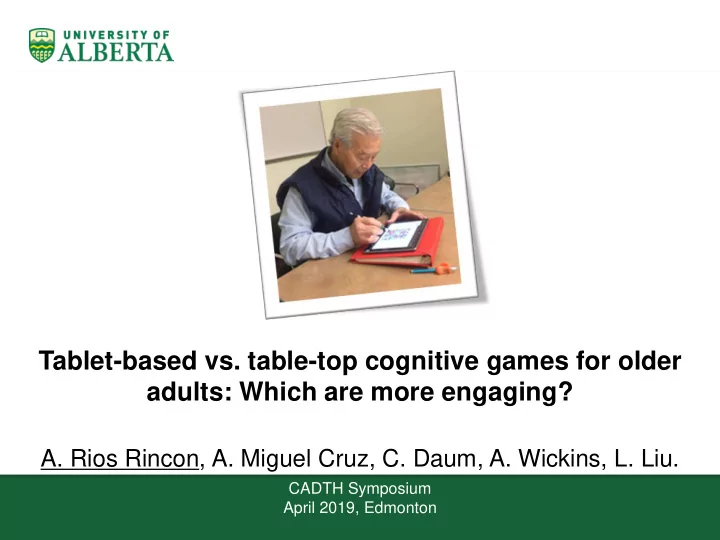
Tablet-based vs. table-top cognitive games for older adults: Which are more engaging? A. Rios Rincon, A. Miguel Cruz, C. Daum, A. Wickins, L. Liu. CADTH Symposium April 2019, Edmonton Disclosure I have no actual or potential conflict of


slide-1
SLIDE 1

CADTH Symposium April 2019, Edmonton

Tablet-based vs. table-top cognitive games for older adults: Which are more engaging?

  • A. Rios Rincon, A. Miguel Cruz, C. Daum, A. Wickins, L. Liu.
slide-2
SLIDE 2

Disclosure

I have no actual or potential conflict of interest in relation to this topic or presentation.

slide-3
SLIDE 3

Several thinking skills such as memory and focus decline in older adults with cognitive impairment or dementia

Source: https://www.remediesforme.com/natural- remedies-improve-memory-focus-concentration/ Source: https://www.carehome.co.uk/news/article.cfm/id/1578909/D ementia-care-home-designed-without-mirrors-reduces- confusion-frustration-and-embarrassment

slide-4
SLIDE 4

Video-game and computerized cognitive training (CCT) improve cognitive functioning in healthy adults

  • Video games and CCT improves several cognitive functions that decline

with aging (Toril et al., 2014).

  • Significant effects on the cognitive functions: nonverbal memory,

verbal memory, working memory, processing speed, and visuospatial skills (Lampit, Hallock and Valenzuela, 2014).

Outcomes Participants Interventions

Older participants (>71 years) improved cognitive functions after training than younger participants (60–70 years) (Toril et al., 2014).

  • A training of ≤6 weeks (Toril et al., 2014).
  • ≤3 sessions per week (Lampit, Hallock and Valenzuela, 2014)
  • Sessions of 30 minutes long or longer (Lampit, Hallock and

Valenzuela, 2014)

  • Group-based interventions (Lampit, Hallock and Valenzuela,

2014).

4
slide-5
SLIDE 5

VibrantMinds

Software by: Guana, Murdoch, Lazar, Liu, Stroulia https://guana.github.io/phydsl/

Whack-a-Mole Bejeweled Word Search Mahjong

slide-6
SLIDE 6

Engagement

  • Critical when doing meaningful activities
  • Immersion or task involvement
  • “player's subjective acceptance of a game's

reality and degree of involvement and focus

  • n the task.” (Roozeboom, Visschedijk, &

Oprins, 2017, p. 85).

6

slide-7
SLIDE 7

Objective

To describe how older adults with and without cognitive impairment engage during tablet- based vs. table-top cognitive games.

7

slide-8
SLIDE 8

2- 5 sessions 16 sessions 1- 3 sessions

Data and Methods

Single Case Design 14 Older Adults No CI 6 Older Adults dementia

Baseline Intervention Follow-Up

slide-9
SLIDE 9

Baseline Intervention Follow-Up

slide-10
SLIDE 10

Cognitive measures

slide-11
SLIDE 11

Cognitive measures

TMT-A MOCA TMT-B

slide-12
SLIDE 12

Sessions

slide-13
SLIDE 13

Each session

slide-14
SLIDE 14

Each session

slide-15
SLIDE 15

Results

15

Variable P3 P15 Age in years 74 83 Female Y Y Diagnosis of cognitive impairment Y N Residential Status Lives in community with partner Retirement home/assisted living Education Level College Diploma Bachelor's Degree Handedness Right Right Technological Literacy (use of computers, tablets, or smartphones) Daily Daily

slide-16
SLIDE 16

Results

16

Participant: P3 PANAS ENGAGEMENT

Forgot glasses // = Missing data

15.7%

slide-17
SLIDE 17

Results

17

Participant: P15 PANAS ENGAGEMENT

5 points 10%

slide-18
SLIDE 18

Conclusion

  • Emotions and engagement increased during the

intervention; however, it was not significant.

  • Measuring engagement in older adults with

dementia is challenging.

  • Tablet-based games provided clear and

immediate feedback  play more independently compared with the table-top games

  • An alternative for people with dementia to

engage in cognitive activities.

18

slide-19
SLIDE 19

Research assistants

Acknowledgments

slide-20
SLIDE 20

Thank you! lili.liu@ualberta.ca aros@ualberta.ca