Topics The Tablet PC: The Tablet PC: Designing Pen- Designing Pen - - PDF document

topics
SMART_READER_LITE
LIVE PREVIEW

Topics The Tablet PC: The Tablet PC: Designing Pen- Designing Pen - - PDF document

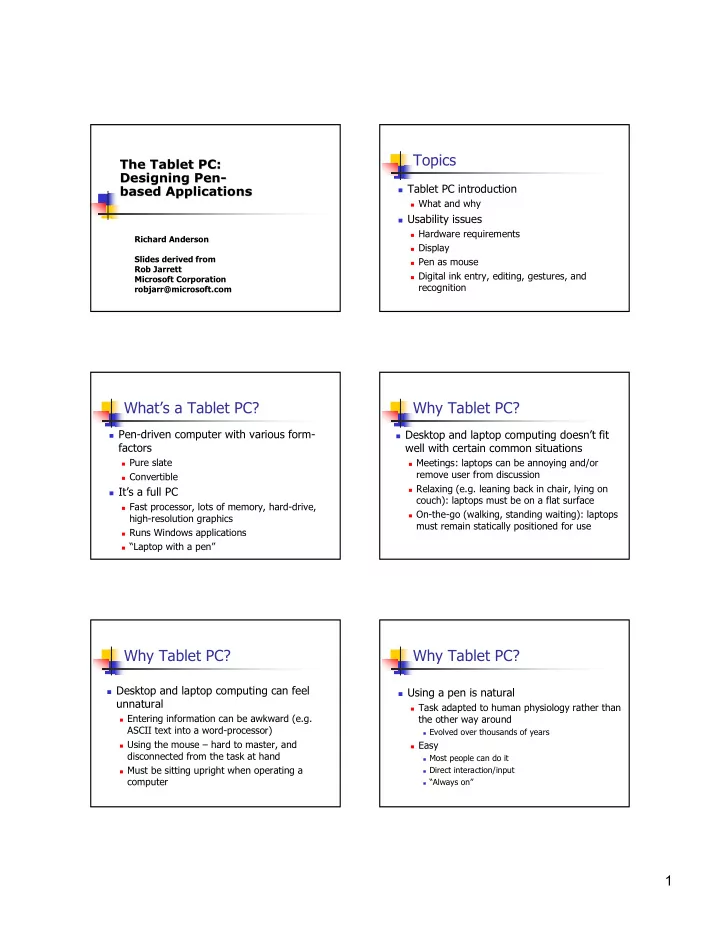
Topics The Tablet PC: The Tablet PC: Designing Pen- Designing Pen - ! Tablet PC introduction based Applications based Applications ! What and why ! Usability issues ! Hardware requirements Richard Anderson ! Display Slides derived from !


slide-1
SLIDE 1

1

Richard Anderson Slides derived from Rob Jarrett Microsoft Corporation robjarr@microsoft.com

The Tablet PC: The Tablet PC: Designing Pen Designing Pen-

  • based Applications

based Applications

Topics

! Tablet PC introduction

! What and why

! Usability issues

! Hardware requirements ! Display ! Pen as mouse ! Digital ink entry, editing, gestures, and

recognition

What’s a Tablet PC?

! Pen-driven computer with various form-

factors

! Pure slate ! Convertible

! It’s a full PC

! Fast processor, lots of memory, hard-drive,

high-resolution graphics

! Runs Windows applications ! “Laptop with a pen”

Why Tablet PC?

! Desktop and laptop computing doesn’t fit

well with certain common situations

! Meetings: laptops can be annoying and/or

remove user from discussion

! Relaxing (e.g. leaning back in chair, lying on

couch): laptops must be on a flat surface

! On-the-go (walking, standing waiting): laptops

must remain statically positioned for use

Why Tablet PC?

! Desktop and laptop computing can feel

unnatural

! Entering information can be awkward (e.g.

ASCII text into a word-processor)

! Using the mouse – hard to master, and

disconnected from the task at hand

! Must be sitting upright when operating a

computer

Why Tablet PC?

! Using a pen is natural

! Task adapted to human physiology rather than

the other way around

! Evolved over thousands of years

! Easy

! Most people can do it ! Direct interaction/input ! “Always on”

slide-2
SLIDE 2

2

Why Tablet PC?

! Ink is a great data type

! Expressive

! Text, graphics, diagrams, etc.

! Personal

! ASCII text is “cold” :-)

! Free-form input

! Write anywhere

Why Tablet PC?

! Hardware finally makes it doable

! Small enough: 8.5” x 11”, under 3 lbs, less

than 1” thick, good battery life

! Cheap enough: shouldn’t cost more than a

nice laptop

! Fast enough: real-time ink, handwriting

recognition

! Software is good enough

! Handwriting recognition doesn’t suck ! “Ink as ink”

Why past efforts failed

!

Hardware was cumbersome

!

Units were slow and heavy

!

Screens were black and white, low resolution

!

Handwriting reco was bad, but the usage paradigm needed it to be great

!

Often, ink was instantly converted to text, making bad reco obvious

!

Usage paradigm was unnatural

!

Conversion to text often required

!

Little use of free-form input

!

Ink “gestures”

Why past efforts failed

! No standard software development

platform

! Low market penetration, tough business

justification for 3rd parties

! Therefore no “killer apps”

! Portable computers were niche

! Networking wasn’t common for PCs ! Tradeoffs were significant in comparison to

today (e.g. screens, upgradability, speed)

What about palm-sized devices?

! Great at what they do

! Contacts, scheduling, jotting down short notes,

etc.

! Saving grace (IMO): synchronization with

desktop PCs

! Form factor is awesome

! Fits in your pocket or hand!

What about palm-sized devices?

! We still have to adapt to them

! Small screens ! “Graffiti” input

! Not good at desktop tasks

! Unsatisfying for web surfing, email

composition, document viewing, etc.

! Syncing is a pain for some ! Peripheral device for many users

slide-3
SLIDE 3

3

Windows XP Tablet PC Edition

! Version 1.0 released November ’02 ! Superset of Windows XP Professional

! Runs all apps XP Pro can

! Culmination of many years of work

! Ink recognition software ! End-user studies ! Learning from the past

! Evolution rather than revolution

Windows XP Tablet PC Edition

!

The goal: the simplicity of paper combined with the power of the PC

!

“Ink as ink” / “Ink as a first-class type”

!

Data lives life as ink

!

Editable, searchable, persistable

!

Natural feel

!

Ink flows out of the pen quickly and smoothly

!

Free-form input

!

Pages of paper instead of infinite canvas

Windows XP Tablet PC Edition

! The goal: the simplicity of paper combined

with the power of the PC (cont’d)

! Using existing (“legacy”) apps with the pen

! Mouse input ! ASCII text input

About the digitizer

! Want accurate ink: looks more “real”, and

has better recognition results

! Therefore need high sampling rate with high

resolution

! Must be low power consumption

! Narrows range of technologies that can be

employed

! Electromagnetic is popular choice, but not

without tradeoffs

About the digitizer

! Pen hovering capability

! Important to connect the user interface with

the pen even when it’s not touching the screen

! Capture other data from pen besides x,y

position

! Pressure, tilt, rotation, roll, etc. ! Great ink and data manipulation

About the digitizer

! Tradeoffs: sensitive to interference

! Hard drive, CPU, battery, and other

components can alter where the digitizer thinks the pen actually is

! Calibration system (i.e. software correction)

helps tremendously, but still not perfect

slide-4
SLIDE 4

4

Display hardware

! User can’t write directly on the LCD surface

! Psychedelic color blooming occurs because of

squishing liquid crystals; very distracting

! Bad for the display

! Solution: glass overlay

! Doesn’t allow any “give” across the display ! Protects the LCD

Display hardware

! Tradeoffs:

! No “give” means it feels unnatural ! Glass is slippery to a hard plastic pen

! Pen skids a little, making writing and targeting a bit

more difficult

! Parallax

! Thickness of glass causes visual disconnect from

ink/cursor/etc. when pen tip touches the display

! These will get better

Pen/stylus design

! Very personal piece of hardware!

! People play with it, chew on it, etc.

! Should be as close to a ballpoint in size

and weight as possible

! Pocket clip is a good thing too, even if people

don’t use it for their pocket

! Needs rugged design

! Most people on the tablet team have broken a

pen because the design was fragile

Pen/stylus design

!

Pen tip

!

Some pens have their tip act as a momentary switch so the digitizer knows when the pen is touching vs. hovering – feels strange

!

Pen button

!

Very useful trigger for non-ink functionality

!

Right-button click, erasing, selection, etc.

!

Some designs are very prone to accidental clicks by users

!

Causes undesirable behavior – very frustrating!

High DPI displays

! Displays are small but high resolution –

increased DPI

! Ink and eBooks look great

! Tradeoff: Legacy apps suffer

! Many hard-coded pixel sizes, meaning text,

icons hard to see

! Targeting areas get smaller ! Can only expect evolution here; platform

makes this a pain today, tomorrow will be easier

Portrait-mode display

! Support portrait mode; just like paper

! Great for web surfing, reading eBooks and

most other document types

! Hot-switch to landscape and back is great for

convertibles

! Tradeoff: Legacy apps suffer

! All written assuming horizontal > vertical

resolution

! Toolbars, menus, etc. can be cut off

slide-5
SLIDE 5

5

Pen as mouse: Hovering

! Hovering still with a pen is tough

! While in-air, our control of a pen is

considerably worse than when the pen is touching a surface

! Mouse is intrinsically static, pen is not ! Legacy applications typically assume cursor

must be perfectly still for e.g. tooltips to appear

! Software help needed to “smooth” hover

location of cursor

Pen as mouse: Hovering guidelines

! Features requiring hover should have

generous tolerances

! For instance, tooltips ! Use COMCTL32 provided ToolBars

! Test hover-triggered features for ease of

use

Pen as mouse: Obstruction

! Viewing obstruction

! Pen is a direct pointing

device and the hand covers screen; mouse does not

! Menus and tooltips

display towards the right

! Most people are right-

handed!

! Lefties have it tough with scrollbars

Pen as mouse: Obstruction guidelines

! Ensure state changes do not occur under the

hand

! Ensure that consequences of actions do not

appear under the hand

! Respect user handedness system setting

! Check SPI_GETMENUDROPALIGNMENT via

SystemParametersInfo()

! Apply it to Tooltips, menus, popup menus

Pen as mouse: Targeting

! Because hovering still with a pen is tough,

targeting is tough

! Operations such as resizing windows, selecting

ASCII text, clicking push buttons, checkboxes, scrollbar buttons, etc. were designed for the mouse

! Downward motion of pen alters x,y location of

cursor

! Very frustrating for users to “miss” ! Software help would have great benefits

Pen as mouse: Clicking

! Clicking with a pen is tough

! Legacy applications typically assume during a

click the mouse doesn’t move

! Pen taps are more like little strokes or stabs

because of pen skidding and high-precision digitizers

! Detecting the difference between tap and a

drag is an interesting problem!

! Double-clicking is even tougher

! Quick motion means sloppier result

slide-6
SLIDE 6

6

Pen as mouse: Pen positioning

!

Pen positioning can be arduous work if UI requires targeting all over the display

!

Mouse can move the cursor far without much arm/hand movement, but the pen requires a lot of arm/hand movement

!

Menus and toolbars are typically at the top of a window; editing often occurs mid-way or toward the bottom

!

Lots of physical arm/hand movement results – a real pain for users

!

More local UI is desirable (e.g. context menus)

Pen as mouse: Targeting guidelines

! Cursor feedback ! Bigger, easily-targeted controls ! Generous tap, double-click, and hover

tolerances

! Keep related objects in proximity

Pen as mouse: Right-clicking

! Need to be able to right-click with the pen

! While not used by majority of Windows users,

still an important capability for backwards compatibility and contextual UI

! Solutions: “Press-and-hold” and pen barrel-

button invocation

! P & H was fairly controversial because some felt it

got in the way

Digital ink realism

! Ink should look smooth

! No “jaggies” -> antialiased ! No straight lines -> curve-fitted

! Use pen pressure information

! Vary stroke width (more pressure means wider

stroke)

! Support pen tips

! Round/ballpoint vs. rectangular/ highlighter

Digital ink performance

! Writing requires uninterrupted inking

! Users have difficulty with delays in ink

appearance

! Users are frustrated with delays in inking

! Guideline

! Ensure fast efficacy ! Is it as fast as writing on paper?

Pen modes & cursors

! Explicit vs. implicit input modes

! A.k.a. Modal vs. modeless

! How to allow things to be efficient but not

confuse users

! Select mode uses “right-mouse button” for

implicit mode as well as utilizing an explicit mode

! Erase mode uses pen’s eraser tip (if available)

for implicit mode as well as utilizing an explicit mode

slide-7
SLIDE 7

7

Pen modes & cursors

! Need feedback as to the mode of the

pen

! Indicates actions available to the user

! Guideline

! Develop a set of cursor feedback to indicate

the different modes of the pen

! Careful attention to cursor design

! Either symmetric or use handedness setting

Pen gestures

!

Gestures need precise tuning

!

Trade-off between accidental activation vs. not getting when wanted

!

False activations are annoying and distracting to the task!

!

Guideline

!

Use gestures guardedly

!

Error on the side of having “zero” incidence

  • f false activation

!

Non-destructive consequences are better

Writing location

! Users have an initial expectation that they

can write digital ink anywhere

! Guideline

! Communicate clearly where users can ink ! Ink enabled controls should be self-evident

Ink selection

! Traditional rectangular selection tools are

inadequate

! “Lasso” selection is much more natural

! Percentage-based stroke tolerances ! Employ word-based selection ! Visual feedback is essential, real-time is much

better than static

Recognition expectations

! Handwriting recognition is highly variable

by person

! Errors are expected ! Perceived good or bad handwriting effects

expectation of accuracy

! Guideline

! Be realistic about recognition accuracy rate,

don’t rely heavily on it for authoring