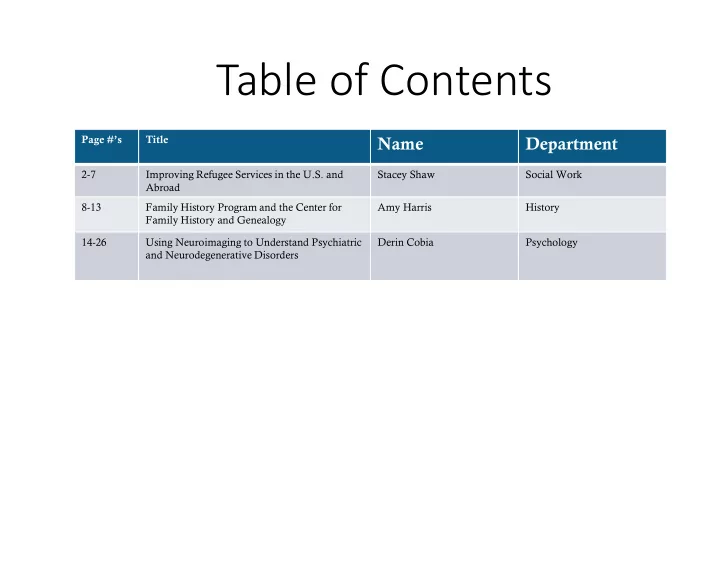
Table of Contents Page #s Title Name Department 2-7 Improving - - PowerPoint PPT Presentation

table of contents
SMART_READER_LITE
LIVE PREVIEW

Table of Contents Page #s Title Name Department 2-7 Improving - - PowerPoint PPT Presentation

Table of Contents Page #s Title Name Department 2-7 Improving Refugee Services in the U.S. and Stacey Shaw Social Work Abroad 8-13 Family History Program and the Center for Amy Harris History Family History and Genealogy 14-26


slide-1
SLIDE 1

Table of Contents

Page #’s Title

Name Department

2-7 Improving Refugee Services in the U.S. and Abroad Stacey Shaw Social Work 8-13 Family History Program and the Center for Family History and Genealogy Amy Harris History 14-26 Using Neuroimaging to Understand Psychiatric and Neurodegenerative Disorders Derin Cobia Psychology

slide-2
SLIDE 2

Improving r refugee s services in the U U.S.

  • S. an

and ab abroad

Stacey Shaw Social Work stacey_shaw@byu.edu Areas of Interest:

Refugee resettlement and mental health, religion/spirituality and health

slide-3
SLIDE 3

Hi, my name is Stacey

slide-4
SLIDE 4

You may have heard…

slide-5
SLIDE 5

Our call to action:

  • We must be careful that news of the refugees’

plight does not somehow become commonplace when the initial shock wears off and yet the wars continue and the families keep coming.

  • each one of us can increase our awareness of the

world events that drive these families from their

  • homes. We must take a stand against intolerance

and advocate respect and understanding across cultures and traditions.

slide-6
SLIDE 6

In progress

  • Group supports for refugees in Malaysia: mental

health, parenting, physical health

  • Building comprehensive, equitable services in the

U.S.

  • Training at camps in Thailand
  • Examining the role of religion in coping/adjustment
slide-7
SLIDE 7

Let’s work together

slide-8
SLIDE 8

Family H Histor

  • ry P

Prog

  • gram a

and t the Cen enter for F Family H History a and Ge Genea ealog

  • gy

Amy Harris History FH Program Coordinator amy.harris@byu.edu (801) 422-6408

Areas of Interest:

Family History, British History, Siblings, Families and Poverty, Women and Gender, Paleography

Jill Crandell History Director for the CFHG jill_crandell@byu.edu (801) 422-2944

Areas of Interest:

Family History, Mormon History, Software Development, Prosopography

slide-9
SLIDE 9

Familyhistory.byu.edu

slide-10
SLIDE 10

Family Hi Histor

  • ry BA

The overall purpose of the BA in family history is to educate students in methodologies and resources used for historical family reconstitution in order to explore, from the perspective of the family, how human societies function and change over time.

https://learningoutcomes.byu.edu

It is meant to prepare students for careers in family history related fields as well as to more broadly understand and appropriately analyze their world with an historical perspective in a manner that spiritually strengthens each student.

slide-11
SLIDE 11

Center r for r Family History and Genealogy

  • Projects
  • Nauvoo Community Project
  • Immigrant Ancestors Project
  • Script Tutorial
  • Bertram Merrell’s Index of English Marriages
  • Welsh Mormon History Project
  • Discovering English Ancestors
  • Family History Companion
  • Faculty involvement and History department support
  • Tenure-track professional faculty member as director
  • Part-time staff member (in addition to student employees)
  • History department faculty as project supervisors and mentors
  • Student employment
  • Over 40 students each semester
  • Donors and internships
  • Provides scholarship money to support 10-15 interns each year – all

internship beyond the Wasatch Front (local internship have other supports)

slide-12
SLIDE 12

Research Grants

https://cfhg.byu.edu/Pages/faculty-research-grants.aspx

slide-13
SLIDE 13

Familyhistory.byu.edu

slide-14
SLIDE 14

Understand Psychiatric and Neurodegenerative Disorders

Derin Cobia, PhD Department of Psychology derin.cobia@gmail.com

Areas of Interest:

  • Neuropsychology, Neuroscience, Psychosis, Dementia
  • Utilizing neuroimaging to study how changes in brain structure and

function influence cognition and behavior

slide-15
SLIDE 15

Neuropsychology

= +

slide-16
SLIDE 16

Neuropsychology

IQ Attention/Concentratio n Processing Speed Language Visuospatial Memory Reasoning

slide-17
SLIDE 17

Neuroimaging

slide-18
SLIDE 18

Cortical Thickness

slide-19
SLIDE 19

1. Large-deformation maps

  • Building atlases
  • Mapping

correspondences through maps 2. Probability laws

  • Computing averages
  • Statistics on maps

3. Inferences

  • Hypothesis testing
  • Classification

Computational Anatomy

Miller (2004), Neuroimage

➡ CA focuses on the

quantitative analysis of shape variability of biological structures

slide-20
SLIDE 20
  • What kinds of anatomical abnormalities exist in individuals

with brain disease?

  • Where? In what way?
  • Do brain differences relate to their clinical and cognitive

presentation?

Questions

slide-21
SLIDE 21

Heterogeneity in Schizophrenia

Cobia et al. (2011) Schiz Research

  • 1.5
  • 1.0
  • 0.5

0.0 0.5 1.0

Z-score

COM NPNN

slide-22
SLIDE 22

Brain Mapping

Cobia et al. (2009), Schiz Research

slide-23
SLIDE 23

Subcortical Shape Characteristics

Rig ht Rig ht Rig ht Rig ht Rig ht Lef t Lef t Lef t Lef t Lef t

View: Anterio r Posterior Superior Inferior Anterior-Lateral

NPI vs COM NPNN vs COM

Inward Deformation Outward Deformation

  • 3.0

3.0 Surface maps of thalamic shape deformations between groups (studentized-t)

  • al. (2011)
slide-24
SLIDE 24

Anterior Posterior Anterior Caudate Pallidum

AFF Inward Deformation AFF Outward Deformation

Putamen Inferior Superior

  • al. (2014)

Basal Ganglia

slide-25
SLIDE 25

Neurodegenerative Disorders

  • Primary Progressive

Aphasia

  • Language-based

Dementia Syndrome

Mesulam et al. (2009), Arch Neurol

slide-26
SLIDE 26

Clinical Utility

Gottesman and Gould (2003) Am J Psychiatry

Ultimate goal:

  • Biomarkers &

Endophenotypes

  • Associated with illness
  • Heritable
  • Stable trait
  • Co-segregates with

illness in families

  • Found in non-affected

family members