System: Creating a New Social-Science Sub-Field of Global Public - - PowerPoint PPT Presentation

system
SMART_READER_LITE
LIVE PREVIEW

System: Creating a New Social-Science Sub-Field of Global Public - - PowerPoint PPT Presentation

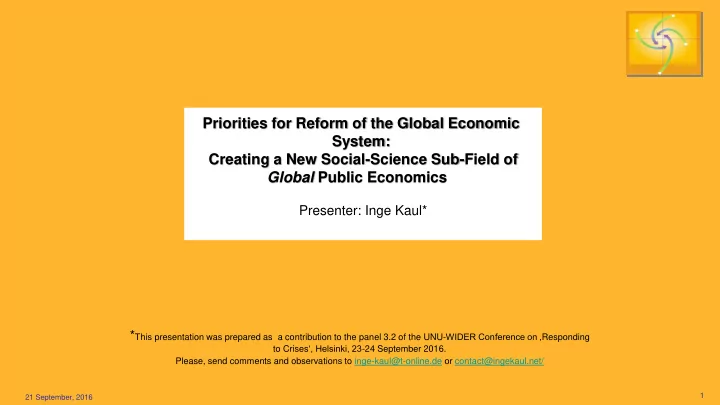
Priorities for Reform of the Global Economic System: Creating a New Social-Science Sub-Field of Global Public Economics Presenter: Inge Kaul* * This presentation was prepared as a contribution to the panel 3.2 of the UNU- WIDER Conference on


slide-1
SLIDE 1

Priorities for Reform of the Global Economic System: Creating a New Social-Science Sub-Field of Global Public Economics

Presenter: Inge Kaul* *This presentation was prepared as a contribution to the panel 3.2 of the UNU-WIDER Conference on ‚Responding

to Crises‘, Helsinki, 23-24 September 2016. Please, send comments and observations to inge-kaul@t-online.de or contact@ingekaul.net/

1 21 September, 2016

slide-2
SLIDE 2

Introduction: Why a focus on creating a new social- science sub-field of global public economics?

  • More and more policy issues today are of a transnational or worldwide reach and possess properties of a

public good (PG). They can be viewed as global public goods (GPGs).

  • Many of these goods are not only global-public in consumption but also in provision, entailing policy

interdependence among states.

  • However, we are still lacking a genuine theory of global public economics, including a well-founded theory of

GPGs.

  • As a result, much of the policy advice offered to policymakers on institutional reform of the global economic

system tends to be backward-oriented and contributing to political stalemate, impeding – rather than facilitating – adequate GPG provision.

  • The purpose of this presentation is: to demonstrate select cases of current academic (social-science) failure;

and to suggest, for further research and debate, possible corrective steps.

  • I will argue that correcting the identified faults/weakness of the theories we tend to employ at present is likely

to change, in significant ways, our views on the institutional reforms that may be required.

  • The main conclusion is that change in global economic governance has to start from the core of the

present system: from a change in the relation between market and states that encourages and enables states to play, nationally and internationally, a stronger role in support of enhanced GPG provision and sustainable global growth and development.

21 September, 2016 2

slide-3
SLIDE 3

Structure of the Presentation

The discussion will proceed as follows:

I Setting the stage: Defining public goods (PGs) and global public goods (GPGs) II Select theoretical and practical-political reform priorities:

Priority 1: Moving from a micro-analytical to a macro-analytical perspective

  • n GPGs

Priority 2: Correcting state failure in the presence of GPGs Priority 3: Recognizing the systemic integrity requirements of GPGs Priority 4: Widening the research and policy focus: from GPGs to global public finance and economics more broadly

Conclusion:

21 September, 2016 3

slide-4
SLIDE 4

I Setting the stage: Defining public goods (PGs) and global public goods (GPGs) I.1 A two-tier definition of PGs:

Definition I: Goods have a special potential for being public if they have non-excludable, nonrival properties or both. Definition II: Goods are de facto public, available for all to consume, if they are non-exclusive.

Source: Kaul and Mendoza, in: Providing Global Public Goods (2003)

21 September, 2016 4

slide-5
SLIDE 5

I Setting the stage (cont.)

Figure 1: The public-private continuum

Source: Kaul et al. (2016) 21 September, 2016 5

slide-6
SLIDE 6

I Setting the stage (cont.)

I.2 Defining GPGs

  • GPGs are marked by publicness in consumption that meets one or more of the following

criteria:

  • It spans several geographic regions or the global as a whole;
  • It stretches across several generations and has long-lasting, possibly even irreversible impact;
  • It penetrates into countries, areas beyond national jurisdiction, or both.
  • GPGs may also be marked by publicness in provision that entails policy interdependence

among states: In these cases nations cannot unilaterally change the goods‘ provision status (form or level) but need to seek the cooperation of others, if they wish to do so.*

Note: Policy interdependence may in fact be given in most GPG cases, viz. all those that abide by summation and weak-link aggregation technologies and, even, in the case of some best-shot goods.

Souce: Kaul et al. (2016)

21 September, 2016 6

slide-7
SLIDE 7
  • I. 2 cont.

Figure 2 The provision path of a summation-type GPG

Source: Kaul et al. (2016)

21 September, 2016 7

slide-8
SLIDE 8

II Select theoretical and institutional reform priorities:

Priority 1: Moving from a micro-analytical to a macro-analytical perspective on GPGs

A recent literature survey* has shown that most of the current studies on GPG-type challenges adopt a very narrow research focus. These micro-analyses of particular policy interventions in global challenge areas can be grouped as follows, based on the policymaking arena/event on which they focus:

  • Multilateral cooperation initiatives among state actors at the international/interregional-level
  • International club arrangements, notably voluntary arrangements among a small number of like-minded states
  • Regional interventions addressing regional initiatives as stepping stones towards meeting global challenges
  • National-level interventions, including follow-up to international agreements taken by central/federal-level government entities
  • Voluntary local community initiatives of potential relevance to a global challenges (e.g. the E. Ostrom-type case studies)
  • Private sector initiatives, e.g. self-regulation and GPG-related CSR
  • Voluntary individual contributions, including, for example, contributions by individual actors to open software development

Only a limited number of studies discusses issues of how to link the interventions that may be required at various politico-administrative levels; and even fewer studies place the good itself at the centre of the analysis and explore what it would take to foster ist adequate provision, given today‘s policymaking realities.

* Kaul et al. (2016)

21 September, 2016 8

slide-9
SLIDE 9

II Select theoretical and institutional reform priorities:

Priority 1: Moving from a micro-analytical to a macro-analytical perspective on GPGs (cont.)

  • Thus, at present, one finds, on the one hand, global governance studies (e.g. IR studies) that examine

governance at the international level, taking today’s political realities into account – but not the full nature of GPGs to be produced; and, on the other hand, one finds many GPG-related studies that take isolated aspects

  • f the good or the good in full into account but not always also the broader policy context.
  • Possible corrective steps: Placing the good itself at the center of the research and related institutional reforms

by:  Rethinking the present organization of the social sciences  Preparing comprehensive and integrated provision path analyses of the GPG being addressed  Recognizing the policy space of the goods’ provision path as a new policy space to be managed  Including into existing governance systems (nationally and internationally) global-issue management as a new governance function  Create a network of global-issue managers/facilitators to share knowledge, information and peer review and monitoring

  • Possible advantage/benefit: A more integrated, transparent, coherent and, perhaps, also efficient and effective

production of the good.

21 September, 2016 9

slide-10
SLIDE 10

II Select theoretical and institutional reform priorities:

Priority 2: Correcting state failure in the presence of GPGs

At present, states’ hesitance to cooperate is often misinterpreted as free-riding:

  • Analysts (those who look at the generally note that the international realm) usually note that, at the international level, the

state, too, is an individual actor and likely to pursue particular national interests that may not overlap with global interests.

  • Thus, in line with conventional standard theory, they assume that states are prone to free-ride. However, mounting evidence

shows that this assumption cannot be generalized. Moreover, as many analysts also assume that (G)PGs are good (in a value sense) for all, they hypothesize that that international cooperation will work where a state or a group of states acts as a

  • leader. They tend to look to the past (e.g. the 1970s) to find confirming evidence. As they tend to exclude the global policy

context from their analytical framework they feel justified to generalize that effective IC requires strong leaders – an argument justifying continuing power politics even under the current conditions of multi-polarity and despite plenty of evidence of political opposition to top-down, ill-fitting policy prescriptions by ‘clubs of the conventional powers’. High levels of abstraction, continued use of largely unproven assumptions (such as the rational choice and free-rider assumptions) and backward-oriented empirical research make it possible. No doubt, some free-riding occurs. But, more than free-riding explains states’ hesitance to cooperate:

  • In many cases, hesitance to cooperate reflects political opposition and is an attempt to avoid the costs of complying with

international agreements that don’t fit states’ circumstances and don’t respond to their priorities – mainly because they didn’t have an effective say in the matter.

  • Another important factor of hesitance is states’ dependence on market actors, notably private financial institutions.

21 September, 2016 10

slide-11
SLIDE 11

II Select theoretical and institutional reform priorities:

Priority 2: Correcting state failure in the presence of GPGs (cont.)

  • Possible corrective steps

 Strengthening the link between theory and empirical research by, for example:

  • Updating the PG theory and clarifying, in the light of today’s policymaking realities, its basic concepts, including the notion of PGs
  • Examining more systematically the reasons for observed hesitance to cooperate on the part of states
  • Clarifying what type of actor the state is nationally and internationally
  • Developing and testing research approaches that combine micro- and macro-analytical approaches in order to capture the complexity of

GPG-type issues to take account of differences among states in terms of preferences, economic and political power

 Exploring institutional innovations that could tip current incentive structures and strengthen states’ willingness to cooperate, including such questions as:

  • What institutional model would best fit international negotiations/cooperation: Would it be fitting to examine international transactions

among states in certain cases as a ‘political market’? If so, what makes these markets fail or work efficiently?

  • How to differentiate and classify international cooperation activities? (e.g. when are they an exchange or ‘trade’; when genuine collective
  • r joint action; when based coercion (sticks or carrots)?
  • In today’s world of multi-polarity, would fairness need to ‘replace’ power politics as a factor that brings about effective cooperation? And if

so, what would be the motivation for fairness: ‘just’ ethical concerns or ‘enlightened self-interest based on the recognition of interdependence?

  • What are the links between process fairness and/or outcome fairness? Can the hypothesis underlying Figure 4 (shown in the next slide)

be empirically proven?

21 September, 2016 11

slide-12
SLIDE 12

II Select theoretical and institutional reform priorities:

Figure 3: The four dimensions

  • f publicness

Source: Kaul et al. (2016)

21 September, 2016 12

slide-13
SLIDE 13

II Select theoretical and institutional reform priorities:

Priority 2: Correcting state failure in the presence of GPGs (cont.)

 Exploring ways and means of breaking the current dependence of states on markets, notably on financial market actors, including ideas like:

  • ‘Helicopter money’ (as suggested by M. Wolf 2016 and R. Skidelsky 2016)
  • Other ways and means of ending the ‘upward pre-distribution’ currently embedded in market rules (R. Reich 2016)

 Formulating a dual-actor (market and state) failure theory And importantly:  Identifying and encouraging (?) possible countervailing forces and ‘tipping points’ that could trigger the suggested changes, most of which would require action on the part of the states, whose hands are largely ‘tied’ today.  Might a possible way forward be encouraging consensus on a norm calling for a ‘responsible exercise of national policymaking sovereignty’, as proposed in the next slide?

  • Advantages likely to result from the proposed corrective steps

Strengthened willingness of states to engage in international cooperation, faster agreements, more effective follow-up, fewer crises and reduced crisis prevention and management costs, enhanced sustainability

21 September, 2016 13

slide-14
SLIDE 14

II Select theoretical and institutional reform priorities:

Priority 2: (cont.) Responsible exercise of national policymaking sovereignty

International cooperation is often seen as undermining states’ policymaking sovereignty. No doubt, it often does; and therefore, governments frequently shy away from a global, concerted policy response, even in issue areas that involve transnational challenges which no single nation can effectively and efficiently address alone. In the absence of a cooperative approach, global challenges will linger unresolved, potentially making all parties worse off. Thus, when confronting challenges that entail policy interdependence, it is often in the enlightened self-interest of all concerned states to offer fair and mutually beneficial cooperation. This requires mutual confidence and trust. Accordingly, there must be a shared commitment among states to act responsibly, both toward their own territories and constituencies – protecting against negative spill-ins from abroad – and toward other states, because non-cooperation could undermine welfare and well-being for all. In other words, exercising responsible sovereignty means pursuing national interests in a way that is fully respectful of both, the sovereignty of other nations and the systemic integrity requirements of GPGs, and, to that end, oriented toward the maintenance of global balances and planetary environmental boundaries. Just as states’ commitment to the norm of collective security strengthens the inviolability of national territorial borders, a commitment to exercising their policymaking sovereignty in a mutually respectful and responsible manner could, in areas of policy interdependence, be the best way to secure their national policymaking capacity. However, a precondition is that international-level decision-making on global challenges is marked by fairness and justice and fostering mutually beneficial policy outcomes.

Source: Kaul (2013), Kaul and Blondin (2015) 21 September, 2016 14

slide-15
SLIDE 15

II Select theoretical and institutional reform priorities:

Priority 3: Recognizing the systemic integrity requirements of GPGs

  • At present, the intersts being considered and taken into account in the decision-making on GPGs are, in large

measure, the interests of states, reflecting those of governments and various non-state-actor constituencies. It is rare to find that decision-making is aimed at meeting the systemic integrity requirements of the GPGs under consideration (e.g. those of the atmosphere, the ocean, financial stability or global equity).

  • The reason (or result) is that, so far, only few ‚gap reports‘ exist, although their number is increasing. Yet, even

in policy fields in which decisive corrective action is an urgent matter, corrective action is often slow and hesitant.

  • The underlying factors are, in large measure those, discussed above, in reference to Priority 2. Therefore, as

long as we live (and prefer to live) in a world of nation states and electoral democracies, there will be a certain risk of policymakers/politicians‘ behavior not only being influenced by bounded rationality but, perhaps, also by free-riding temptations and, hence, underprovision of GPGs.

21 September, 2016 15

slide-16
SLIDE 16

II Select theoretical and institutional reform priorities:

Priority 3: Recognizing the systemic integrity requirements of GPGs (cont.)

  • Possible corrective steps

 Preparing assessments of the systemic integrity requirements of all major GPGs – which, if available, would greatly facilitate the preparation of:

  • Provision path analysis and management, mentioned before (under Priority 1)
  • Cost/benefit analyses, which would be important for decision-makers to have a clearer idea about when and to what extent international

cooperation ‚pays‘ and can be considered to be fair, and

  • Assessments of what constitutes adequate or full provision

 Recognition of the global public domain as a further new global policy space that requires attention, monitoring and the fostering of coherence to avoid ‚conflicts‘ between GPGs (e.g. TRIPS and global health) and to encourage synergy between, for example, the finance system and global equity  Creating a Global Stewardship Council , as outlined in the next slide

  • Possible advantages

More effective and efficient global public policymaking, longer.term sustainability, enhanced inter-generational fairness

21 September, 2016 16

slide-17
SLIDE 17

II

Select theoretical and institutional reform priorities:

Priority 3: (cont.) Creating a global stewardship council

Past experience has shown that intergovernmental bodies tend to be primarily concerned about their national interests rather than about the systemic integrity requirements of GPGs. As regards the global natural commons, notably the challenge of climate change, some progress has been made in terms of keeping these systemic requirements into account. Mention can also be made in this context of the concept of planetary boundaries. However, in many instances, including in the climate field states’ willingness to take corrective action is still for the most part reflecting their national concerns not those of the GPGs that linger in a state of underprovision. This happens even where the costs of inaction are well-documented and the technical and financial means for taking corrective action are available. Therefore, it could perhaps be useful to consider the creation of an independent Global Stewardship Council. The members of such a council could be eminent personalities nominated in their personal capacity as representatives of both: (1) certain GPGs such as the atmosphere, the ocean, financial stability, global equity, the global knowledge stock, and global agreed- upon norms such as the basic human rights; and (2) certain groups of states. However, council members would in both cases be guided not by special, particular interest but by concerns about global social, economic and environmental

  • sustainability. Council members would aim at identifying opportunities for mutually beneficial bargains that might persuade

states and nonstate actors to take faster and more decisive action on unresolved challenges. The Global Stewardship Council would, perhaps, best be located within the United Nations. Initially, it could also be organized

  • utside of the United Nations, as an independent platform.

21 September, 2016 17

slide-18
SLIDE 18

II Select theoretical and institutional reform priorities:

Priority 4: Moving towards a broder theory of global public policy/finance/ economics

  • Priorities 1-3 outline but some select theoretical and instititutional reform steps that could be taken in order to

improve the governance of GPG-type policy challenges. However, other elements of public policy, finance and economics would also need to be re-examined from the perspective of whether they might need modification when placed in a global context.

  • Important suggestions on the issues that may need re-examiniation can be found, among others, in the works
  • f T. Atkinson (2006), IPCC (2014) Sandmo (2015) and Stern (2015).

21 September, 2016 18

slide-19
SLIDE 19

Conclusion

The foregoing discussion suggests that an effective response to the lengthening list of global crises, which we are facing, requires, first of all, that we, social-science scholars, do our part in terms of correcting over-simplified and untested assumptions, as well as updating conventional theories in order to reflect the nature of today‘s policymaking challenges and current policymaking realities. Importantly, the organization of the social sciences has to be rethought, notably the division of sub-disciplines along the foreign/domestic line – beginning with forging agreement on the meaning of ‚global‘ (to end ist equation with inter-national or foreign). Though this presentation has commented on only four possible research and institutional reform priorities, a long list of topics for future research and policy innovation has emerged. A major change to achieve in the field of public economics/PG theory is to place the goods themselves at the center of the analysis and to examine under what conditions different actor groups (state and nonstate) tend to succeed or fail in making their contribution to an adequate supply of these goods. In other words, the state-centric focus of much of the conventional PG theory would need to be widened so that the main focus is on the goods and their provision requirements rather than on the actors‘ interests and preferences, which may or may not be in line with the systemic integrity requirements of the goods. As we saw, such a refocusing of our research and the corresponding rethinking of conventional assumptions and theories would lead us to institutional reform ideas that differ from those we have been propagating to date. Importantly, the foregoing analysis suggests that change in global economic governance has to start from the core of the present system: from a change in the relation between market and states that encourages and enables states to play a stronger role in support of enhanced GPG provision and sustainable global growth and development.

21 September, 2016 19

slide-20
SLIDE 20

References

Atkinson, T. 2006. Global public finance. In: Oxonomics 1: 2-4. IPCC (Intergovernmental Panel on Climate Change). 2014 Kaul, I. 2013. “Meeting Global Challenges; Assessing Governance Readiness.” In: Hertie School of Governance. The Governance Report 2013. Oxford, UK: Oxford University Press. Kaul, I. and D. Blondin. 2015. “Los bienes públicos globales y las Naciones Unidas. In Ocampo, J.A. (ed.). Gobernanza Global Y Desarrollo; Nuevos desafíos y prioridades de la cooperación internacional. Siglo Veintiuno Editores: Buenes Aires. Kaul, I., D. Blondin and N. Nahtigal (2016). Introduction: Understanding Global Public Goods; Where We Are and Where to Next. In: Kaul, I., ed. Global Public Goods. Cheltenham, UK: Edward Elgar. (forthcoming August 2016) Reich, R. B. Saving Capitalism. Vintage Books: New York. Sandmo, A. 2015. The Public Economics of Climate Change. Norwegian School of Economics: Oslo. (available

  • nline)
  • Skidelsky. R. 2016. A tweak to helicopter money will help the economy take off. In: FT, 4 August 2016.

Stern, N. 2015. What Are We Waiting For? MIT Press: Cambridge, Mass. Wolf, M. 2015. The Shifts and The Shocks. Penguin Books.

21 September, 2016 20

slide-21
SLIDE 21

Just published by Edward Elgar

See, for more details (list of contents, overview chapter, contributors, advance praises):

http://www.elgaronline.com/view/Research_Reviews/9781783472994/intro.xml http://www.e-elgar.com/shop/global-public-goods/

21 September, 2016 21

slide-22
SLIDE 22

For more information, see: Edited by Inge Kaul et al. and published by Oxford University Press, 1999 and 2003, respectively. Edited by Inge Kaul and Pedro Conceição, published by Oxford University Press, New York, 2006

21 September, 2016 22

slide-23
SLIDE 23

About the logo:

The defining feature of many policy approaches and tools today is their engagement at the intersection of the public and private and the domestic and foreign policy axes.

Thank you.

*Please, send comments and observations to inge-kaul@t-online.de or via www.ingekaul.net

23 21 September, 2016