SYMPT OM PRESENT AT IONS OF MAJOR DEPR ESSIVE DISOR DER Jhunu - - PDF document

sympt om present at ions of major depr essive disor der
SMART_READER_LITE
LIVE PREVIEW

SYMPT OM PRESENT AT IONS OF MAJOR DEPR ESSIVE DISOR DER Jhunu - - PDF document

Bangladesh Journal of Psychiatry, December, 1995, 8, 2,14 SYMPT OM PRESENT AT IONS OF MAJOR DEPR ESSIVE DISOR DER Jhunu Shamsu n N ahar1 , M SI M ullick2, G u lshan A ra M aliha3 Summary Fifty two patients suffering from major depressive


slide-1
SLIDE 1

Bangladesh Journal of Psychiatry, December, 1995, 8, 2,14

SYMPT OM PRESENT AT IONS OF MAJOR DEPR ESSIVE DISOR DER

Jhunu Shamsu n N ahar1 , M SI M ullick2, G u lshan A ra M aliha3

Summary

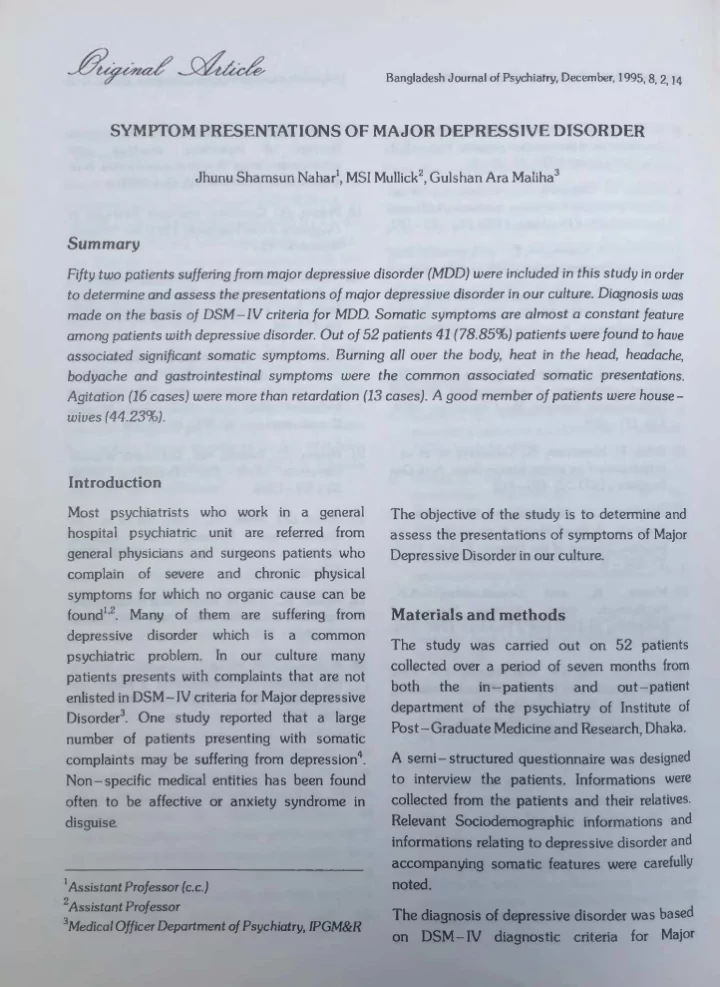
Fifty two patients suffering from major depressive disorder (M DD) were included in this stu dy in order to determine and assess the presentations of major depressive disorder in our culture. Diagnosis was made on the basis of D S M - IV criteria for M DD Somatic sym ptom s are almost a constant feature among patients with depressive disorder. Out of 52 patients 41 (78.85%) patients were found to have associated significant somatic symptoms. Burning all over the body, heat in the head, headache, bodyache and gastrointestinal sym ptom s w ere the common associated somatic presentations. Agitation (16 cases) were more than retardation (13 cases). A good member of patients were house­ wives (44.23%).

Introduction

M ost psychiatrists w ho work in a general hospital psychiatric unit are referred from general physicians and su rgeons patients w ho com plain

  • f

severe and chronic physical sym ptom s for which no organic cau se can b e fou nd1 ,2 . M any o f them are suffering from depressive disorder which is a com m on psychiatric problem. In

  • ur

culture many patients presents with com plaints that are not enlisted in D S M - IV criteria for M ajor depressive D isorder3 . O n e stu dy reported that a large number o f patients presenting with som atic com plaints may b e su ffering from depression4. N o n - s p ecific medical entities has b een fou nd

  • ften to b e a ffective or an xiety syndrom e in

disguise.

1 Assistant Professor (c.c.)

  • Assistant Professor

3 Medical Officer Department of Psychiatry, IPGM&R

Th e ob jective o f the stu dy is to determine and assess the presentations o f sym ptom s of Major D epressive D isorder in our culture.

Materials and methods

Th e stu dy w as carried ou t on 52 patients collected over a period o f seven months from b oth the in - p a tien ts and

  • u t- pa tien t

departm ent o f the p sych ia try o f Institute of P os t- G ra d u a te M edicin e and Research, Dhaka. A s em i- s tru ctu red qu estionnaire w as designed to interview the patients. Inform ations were collected from the patients and their relatives. Releva n t S ociod em ogra p h ic inform ations and inform ations relating to d ep ress ive disorder and a ccom pa n yin g s om a tic fea tu res w ere carefully noted. Th e diagn osis o f depressive disorder w as based

  • n

D S M - IV d ia gn ostic criteria for Major

slide-2
SLIDE 2

Symptom Presentations of Major D epressive Disorder Bangladesh Journal of Psychiatry, December, 1995, 8, 2,15

D epressive D isorder. Th e data w ere presented in tabu lation form and statistical analysis was done where required.

Results:

A m on g the 52 patients under stu dy 41 patients w ere fou nd to have associated som atic sym ptom s (Tab le No. 3a). This finding is Table No. I: Socio-demographic characteristics of the patients Cha racteristics N o.

%

A ge 15- 24 4 7.70 2 5 - 3 4 14 26.92 3 5 - 4 4 16 30.76 4 5 - 5 4 13 25.00 5 5 - 6 4 5 9.62

Mean = 39.69 (SD = 1L02) yrs Range = 1 9 - 6 0 yrs

patients w ere from 19 yrs to 60 yrs with mean age 39.69 years. Tw enty seven patients w ere fem ale and 25 patients w ere male and the male fem ale ratio w as

  • 1:1.08.

Tw enty three (44.23% ) patients ou t o f 52 w ere hou sew ives (Tab le N o. 1). Tab le No. 2 show s the D S M - IV criteria for M ajor D epressive D isorder (M D D ). A ll the the patients fulfilled the D S M - IV criteria for MD D . Agitation was more (16 ca ses) than retardation (13 cases). Tab le N o. 3b show s the a ssocia ted C haracteristics N o.

%

O ccu pation House wife 23 44.23 Business 5 9.60 Service 14 26.92 Retired 3 5.76 Unemployed 2 3.85 Cultivator 2 3.85 Student 3 .76 S ex Edu cation Male 25 48.08 Illiterate 10 19.23 Female 27 51.92 Primary 11 21.15 Secondary 4 7.70 M a le: Female = 1:1.08 S.S.C 5 9.62 H.S.C 11 21.15 M arital status Graduate 8 15.38 Unmarried 9 17.30 Post-gradu ate 3 5.76 Married 39 75.00 S ocia l b ackgrou nd Separated 2 33.85 Urban 35 67.31 Divorced 2 3.85 Rural 17 32.69

slide-3
SLIDE 3

Symptom Presentations of Major D epressive Disorder Bangladesh Journal of Psychiatry, D ecember, 1995, 8, 2,16

Table No. I I : D S M - IV criteria for D epressive present among the patients.

(M ore than one symptom was p r e s e n t ) ___________ ____________

Symptoms _________ N o. o f Patients

a.

h

c. d. f.

9

  • h.

D epressed mood Loss of interest and pleasure W eight loss (no weight gain was reported) L Insomnia

  • ii. Hypersomnia

i. Psychomotor agiatation it Psychomotor retardation Fatigue or loss of energy Feeling of worthlessness and guilt Diminished ability to think concentrate or indecisiveness i Recurrent thoughts of death or recurrent suicidal ideation suicide attempt specific plan for committing suicide

49 49 9 46

2

16 13 41 38 46 32 Table N o. I l l : Patients with associated somatic symptoms. Table N o. Ilia

Somatic symptoms

N q of Patients

% Yes

41 78.85

N o

11 21.15

Total

52 100.00 X2 = 1 7 .3 1 , df= l,P<0.001 Table No. IHb Somatic symptoms

Nq of patients

  • 2. Buring all over the body and heat in head
  • 3. Headahe
  • 4. Gas in Abdomen
  • 5. Bowel disturbance
  • 6. Pain all over the body

7 . Abdominal pain

  • 8. White discharge with urine
  • 9. Sound in ear

3 16 15

8

6 8 2

4 3

(More than one symptom was presenfj

slide-4
SLIDE 4

Symptom Presentations of Major D epressive D isorder Bangladesh Journal of Psychiatry, D ecember, 1995, 8, 2,17

Table No. I V : Treatment received by the patients

Drugs

Nq of patients

Imipramine 20 Fluoxetine 18 Amitriptyline 11 Thioridozine 9 (Some of the patients received more than one drug).

som atic sym ptom s. B u rning all over the body, heat in the head, headache, b odya ch e and ga s tro- in tes tin a l sym p tom s w ere the com m on a ssociated som a tic sym ptom s. Th e patients w ere trea ted with Imipramine, Flu oxetine, Am itriptylin e and Thioridazin e (Tab le N o. 4)

Discussion

Fifty tw o patients su ffering from depressive disorder collected over a period o f seven months from b oth the in - p a tien t and ou t- p a tien t departm ent o f the psychiatry unit o f Institu te of P os t- g ra d u a te M edicine and Research, D haka w ere inclu ded in the present study. O u t of 52 patients 41 patients w ere fou nd to have a ss ocia ted som a tic su m ptom s (w hich is highly significant) like buring sensations, heat in the head, headache, b od y ache and gastrointestinal sym ptom s. A large proportion o f patients w h o consu lts physicians w ith som a tic sym ptom s are su ffering from depressive illness3 ,4 ,5 . O ften patients d o not m ention ab ou t their depressive m ood to doctors. S evera l fa ctors are thought to influ ence this presentation. O n e m ore im portant stigm a is that m entally ill patients b elief that d octors are m ore interested in physical than p sych ologica l com pla in ts6. A p p rop ria te diagnosis is im porta n t b eca u se the b odily sym ptom s are com m on ly u sed as reason for com ing to the doctor. Th e present stu dy findings reveal that som a tic sym ptom s are a lm os t a con s ta n t featu re a m on g patients with depressive disorder. Th is finding is consistent with the findings o f a n oth er stu dy done in our culture b y Karim and M u llick4. O u t o f 52 patients 23 patients w ere hou sew ife. Th is number is qu ite b ig and this is consistent with the fact that the w om en popu lation withou t fu ll- tim e or p a r t- tim e em ploym en t

  • u tside

hom e are m ore vu lnerab le to depression7 . Th e com m on presentaing som a tic featu res w ere bu rning all over the b ody, heat in the head, headache, b od ya ch e and gastrointestinal distu rb ances. Four patients com plaining of w hite discharge w ith urine met the criteria of major depressive disorder. Th is finding is consistent with the findings o f another stu dy where 38.79% patients having w h ite discharge with urine w ere su ffering from depression8. It is know n that depression is tw ice as com m on in w om en than men and fem ale patients u su ally com plain more som atic sym ptom s than male. In

  • ur stu dy male fem a le ratio is 1:1.08. Th is is

m ost prob ab ly due to the fa ct that fem a les are m ore neglected grou p in ou r cou ntry and u su ally avoid hospital or seek treatm ent du e to variou s cultural factors. Psych om otor a gita tion w a s slightly m ore than p sych om otor retardation. Actu ally in

  • u r

culture a m on g depressed patients agitation is m ore than retardation. Patients w ere treated with imipramine, Flu oxetine, Am itriptylin e and Thioridazin e. W e know that thioridazine is very effective in agitated depressed patien ts6 bu t w e cou ld not prescrib e it su fficiently b ecu a se o f its high price. N in e patients ou t o f 16 a gita ted depressed received thioridazine therapy. C o n clu s io n It m ay b e said on the b asis o f the present stu dy that cu ltu re can influ ence the exp erien ce and com m u nication o f sym p tom s o f depression.

slide-5
SLIDE 5

S ym ptom Presentations of M ajor D epressive D isorder B angladesh Jou rnal o f Psychiatry, D ecem b er, 1995, 8, 2,18

U n d erd ia gn os is or m is d ia gn osis ca n b e redu ced b y b eing alert a n d vigila n t to ethnic or cu ltu ral s p ecificity in the p resen tin g com pla in ts o f a M a jor D ep res s ive episode. In s om e cu ltu res d ep ression m a y b e exp erien ced la rgely in s om a tic term s rather than w ith the feelin g o f sadness or guilt. Th e p resen t stu dy findings revea l that the d evelop m en t o f a n ew d ia gn ostic sca le for d ep ress ive d isord er m a y b e very u sefu l in ou r cu ltu re and thus m isdia gn osis and u nderdia gnosis can b e a voided .

  • References
  • 1. Katon, W M

Ries, R. & Kleiman, A. A prospective D S M - M study

  • f

consecutive somatisation

  • patients. Comprehensive Psychiatry, 1984; 25:

3 0 5 - 314.

  • 2. Bridges, K. & G oldberg, D.P. somatic presentation
  • f D S M -II1 psychiatric disorders in primary care

Journal o f Psych osom a tic Research, 1985; 29; 5 6 3 - 569.

  • 3. American

Psychiatric Associa tion . D iagnostic and Statistical manual o f M en ta l D isorders, 4th edition, W eashington D C , 1994.

  • 4. Karim, ME, Mullick M SI, Patterns o f somatic

symptoms in Psychiatric disorders, Th e Hygeia, 1993; 7(2): 8 - 1 3 .

  • 5. Kaplan HI, S adock BJ. S ynopsis o f Psychiatry,

6th edition, M aryland, U S A , W illiams and W ilkins, 1991.

  • 6. Hill P, Murray R, Th orley A. Essentials of Post­

gradu ate Psychiatry, 2nd Edition, London, Grune and Stration Inc. 1986.

  • 7. Brown, G .W . and Harris, T. S ocia l Origins of

D epression. Tavistock, London. 1978.

  • 8. Mullick, MSI., Karim, M E .; Islam, M S, Chowdhury

S, Rahman M, Islam M R; C linical Pattern of Dhat Syndrome, B angladesh medical Journal; 1995; 2 4 :3 - 6 .