Symmetry-Aware Placement of Hydrogens in Molecules: Reduce & - - PowerPoint PPT Presentation
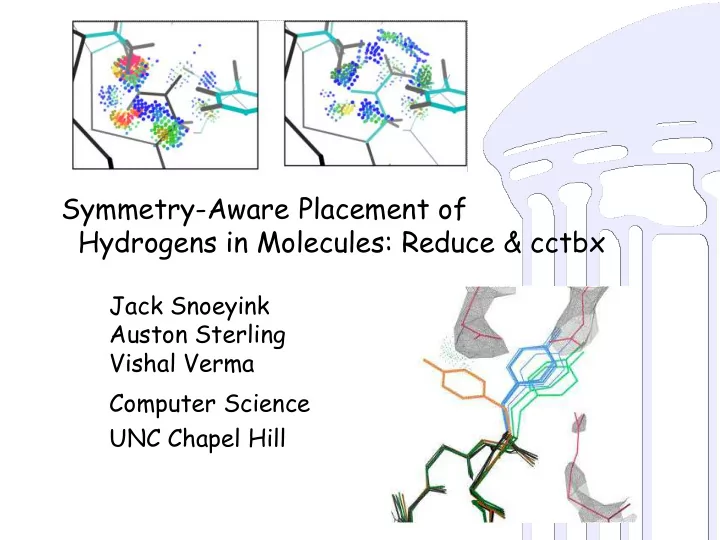
Symmetry-Aware Placement of Hydrogens in Molecules: Reduce & cctbx Jack Snoeyink Auston Sterling Vishal Verma Computer Science UNC Chapel Hill Outline Determining Molecular Structure Why: central dogma How: X-ray
Outline Determining Molecular Structure
- Why: “central dogma”
- How: X-ray crystallography
– Role of symmetry
Structure Validation
- All Atom Contact Analysis: Molprobity
- Hydrogen placement: Reduce
Symmetry-aware Reduce:
- SMP: simple matter of programming
Central Dogma of Biochemistry
Sequence Structure Function
X-ray crystallography to find structure
Sequence Structure Fu
Make crystal X-ray
diffraction
Electron density Backbone threading Rotamer placement Structure Validation
Role of symmetry
Sequence Structure Fu
Of the 230 crystallographic space groups, 91 appear in the Protein Data Bank.
99% coverage by 53 groups 90% coverage by 21 groups
Make crystal X-ray
diffraction
Electron density Backbone threading Rotamer placement Structure Validation
Vocabulary for symmetry (RCSB)
Symmetry group action on Asymmetric unit gives Unit cell. Note: Asymmetric unit has a model; Model need not lie inside it, or inside the unit cell.
Asymmetric unit vs. Biological assembly
Asymmetric unit with portion
- f a biological assembly
Asymmetric unit with
- ne biological assembly
Asymmetric unit multiple biological assemblies Entry 1hho contains half a hemoglobin molecule (2 chains) in the asymmetric unit. A crystallographic two-fold axis generates the other 2 chains. Entry 2hhb contains one hemoglobin molecule (4 chains) in the asymmetric unit. Entry 1hv4 contains two hemoglobin molecules (8 chains) in the asymmetric unit.
X-ray crystallography to find structure
Sequence Structure Fu
Make crystal X-ray
diffraction
Electron density Backbone threading Rotamer placement Structure Validation
Role of symmetry in threading
Coot tutorial:
- Density without
structure may be symmetric copy
- Check: turn on
model symmetry Key point for me:
- for consistency
use their library:
- Comp. Cryst.
Toolbox (cctbx)
All atom contact analysis: Molprobity demo
Reduce: Hydrogen placement by dynamic programming on graphs of small treewidth
- Reduce considers flips & rotations,
which may interact.
- Interaction graphs’ small treewidth
allows fast dynamic programming.
Single model analysis misses “crystal contacts”
- Validation
(Reduce)
- Crystallography
(PHENIX/Coot)
- Protein folding
(Rosetta)
- eg. analysis of Rosetta decoys:
- native
- decoys
- symmetric natives
SymReduce: find neighbors
Q: How should Reduce find its neighbors using the crystallographic symmetries? A: Bucketing…Reduce folds lattice into unit cell; cctbx library folds into asymmetric unit
SymReduce: find neighbors
Copy atoms from the asymmetric unit that lie within an interaction distance limit of the asym. unit. Bucketing must be done in the Euclidean space.
SMP: “simple” matter of programming
- To accommodate candidate H atom positions, we
had to add query (x, y, z) functionality to cctbx;
- therwise we’d need to add/delete-last.
Remaining to do:
- Testing in PHENIX
- Naming convention for output of symmetric copies
- f atoms.
Possible extensions
- Speed up, e.g., queries by batching nearby dots.
- Detect if the “right” symmetry has been specified.
Thanks
- Richardson lab (Molprobity)
- Ralf Grosse-Kunstleve (cctbx)
- PHENIX
- Rosetta Commons
- NIH, NSF