Symbols Lisp was invented to do symbolic processing . S-Expressions - - PowerPoint PPT Presentation

symbols
SMART_READER_LITE
LIVE PREVIEW

Symbols Lisp was invented to do symbolic processing . S-Expressions - - PowerPoint PPT Presentation

Symbols Lisp was invented to do symbolic processing . S-Expressions and Trees A key Racket value is the symbol . The symbol cat is wri<en (quote cat) or 'cat . Symbols are values and so evaluate to themselves. > 'cat 'cat CS251


slide-1
SLIDE 1

S-Expressions and Trees

CS251 Programming Languages

Fall 2017, Lyn Turbak

Department of Computer Science Wellesley College

Symbols

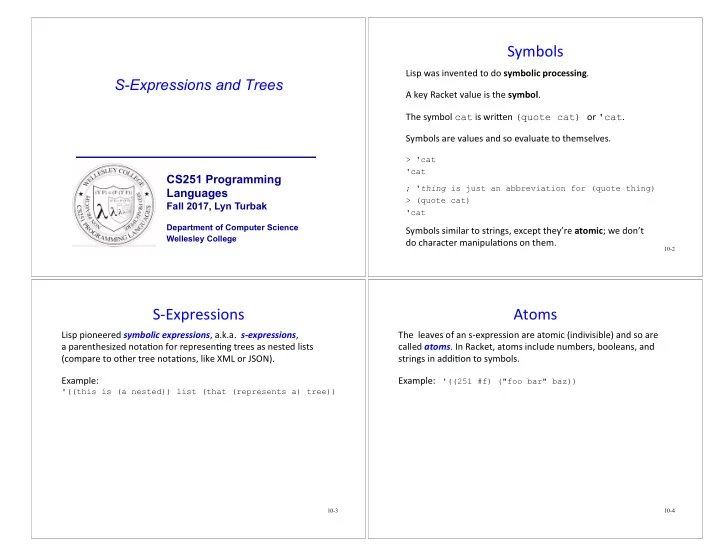
Lisp was invented to do symbolic processing. A key Racket value is the symbol. The symbol cat is wri<en (quote cat) or 'cat. Symbols are values and so evaluate to themselves.

> 'cat 'cat ; 'thing is just an abbreviation for (quote thing) > (quote cat) 'cat

Symbols similar to strings, except they’re atomic; we don’t do character manipulaBons on them.

10-2

S-Expressions

Lisp pioneered symbolic expressions, a.k.a. s-expressions, a parenthesized notaBon for represenBng trees as nested lists (compare to other tree notaBons, like XML or JSON). Example:

'((this is (a nested)) list (that (represents a) tree))

10-3

Atoms

The leaves of an s-expression are atomic (indivisible) and so are called atoms. In Racket, atoms include numbers, booleans, and strings in addiBon to symbols. Example: '((251 #f) ("foo bar" baz))

10-4

slide-2
SLIDE 2

QuotaBon with Atoms and Lists

A quoted atom (quote atom) (abbreviated 'atom) denotes the atom. For atoms that are not symbols, (quote atom) desugars to atom. For example:

  • (quote 251) desugars to 251
  • (quote #t) desugars to #t
  • (quote "Hi there!") desugars to "Hi there!"

A quoted parenthesized structure (quote (...))(abbreviated '(...)) denotes a list, according to the following desugaring: (quote (sexp_1 … sexp_n)) desugars to (list (quote sexp_1) … (quote sexp_n)) Example: What is the desugaring of the following: '((17 foo #f) "bar" (list + (quote quux)))

10-5

A sample s-expression

We will do some exercises with this sample s-expression: (define tr '((a (b c) d) e (((f) g h) i j k))) Draw the tree associated with this s-expression.

10-6

FuncBons on s-expression trees

Write the following funcBons that take an s-expression tree as their only arg:

  • 1. (sexp-num-atoms sexp) returns the number of atoms (leaves) in the s-

expression tree sexp > (sexp-num-atoms tr) 11

  • 2. (sexp-atoms sexp) returns a list of the atoms (leaves) encountered in a

leW-to-right depth first search of the s-expression tree sexp. > (sexp-atoms tr) '(a b c d e f g h i j k)

  • 3. (sexp-height sexp) returns the height of the s-expression tree sexp.

> (sexp-height tr) 4

10-7

An s-expression Read-Eval-Print Loop (REPL)

(define (sexp-repl) (begin (display "Please enter an s-expression:") (let {[(sexp (read)]} ; read prompts user for sexp (if (eq? sexp 'quit) 'done (begin (display (list 'sexp-num-atoms: (sexp-num-atoms sexp))) (newline) (display (list 'sexp-atoms: (sexp-atoms sexp))) (newline) (display (list 'sexp-height: (sexp-height sexp))) (newline) (sexp-repl))))))

10-8

slide-3
SLIDE 3

On to Metaprogramming

10-9

A metaprogram is a program that manipulates another program, such as an interpreter, compiler, type checker, assembler, etc. In a metaprogram, how could we represent a Racket definiBon like this? (define avg (lambda (a b) (/ (+ a b) 2)))