
SLIDE 1
APPENDIX VII Recommended Unit Symbols, SI Prefixes, and Abbreviations
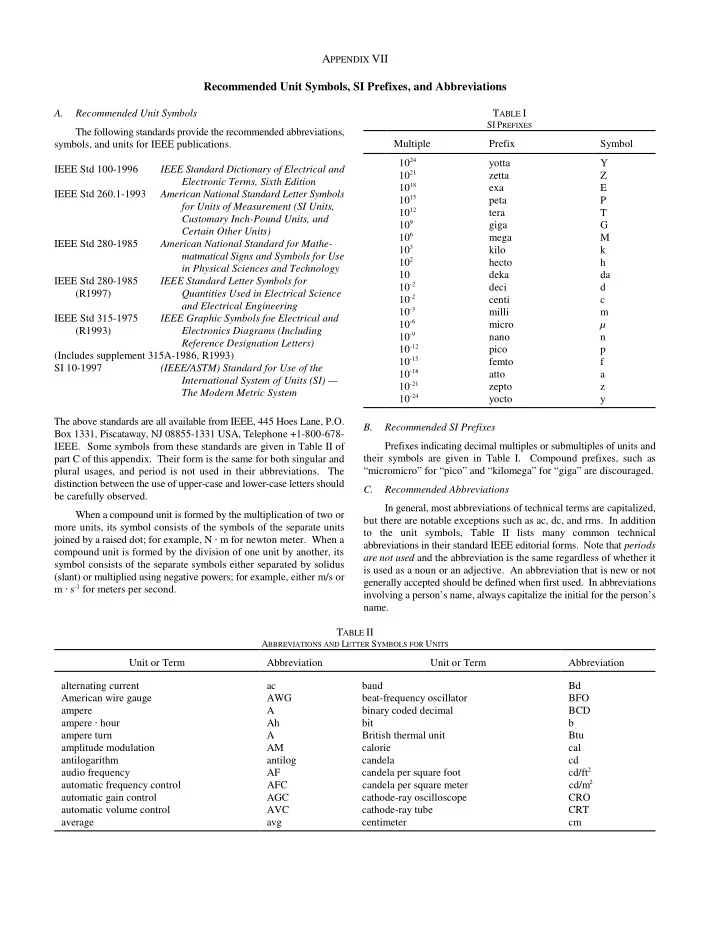
A. Recommended Unit Symbols TABLE I The following standards provide the recommended abbreviations, symbols, and units for IEEE publications. IEEE Std 100-1996 IEEE Standard Dictionary of Electrical and Electronic Terms, Sixth Edition IEEE Std 260.1-1993 American National Standard Letter Symbols for Units of Measurement (SI Units, Customary Inch-Pound Units, and Certain Other Units) IEEE Std 280-1985 American National Standard for Mathe- matmatical Signs and Symbols for Use in Physical Sciences and Technology IEEE Std 280-1985 IEEE Standard Letter Symbols for (R1997) Quantities Used in Electrical Science and Electrical Engineering IEEE Std 315-1975 IEEE Graphic Symbols foe Electrical and (R1993) Electronics Diagrams (Including Reference Designation Letters) (Includes supplement 315A-1986, R1993) SI 10-1997 (IEEE/ASTM) Standard for Use of the International System of Units (SI) — The Modern Metric System The above standards are all available from IEEE, 445 Hoes Lane, P.O. Box 1331, Piscataway, NJ 08855-1331 USA, Telephone +1-800-678-
- IEEE. Some symbols from these standards are given in Table II of
part C of this appendix. Their form is the same for both singular and plural usages, and period is not used in their abbreviations. The distinction between the use of upper-case and lower-case letters should be carefully observed. When a compound unit is formed by the multiplication of two or more units, its symbol consists of the symbols of the separate units joined by a raised dot; for example, N # m for newton meter. When a compound unit is formed by the division of one unit by another, its symbol consists of the separate symbols either separated by solidus (slant) or multiplied using negative powers; for example, either m/s or m # s for meters per second.
- 1
SI PREFIXES
Multiple Prefix Symbol 10 yotta Y
24
10 zetta Z
21
10 exa E
18
10 peta P
15
10 tera T
12
10 giga G
9
10 mega M
6
10 kilo k
3
10 hecto h
2
10 deka da 10 deci d
- 2
10 centi c
- 2
10 milli m
- 3
10 micro µ
- 6
10 nano n
- 9
10 pico p
- 12
10 femto f
- 15
10 atto a
- 18
10 zepto z
- 21
10 yocto y
- 24
B. Recommended SI Prefixes Prefixes indicating decimal multiples or submultiples of units and their symbols are given in Table I. Compound prefixes, such as “micromicro” for “pico” and “kilomega” for “giga” are discouraged. C. Recommended Abbreviations In general, most abbreviations of technical terms are capitalized, but there are notable exceptions such as ac, dc, and rms. In addition to the unit symbols, Table II lists many common technical abbreviations in their standard IEEE editorial forms. Note that periods are not used and the abbreviation is the same regardless of whether it is used as a noun or an adjective. An abbreviation that is new or not generally accepted should be defined when first used. In abbreviations involving a person’s name, always capitalize the initial for the person’s name. TABLE II
ABBREVIATIONS AND LETTER SYMBOLS FOR UNITS
Unit or Term Abbreviation Unit or Term Abbreviation alternating current ac baud Bd American wire gauge AWG beat-frequency oscillator BFO ampere A binary coded decimal BCD ampere # hour Ah bit b ampere turn A British thermal unit Btu amplitude modulation AM calorie cal antilogarithm antilog candela cd audio frequency AF candela per square foot cd/ft automatic frequency control AFC candela per square meter cd/m automatic gain control AGC cathode-ray oscilloscope CRO automatic volume control AVC cathode-ray tube CRT average avg centimeter cm
2 2