What APT does Assumption PI (or equivalent) prefixes of edge sites - - PowerPoint PPT Presentation

what apt does
SMART_READER_LITE
LIVE PREVIEW

What APT does Assumption PI (or equivalent) prefixes of edge sites - - PowerPoint PPT Presentation

What APT does Assumption PI (or equivalent) prefixes of edge sites are not routed globally APT: A Practical Transit Mapping Packets are tunneled from ITRs to ETRs APT Service Provide PI prefixes to ETRs mapping Adapt to


slide-1
SLIDE 1

APT: A Practical Transit Mapping Service

Dan Jen, Michael Meisel,

Dan Massey, Lan Wang, Beichuan Zhang, Lixia Zhang Routing Research Group IETF69

N2 N3 routable address space

H1 H2 P1 P3

L1 L2 L3 L4

P2 H3 H4

What APT does

Assumption

PI (or equivalent) prefixes of edge sites are not routed globally Packets are tunneled from ITRs to ETRs

APT

Provide PI prefixes to ETRs mapping Adapt to failures and recoveries

Recall the questions

Q1: How to get mapping info

Q1.1 How to inject the mapping info into the system Q1.2 Where to distribute, who holds the mapping info Q1.3 Where/who makes selection decision from multiple (Pi Hi)

Q2: How to detect failure Q3: How to handle failure

Q3.1: Which nodes to inform Q3.2: How to handle in-flight packets Q3.3: which party holds the temporary failure info, and how to promptly remove it when failure recovered?

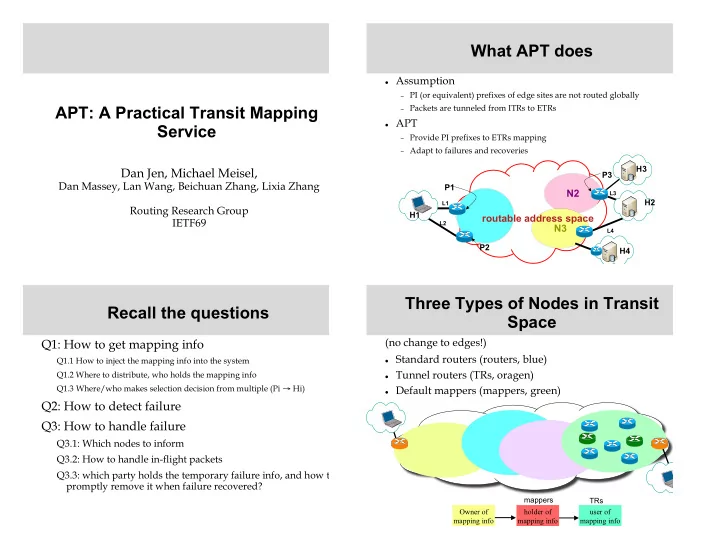
Three Types of Nodes in Transit Space

holder of mapping info user of mapping info Owner of mapping info mappers TRs

(no change to edges!)

Standard routers (routers, blue) Tunnel routers (TRs, oragen) Default mappers (mappers, green)

slide-2
SLIDE 2

Default Mappers

These are a new device Store all edge prefix to transit-space (GRA) address

mappings

Each edge prefix maps to a non-empty set of GRA

addresses

Each GRA address has a priority Same priority? Use the shortest path

At least one per AS

Use multiple for robustness, load sharing, shorter data path Use anycase to reach nearest mapper

Mappers tell ITRs which mapping entries to use

Tunnel Routers (TRs)

Design goals for TRs: minimal changes, stay simple

Encapsulate outgoing packets (ITR mode) Decapsulate incoming packets (ETR mode)

Cache only mapping entries that are currently in use

No mapping entry? Tunnel packet to mapper's anycast address Mapper (1) forwards the packet, and (2)responds with a

mapping entry containing one GRA address for the edge prefix

Standard Routers (“Routers”)

These are the rest of the existing routers (roughtly) no changes required to support APT

Default Mapping Example X M X X X X

1.1.1.0/24 a.b.c.d edge prefix GRA address 2.2.0.0/16 a.b.c.e 3.3.3.7 edge Space GRA Space

X

slide-3
SLIDE 3

Mapping Not in Cache X M X X X X X

1.1.1.0/24 a.b.c.d edge prefix GRA address 2.2.0.0/16 a.b.c.e

Mapping Cache Miss!

3.3.3.7

Use the Default Mapper X M X X X X X

3.3.3.7

edge prefix is Multihomed X M X X X X X

... ... ... edge prefix GRA address 3.3.3.0/24 ... a.b.c.f p.q.r.s ... Priority 10 20 ... 3.3.3.7

Default Mapper Selects a Mapping X M X X X X X

... ... ... edge prefix GRA address 3.3.3.0/24 ... a.b.c.f p.q.r.s ... Priority 10 20 ... a.b.c.f 3.3.3.7

slide-4
SLIDE 4

Default Mapper Responds with Mapping and Delivers Packet X M X X X X X

ICMP Mapping Response a.b.c.f 3.3.3.7

Mapping Added to Cache X M X X X X X

1.1.1.0/24 a.b.c.d edge prefix GRA address 2.2.0.0/16 3.3.3.0/24 a.b.c.e a.b.d.f a.b.c.f 3.3.3.7

Packet Decapsulated and Delivered X M X X X X X

1.1.1.0/24 a.b.c.d edge prefix GRA address 2.2.0.0/16 3.3.3.0/24 a.b.c.e a.b.d.f 3.3.3.7

Next Packet X M X X X X X

1.1.1.0/24 a.b.c.d edge prefix GRA address 2.2.0.0/16 3.3.3.0/24 a.b.c.e a.b.d.f 3.3.3.7

slide-5
SLIDE 5

Mapping Already in Cache X M X X X X X

1.1.1.0/24 a.b.c.d edge prefix GRA address 2.2.0.0/16 3.3.3.0/24 a.b.c.e a.b.d.f 3.3.3.7

Packet Encapsulated X M X X X X X

1.1.1.0/24 a.b.c.d edge prefix GRA address 2.2.0.0/16 3.3.3.0/24 a.b.c.e a.b.d.f a.b.c.f 3.3.3.7

Packet Delivered X M X X X X X

a.b.c.f 3.3.3.7

Handling Temporary Failures

  • Three situations require failover to alternate ETR

addresses

1.

A transit space prefix is unroutable via BGP

2.

A single transit space address becomes unreachable

3.

A link between an ETR and user space fails

  • Basic approach:
  • Temporarily invadidate the corresponding mapping entries
  • Do not change the mapping table
  • Additional info at default mappers
  • Reverse mapping table: ETR to all PI-prefixes reachable thru it
  • Time Till Retry (TTR) for each mapping entry
slide-6
SLIDE 6

Situation 1: GRA Prefix Unroutable

ITR1 M1

X X X

3.3.3.7 M2 ETR1

X X X

ETR2 Michael Dan

ETR1 prefix unreachable!

Situation 1: GRA Prefix Unroutable

ITRs forward packets with unroutable destinations

to their default mapper

Default mappers use mapping priorities to pick a

routable GRA destination address

And reply to ITR with a new mapping entry of a short TTL

Situation 2 Example

ITR1 M1

X X X

3.3.3.7 M2 ETR1

X X X

ETR2 Michael Dan Lixia

Router Down!

Situation 2: Single GRA address Failure

Handling packets in-the-fly: minimizing losses

In the ETR domain: Forwards packets destined to ETR to its

default mapper

At the ETR’s mapper: Tries to find an alternate GRA

destination address to tunnel packet to

Informing the sender: 2 options

  • 1. The involved router sends an ICMP destination-unreachable

msg to sending ITR, which in turn forwards to its mapper

  • 2. (with a wellknown mapper address definition) ETR domain's

mapper sends the ICMP msg to ITR's mapper; the ITR mapper informs the ITR

In either case: ITR’s mapper temporarily avoids

corresponding mapping entries

Set the TTR in the reverse mapping table

slide-7
SLIDE 7

Situation 2 Example

ITR1 M1

X X X

3.3.3.7 M2 ETR1

X X X

ETR2 Michael Dan

Router Down!

Lixia

Situation 3 Example

ITR1 M1

X X X

3.3.3.7 M2 ETR1

X X X

ETR2 Michael Dan Lixia

Situation 3: Border Link Failure

  • Handling packets in-the-fly: minimize losses
  • At the ETR: Forwards the data packet to its default mapper
  • At the ETR’s default mapper: Tries to find an alternate GRA

destination address to tunnel packet to

  • Informing the sending AS: 2 options

1.

ETR sends an ICMP Border Link Failure msg to ITR

2.

ETR's mapper sends the ICMP msg to ITR's mapper; the mapper informs ITR

  • In either case: ITR’s mapper invalidates mapping

entry by setting its TTR for the particular edge prefix mapping entry

Distributing Mappings Between ASes

APT has two distinct parts

Data forwarding Mapping info distribution to mappers

The latter can take any new distribution protocol

  • nce we have one

e.g. NERD, or CONS

The current option: APT floods mapping info by

piggybacking on BGP announcements

slide-8
SLIDE 8

Distributing Mappings Between ASes

Define a new BGP transitive attribute

mapping entry: edge prefix to GRA address mapping

An edge network sends signed mapping to all its

provider

A provider network floods their customers’

mappings to other provider networks via BGP

this GRA address may not have any relation with the prefix

being announced

All APT nodes (ITRs and mappers) listen

Default mappers store all incoming mappings ITRs just invalidate cache entries that match incoming

mappings

In Defense of piggybacking on BGP

Mapping updates far less problematic than BGP

routing updates

It only matters where mapping messages go, not what path

they take

Only require processing at APT nodes No path exploration for mapping messages

Eases incremental deployment

Security and Robustness

Wins

Transit space is not directly addressable from user space Mapping announcements are only accepted from configured

BGP peers

Issues

ICMP packets are unreliable and can be spoofed Mappings can be misconfigured

Security and Robustness for ICMP Packets

Mapping messages

Only used within an AS, drop them at AS boundaries if any trying to cross borders

Border Link Failure messages

Can only be sent by GRA routers Signature field allows easy addition of cryptographic security

slide-9
SLIDE 9

Incremental Deployment

The user address space will not be affected Some edge prefixes will simply not have mappings

Packets destined for unmapped addresses are sent via the

current infrastructure

TRs keep negative cache entries

Regular Mapping Refresh

Newly added default mappers will need to get the

full mapping table

Allows stale mappings to expire Each provider re-announces its customers’

mappings on a regular basis

Daily? Weekly?

New default mappers boostrapping from other

mappers

(near) Future Work

Finish an incremental deployment design

Borrow ideas from other work (e.g. IvIP)

Understanding TR cache size using real-world data

Help us get real data !!!

Reliable key distribution/discovery

Edge network keys Provider keys

Securing ICMP msgs

Questions?

bgpng@cs.ucla.edu