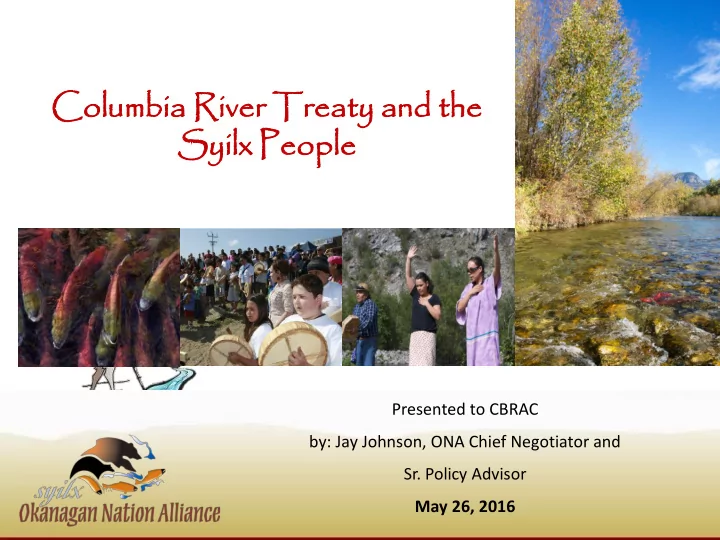
SLIDE 1 Colum lumbi bia a River er Tre reaty ty and nd the e Syilx lx Pe People le
Presented to CBRAC by: Jay Johnson, ONA Chief Negotiator and
May 26, 2016
SLIDE 2 Okanagan (Syilx) Nation Revitalization of an Okanagan Fishery & the Salmon People
Seven member band communities: 1. Osoyoos Indian Band 2. Penticton Indian Band 3. Westbank First Nation 4. Okanagan Indian Band 5. Upper Nicola Band 6. Lower Similkameen Band 7. Upper Similkameen Band, and 8. Colville Confederated Tribes (USA)
The Okanagan People Today
SLIDE 3
Okanagans are a Non-treaty First Nation and as such have not
surrendered its Title and Rights interests on its (69,000km2) Territory
The CCT in the US formally re-joined the ONA and the CEC in
2010
The CEC is the elected political decision making governing body ONA is the administrative and technical arm of the Nation ONA has five departments and over 100 f/t staff One of the largest Fisheries departments in BC --
bigger than DFO-BC Region and the BC FLNRO/MOE fisheries combined
Okanagan Title and Rights
SLIDE 4 Oka kanag nagans ans / / Sini nixts xts
- Sinixts original inhabitants of the
Arrow Lakes
- Okanagans (Syilx) and the Sinixts
- same Insyilchen speaking
peoples
- 19th C. Small pox and miners
devastated Sinixts populations
population abandoned last West Kootenay reserves
- Federal Government declared
Sinixts Extinct in 1959
descendents reside primarily at CCT and the ONA, and in other neighbouring First Nations
- First Nations still use and access
region – practice rights regularly
SLIDE 5 Okanagans are a Salmon People Columbia River is the main artery of the nation delivering
salmon and as historical corridor – Okanagan River is a tributary of the Columbia River
Industrialization and CRT devastated region and Salmon First Nations had no involvement in CRT – despite letters Massive impacts from CRT flooded lands/ fisheries and erosion Okanagan System is a tributary
Columbia River as a Life Force
SLIDE 6 A WAY OF LIFE
Douglas R. Hudson, “The Okanagan Indians of British Columbia,” in Jean Webber and the En’owkin Centre, eds., Okanagan Sources. Penticton: Theytus Books, 1990, p. 57.
“The key resource
for many of the Okanagan groups was fish, especially salmon.”
SLIDE 7 “It has been determined that the Syilx consumed four or five times more salmon than other game animals.”
Marlowe Sam, 2008. Okanagan Water Systems: A Historical Retrospect of Control, Dominance, and Change. Masters Thesis, University of British Columbia Okanagan, p. 23.
SLIDE 8 FISHING
“The Indians at Okanagan have a very clever way of catching the salmon…. They make an artificial leap of wicker work right across the river over which the fish jump only to tumble into a basket on the other side.”
Surveyor Charles Wilson, August 12, 1860 (quoted in Hudson, 1990, p. 59)
SLIDE 9 TIME-HONORED CEREMONY
“Salmon fishing was controlled by a Salmon Chief who directed the construction of the traps and weirs and performed a ceremony to mark the capture of the first salmon. …the First Salmon Ceremony symbolized the dependence on the salmon and the need to maintain a proper relationship with this renewable resource.”
Douglas R. Hudson, “The Okanagan Indians of British Columbia,” in Jean Webber and the En’owkin Centre, eds., Okanagan Sources. Penticton: Theytus Books, 1990, p. 59.
SLIDE 10 TRADING CENTRE
“The Syilx trading networks reached as far south as the Walula (Snake River confluence), to the Thompson country in the north, to the west the Pacific Coast and extended to the Plains country in the east.”
Marlowe Sam, 2008. Okanagan Water Systems: A Historical Retrospect of Control, Dominance, and Change. Masters Thesis, University of British Columbia Okanagan, p. 23.
SLIDE 11
IMPACTS
Fishing at Kettle Falls
SLIDE 12
Grand Coulee Dam under construction
SLIDE 13
Grand Coulee Dam
NO FISH PASSAGE
SLIDE 14
CEREMONY OF TEARS
SLIDE 15
CELILO FALLS DALLES DAM
SLIDE 16 COLUMBIA RIVER TREATY
“The Treaty has disrupted
- ur way of life in ways that
very few other things have.”
Grand Chief Stewart Phillip, Okanagan Nation Alliance
SLIDE 17
Industrialization of the Columbia culminated with the CRT CRT has had massive impact to the Title and Rights interests of
the Nation – habitat and 100k + species lost to flooding
Flooded hundreds of kilometers of land – inundated village and
burial sites, fishing and hunting grounds, fertile valleys
Altered the river system into an industrial reservoir Continues to Impact on eco-systems, fish, erosion Removed FNs from their responsibilities to the land Villages, Ancestral remains, and cultural burial sites
inundated – many exposed to erosion/ exposure on new banks
CRT Impacts
SLIDE 18 ONA rejected BC’s original consultation process Jointly designed new ‘CRT Critical Path Process’ Insisted Canada Join process – Canada remain as Observers Critical Path - Concluded with BC unilaterally releasing its 14
principles
Deeper fisheries mitigation Salmon Passage restore Resolution to Industrial reservoir on-going impacts Consistent processes from Tsilhqot’in SCC decision CRT with meaningful eco-system functions – all species Meaningful Economic Benefits
CRT ONA Review Process
SLIDE 19
A DIFFERENT FUTURE AHEAD
SLIDE 20
HARD WORK, PARTNERSHIPS & PRAYER
SLIDE 21
THE MIRACLE CONTINUES
SLIDE 22
SLIDE 23
As we learn from the past, our Nation moves forward. We envision a sustainable territorial land, culture and way of life hundreds of years from now.
SLIDE 24
SLIDE 25
SLIDE 26
For More Information visit us at www.okanagannation.com