fwcp.ca 1 Introductions FWCP Columbia Region Manager Crystal Klym - - PowerPoint PPT Presentation

fwcp ca
SMART_READER_LITE
LIVE PREVIEW

fwcp.ca 1 Introductions FWCP Columbia Region Manager Crystal Klym - - PowerPoint PPT Presentation

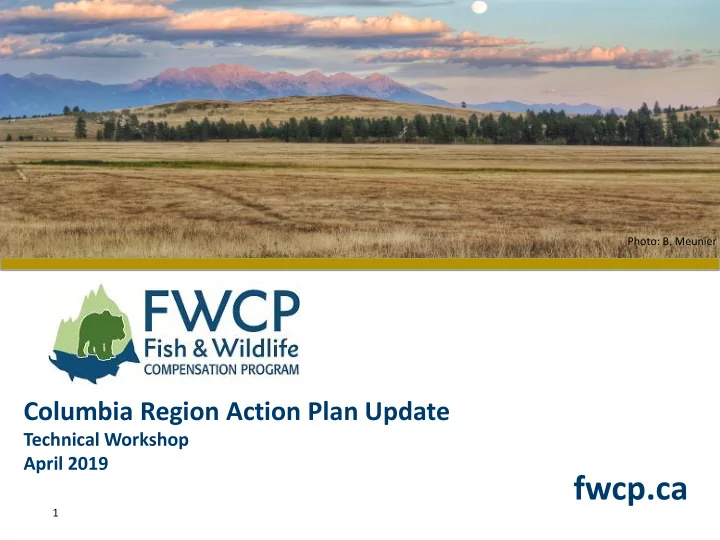
Angus Glass Photo: B. Meunier Columbia Region Action Plan Update Technical Workshop April 2019 fwcp.ca 1 Introductions FWCP Columbia Region Manager Crystal Klym FWCP Communications Angus Glass Lynne Betts FWCP Board Members FWCP Team


slide-1
SLIDE 1

Columbia Region Action Plan Update

Technical Workshop April 2019

Angus Glass

fwcp.ca

1 Photo: B. Meunier
slide-2
SLIDE 2

Introductions

2

FWCP Columbia Region Manager Crystal Klym FWCP Communications Angus Glass Lynne Betts FWCP Board Members FWCP Team LGL Limited environmental research associates Marc d’Entremont Krysia Tuttle Megan Mathews

slide-3
SLIDE 3

Today’s Purpose & Outcomes

Purpose: Present and discuss draft priority actions Review options and timing for input Outcomes: Increase awareness of draft priority actions Get your initial input on draft priority actions

3

slide-4
SLIDE 4

Today’s Agenda

1. Introductions & agenda review 2. FWCP overview & context 3. Action Plan Update introduction 4. Review & discuss draft priority actions 5. Roundtable & wrap-up 6. Adjourn

4

slide-5
SLIDE 5

Introduction to FWCP

The FWCP is a partnership between BC Hydro, the Province of B.C., Fisheries and Oceans Canada, First Nations and Public Stakeholders, to conserve and enhance fish and wildlife in watersheds impacted by BC Hydro dams. BC Hydro fulfills water licence and voluntary commitments through the FWCP. The FWCP is funded by BC Hydro.

5

slide-6
SLIDE 6

FWCP’s Vision & Mission

6

Our Vision Thriving fish and wildlife populations in watersheds that are functioning and sustainable. Our Mission The Fish & Wildlife Compensation Program compensates for fish and wildlife in watersheds impacted by BC Hydro dams.

fwcp.ca/our-story/

slide-7
SLIDE 7

Approach to Fulfilling Mission

7

FWCP’s approach is forward looking:

1. continual adaptation will be required in a dynamic natural environment 2. considers the objectives and priorities of its program partners 3. considers projected local impacts of climate change, cumulative effects on the landscape, and emerging ecological issues 4. protects past conservation efforts and benefits to fish & wildlife 5. contributes to the resilience of our watersheds and ecosystems

  • 6. focused on overall mission to conserve and enhance fish and wildlife in

watersheds impacted by BC Hydro dams fwcp.ca/our-story/

slide-8
SLIDE 8

FWCP’s Strategic Objectives

8

Conservation

Maintain or improve the status of species or ecosystems of concern. Maintain or improve the integrity and productivity of ecosystems and habitats.

Sustainable Use

Maintain or improve opportunities for sustainable use, including harvesting and other uses. Harvesting includes First Nations, recreational, sport and commercial harvests. Other uses may include cultural, medicinal, or non-consumptive uses.

Community Engagement

Build and maintain relationships with stakeholders and aboriginal communities. This

  • bjective stems from BC Hydro’s social responsibility policy and the Province of B.C. shared

stewardship objective. fwcp.ca/our-story/ fwcp.ca/fwcp-governance-manual/

slide-9
SLIDE 9

FWCP’s Three Regions

9

slide-10
SLIDE 10

How we’re structured

10

slide-11
SLIDE 11

Columbia Region Board

11

fwcp.ca/wanted-new-board-member Fish & Wildlife Technical Committees support our Board fwcp.ca/columbia-region-board-committees

slide-12
SLIDE 12

FWCP’s Columbia Region

12

slide-13
SLIDE 13

Vision Mission Strategic Objectives Action Plans Outline Priority Actions Project Delivery Mechanisms

Annual Grants Long-term Agreements and Partnerships Board Directed Projects

e.g. RFPs and direct award agreements

How we work

How we work

13

slide-14
SLIDE 14

Priority Actions

14

Priority Actions in Updated Action Plans:

  • 1. Align with FWCP mission, vision and

strategic objectives;

  • 2. Are within geographic scope;
  • 3. Align with FWCP investment criteria; and
  • 4. Are eligible for FWCP funding.
slide-15
SLIDE 15

FWCP’s Project Investment Criteria

15

Insert investment criteria What we fund Don’t fund Insert list of project types

slide-16
SLIDE 16

Reviewing Draft Priority Actions

16

Please download draft priority actions at: fwcp.ca/updating-columbia-action-plans/

Draft priority actions are organized by ecosystem-based action plan type:

  • 1. Reservoirs & Large Lakes
  • 2. Small Lakes
  • 3. Rivers & Riparian Areas
  • 4. Wetlands & Riparian Areas
  • 5. Upland & Dryland Areas
slide-17
SLIDE 17

Reviewing Draft Action Tables

17

Please focus on draft priority actions today for ecosystems and species fwcp.ca/updating-columbia-action-plans

slide-18
SLIDE 18

Your Feedback?

18

Draft Priority Actions Do you have any feedback on or suggestions about the draft priority actions? Draft Species of Interest Do you have any feedback on or suggestions about the draft list of species of interest, or the species categories assigned to each species? Improving our Action Plans Do you have any feedback on or suggestions for improving Columbia Region Action Plans so they can better provide guidance to grant applicants and others interested in actions eligible for FWCP funding?

slide-19
SLIDE 19

Inputs to Draft Action Tables

19

  • 1. Strategic project review
  • 2. Literature review
  • 3. Early engagement:
  • FWCP partners, agencies, technical committees
  • First Nations
  • Regional & provincial stakeholders
  • Columbia Region Board
  • 33 interviews
slide-20
SLIDE 20

Considerations: Emerging Issues

20

  • 1. Climate change (rate of loss/change in ecosystems)
  • 2. Water levels & waterways
  • 3. Cumulative effects
  • 4. Fire suppression and forestry practices
  • 5. Transportation corridors & wildlife movements
  • 6. Invasive species
  • 7. Conservation & protection of habitat / species
  • 8. Land stewardship & private land development
  • 9. Fish and wildlife diseases (e.g. White nose syndrome)
  • 10. Columbia River Treaty
  • 11. Fish passage
  • 12. Salmon restoration
slide-21
SLIDE 21

Considerations: Ecological Priorities

21

  • 1. Land securement & habitat protection
  • 2. Climate change
  • 3. Species at risk
  • 4. Invasive species
  • 5. Connectivity
  • 6. Human presence on landscape
  • 7. Water quality / quantity, natural hydrograph
  • 8. Wetland and riparian areas
  • 9. Upland dryland ecosystems
  • 10. Optimizing ecological values of large lake & reservoir

ecosystems

slide-22
SLIDE 22

Proposed Changes

22

  • 1. FWCP takes a progressive approach that responds to dam impacts

and works toward resilient and functioning watersheds

  • 2. FWCP’s approach to conservation considers:
  • the linkage between dam impacts and climate change impacts
  • ur evolving partnership with First Nations

3. A holistic, ecosystem-based approach 4. More on the ground restoration and land securement actions 5. More monitoring and evaluation actions 6. More species-based actions

slide-23
SLIDE 23

Proposed Changes

23

7. Recognize the importance of riparian areas in each draft plan 8. Clarity about our role:

  • invasive species
  • manage resources

9. Cross-plan actions (e.g., climate change, cumulative impacts)

  • 10. Species of interest are in ecosystem-based action plans
  • 11. New action plan names
  • 12. Action tables reflect progression from research to action and then

monitoring and evaluations

slide-24
SLIDE 24

Reviewing Draft Action Tables

24

Columbia Region Action Plans Reservoirs and Large Lakes Small Lakes Rivers and Riparian Areas Wetland and Riparian Areas Upland and Dryland

slide-25
SLIDE 25

Action Plan – Reservoirs & Large Lakes

25

1. Priority areas: five priority BC Hydro reservoirs (and corresponding tributaries) and other BC Hydro reservoirs and waterbodies > 1000 ha (e.g. Slocan Lake, Pend d’Oreille, Koocanusa Reservoir) 2. Ecosystem actions: effectiveness evaluation of nutrient programs, invasive species, updates within Rainbow Trout (pis. & ins.), Kokanee, Bull Trout and Burbot status indicators 3. Single action for recovery species: White Sturgeon, Mountain Caribou 4. Species Actions: Grizzly Bear, invertebrates See page 1

slide-26
SLIDE 26

Action Plan – Small Lakes

26

1. Priority areas: waterbodies including lakes and reservoirs < 1000 ha (e.g., Summit Lake, Moyie Lake). 2. Ecosystem actions: developing ecosystem restoration plans, restoration and enhancement of habitat 3. Species actions: fish, waterbirds, Western Toad, Western Painted Turtle, bats, invertebrates See page 17

slide-27
SLIDE 27

Action Plan – Rivers & Riparian Areas

27

1. Priority areas: 14 priority rivers, removed Flathead River 2. Ecosystem actions: regional river plans, nutrient restoration evaluation, invasive species 3. Single action for recovery species: White Sturgeon 4. Species actions: Burbot, Westslope Cutthroat Trout, waterbirds, invertebrates See page 21

slide-28
SLIDE 28

Action Plan – Wetlands & Riparian Areas

28

1. Priority areas: Six priority valleys and ‘other’ areas 2. Ecosystem actions: mapping of riparian areas, cottonwood and floodplain habitats, connectivity, habitat restoration and land securement 3. Single action for recovery species: Mountain Caribou, Northern Leopard Frog, Western Screech-

  • wl, Yellow-breasted Chat, Lewis’s Woodpecker

4. Species actions: fish, Grizzly Bear, bats, Western Toad, Western Painted Turtle, Great Blue Heron, invertebrates See page 27

slide-29
SLIDE 29

Action Plan – Upland & Dryland

29

1. Priority areas: four priority ecosystems, Grasslands and Montane added 2. Ecosystem actions: connectivity, old-growth ecosystems, ecosystem restoration plans, land securement 3. Single action for recovery species: Mountain Caribou, American Badger, Lewis’s Woodpecker, Western Screech-owl 4. Species actions: Grizzly Bear, bats, Western Toad, furbearers, invertebrates See page 36

slide-30
SLIDE 30

Action Plan – Species of Interest

30

1. Species of Interest Action Plan rolled into ecosystem-based Action Plans:

  • ties ecosystems and species together
  • allows for development of new actions for species or

groups 2. Feedback on draft species list:

  • add species?
  • remove species?
  • change categories?

See page 44

slide-31
SLIDE 31

Cross Plan Actions

31

1. Actions that apply to each ecosystem based Action Plan 2. Proposed for inclusion in 2019 updated Action Plans

See page 43

slide-32
SLIDE 32

Input Opportunities

32

Eight Workshops 1 – 4 pm Eight Open houses 5:30 – 7 pm RSVP fwcp@bchydro.com fwcp.ca/updating-columbia-action-plans/

fwcp.ca/updating-columbia-action-plans/

slide-33
SLIDE 33

Input Opportunities

33

  • 1. Two online information sessions: April 4 and April 30
  • 2. Online feedback form until May 3, 2019

fwcp.ca/updating-columbia-action-plans/

slide-34
SLIDE 34

Action Plan Update – Next Steps

Engagement on Draft Ideas Spring 2019 Online Feedback Form Deadline May 3, 2019 Review Draft Action Plans June / July 2019 Final Updated Action Plans August 2019 Annual Grant Intake Opens August 2019

34

slide-35
SLIDE 35

Contact us fwcp.ca

35

slide-36
SLIDE 36

Closing Roundtable

36

Wrap-up and summary Next steps and closing comments

fwcp.ca/updating-columbia-action-plans/