SLIDE 1
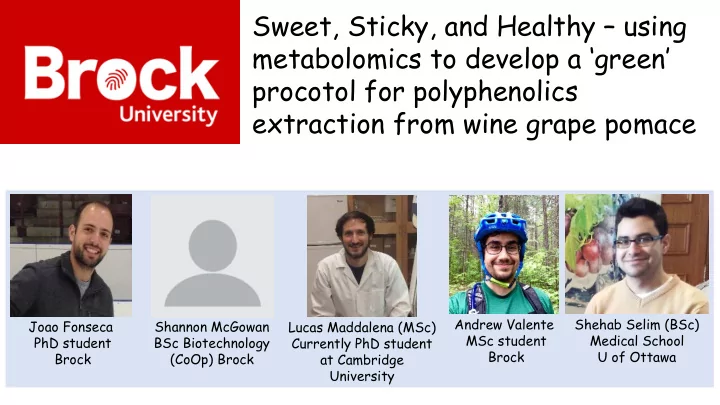
Lucas Maddalena (MSc) Currently PhD student at Cambridge University Joao Fonseca PhD student Brock Andrew Valente MSc student Brock Shehab Selim (BSc) Medical School U of Ottawa Shannon McGowan BSc Biotechnology (CoOp) Brock
Sweet, Sticky, and Healthy – using metabolomics to develop a ‘green’ procotol for polyphenolics extraction from wine grape pomace
SLIDE 4
The Warburg Effect:
SLIDE 5
The Warburg Effect is exploited in the 18F-deoxyglucose PET scan to detect cancers
SLIDE 6 One strategy for slowing growth of cancer cells is to target the Warburg Effect
- Inhibit glucose fermentation / stimulate mitochondrial
- xidative phosphorylation to slow cancer growth
SLIDE 7
MiNA
SLIDE 8
Assessing resveratrol effects on mitochondria
SLIDE 9 50 100 150 200 250 Number of Rods/Puncta Number of Networks Branches per Network Mitochondrial Footprint
* *
Control Resveratrol
Treatment (72h) of prostate cancer cells with 10 μM resveratrol stimulates mitochondrial biogenesis and fusion
SLIDE 10 1 2 3 4 5 6
DMSO RES Respiration Rate (nmol O2 / min / million cells )
* *
Treatment (72h) of prostate cancer cells with 10 μM resveratrol stimulates respiration
SLIDE 11 **
10 20 30 40 50 60
DMSO RES
Cell doubling time (h)
Concomitantly, resveratrol slows prostate cancer cell growth and cells accumulate in G0/G1
10 20 30 40 50 60 70 80 90 100
G0/ G0/G1 G1 S G2/ G2/M Percentage o
ll Popula latio ion
* ** DMSO RES
SLIDE 12
Resveratrol
mitochondrial biogenesis mitochondrial fusion mitochondrial respiration cell g growth wth
SLIDE 13 Is the shift from a glycolytic to oxidative phenotype required for resveratrol’s effects on PC3 cells?
- Investigate potential role of Hypoxia Inducible
Factor-1 (HIF-1), which is elevated in normoxia in some cancer cells, including PC3.
SLIDE 14
HIF-1α regulation
Tal 2012, Biol of Reprod.
SLIDE 15 Experimental approach:
- Stabilize HIF-1α expression by inhibiting
degradation (IOX2)
SLIDE 16
IOX2 inhibits the HIF prolyl hydroxylases (PHDs), thus stabilizing HIF-1α
Tal 2012, Biol of Reprod.
SLIDE 17 1 2 3 4 5 6 Basal FCCP
Respir piratio ion r rate ( (nmol O l O2 / min / n / million cel cells ) ) 20 40 60 80 100 120 140 Number of Rods/Puncta Number of Networks Branches per Network Mitochondrial Footprint
No effects of resveratrol on mitochondrial form or function in IOX2-treated PC3 cells
DMSO RES
SLIDE 18 10 20 30 40 50 60
Control IOX2
Populati tion d doubling t g time (h)
* *
10 20 30 40 50 60 70 80 90 100
G0/G1 S G2/M
Percentage o
Cell P ll Pop
ion
IOX2 abolishes resveratrol’s effects on PC3 cell growth
DMSO RES
SLIDE 19
Since resveratrol negatively affects HIF-1α stabilization is it particularly effective at inhibiting cancer growth in hypoxic conditions?
SLIDE 20
SLIDE 21 HIF-1α Lamin B1 DMSO RES
#
5000 10000 15000 20000 25000 Hypoxia DMSO Hypoxia RES
(normalized to LaminB1)
RES prevents the stabilization of HIF-1α in hypoxia
SLIDE 22 Resveratrol’s growth inhibition effect is greatly increased under hypoxic conditions
20 40 60 80 100 120 0 µM 1 µM 5 µM 10 µM
Population doubling time (h)
Resveratrol concentration
Normoxia Hypoxia
** ** *
SLIDE 23
Funding
SLIDE 25
Industrial partnership with Steve Murdza and Sweet & Sticky
SLIDE 26 Resveratrol synthesis in Vitis vinifera
malonyl
resveratrol phenylalanine
N H
2
O H O
O H O O H O O H
cinnamic acid p- coumaric acid p henylalanine ammonia lyase c innamate 4
C H 3 S O O CoA p
3 +
O H O H O H
stilbene synthase 4
l igase
SLIDE 27 Resveratrol is a precursor to many different stilbenes
Glycosylation Methoxylation Resveratrol Oxidative
Piceid Pterostilbene Ɛ
ƍ - viniferin
O H O H O H O H O O H O H O O H O H O H O O H O C H
3
C H
3
O H O H O O H O H O H
O H O O H O H O H O H
SLIDE 28
Increased stilbene synthesis gene expression in fall/winter
SLIDE 29
Increased stilbene synthesis gene expression in fall/winter
SLIDE 30 Previous collaboration between Sweet & Sticky and Vince DeLuca
- higher resveratrol levels in winter-harvested grapes
used in Ice Syrup production
SLIDE 31
Concentration (mg/kg dry mass)
Grape skins contain high levels of stilbenes
SLIDE 32 Solvent Solubility of Resveratrol (g/L) Water 0.03 Alcohol 50 Resveratrol is highly hydrophobic
- negligible solubility in water
SLIDE 33 Stilbene Solubility in water (g/L) Resveratrol 0.03 ε-viniferin 0.0001319 Some derivatives of resveratrol are even less water soluble
O H O H O O H O H O H
SLIDE 34
How to extract resveratrol and other stilbenes from the waste pomace produced during the manufacture of Ice Syrup?
SLIDE 35 Resveratrol extraction from Ice Wine grape pomace
- Process must be ‘green’
- no toxic solvents
– product must be edible
scalable
- Resveratrol/stilbene content
should be maximized
- Ideally, resultant extract
should be water soluble
SLIDE 36 Study design:
- Two varieties of grape used in Ice Syrup production:
Cabernet Franc and Vidal (Steve Murdza)
- Harvest in October, November, December, sometimes
January
- Harvest years 2015, 2016, 2017
SLIDE 37
Apply the developed green extraction method to all pomace samples
SLIDE 38
Metabolomics profiling of polyphenols in all extracts
SLIDE 39 Samples Treatments
Nov Cab Franc 2mL/g Nov Cab Franc 2mL/g (1)NCF 5mL/g (2)NCF 5mL/g (1)NCF 7mL/g (2)NCF 7mL/g Gallic Acid 1.15 1.04 0.46 0.52 0.21 0.21 Protocatechuic acid (3,4- Dihydroxybenzoic acid) 0.29 0.30 0.01 0.01 N/A N/A Catechin 3.74 3.66 1.69 1.73 1.10 1.14 Chlorogenic Acid 2.00 1.91 0.75 0.81 0.17 0.15 Vanillic Acid 0.71 0.69 0.06 0.08 0.02 0.01 Caffeic Acid 2.46 2.36 1.06 1.11 0.55 0.58 Syringic Acid 0.93 0.89 0.36 0.34 0.28 0.24 Benzoic Acid 1.30 1.27 0.49 0.51 0.21 0.21 Sinapic Acid 1.36 1.25 0.29 0.29 0.25 0.26 Rutin 0.49 0.47 0.14 0.15 N/A N/A Resveratrol 0.58 0.54 0.27 0.30 0.23 0.21 Quercetin 0.20 0.18 0.11 0.12 0.11 0.13 Kaempferol 0.21 0.19 0.16 0.17 0.16 0.17
Concentration of polyphenols in extracts (µg/mg extract mass)
SLIDE 40 Samples Treatments
Nov Cab Franc 2mL/g Nov Cab Franc 2mL/g (1)NCF 5mL/g (2)NCF 5mL/g (1)NCF 7mL/g (2)NCF 7mL/g Gallic Acid 1.15 1.04 0.46 0.52 0.21 0.21 Protocatechuic acid (3,4- Dihydroxybenzoic acid) 0.29 0.30 0.01 0.01 N/A N/A Catechin 3.74 3.66 1.69 1.73 1.10 1.14 Chlorogenic Acid 2.00 1.91 0.75 0.81 0.17 0.15 Vanillic Acid 0.71 0.69 0.06 0.08 0.02 0.01 Caffeic Acid 2.46 2.36 1.06 1.11 0.55 0.58 Syringic Acid 0.93 0.89 0.36 0.34 0.28 0.24 Benzoic Acid 1.30 1.27 0.49 0.51 0.21 0.21 Sinapic Acid 1.36 1.25 0.29 0.29 0.25 0.26 Rutin 0.49 0.47 0.14 0.15 N/A N/A Resveratrol 0.58 0.54 0.27 0.30 0.23 0.21 Quercetin 0.20 0.18 0.11 0.12 0.11 0.13 Kaempferol 0.21 0.19 0.16 0.17 0.16 0.17
Concentration of polyphenols in extracts (µg/mg extract mass)
SLIDE 41 How much resveratrol is present in the pomace extracts?
- An average red wine has 1.9 ± 1.7mg/L *
- An average glass of wine is about 175ml
- Therefore, average glass of wine has ~0.33mg resveratrol
- The best extracts have ~0.6mg/g
- Therefore, ~0.5g of the extract is equivalent to a glass of wine
- The extracts have no alcohol and contain a variety of ‘good’ polyphenols
*
SLIDE 42
If the extracts are added to Ice Syrup (they are water soluble), what concentration of resveratrol could be achieved?
Up to 1.5g of extract per 100ml Ice Syrup Therefore, almost 1mg of resveratrol per 100ml Ice Syrup Compare to 0.19mg resveratrol per 100ml of an average red wine
SLIDE 43
Compound Level in Extract (mg/g) Amount in glass of red wine (mg/175 mls) * Resveratrol 0.56 0.33 Kaempferol 0.20 0.2-2 Catechin 3.70 100-150 Quercitin 0.19 5-20
Relative levels of some other polyphenols in the extracts versus red wine
*Granato et al 2011; Food Chemistry
SLIDE 44
Conclusions
(1) Resveratrol has some health benefits that have been well studied. These include anti-cancer activities.
SLIDE 45
Conclusions
(1) Resveratrol has some health benefits that have been well studied. These include anti-cancer activities. (2) Resveratrol is only one of many stilbenes. Other stilbenes have similar effects on human cells. Stilbenes are polyphenols. Many non-stilbene polyphenols also have positive health effects.
SLIDE 46
Conclusions
(1) Resveratrol has some health benefits that have been well studied. These include anti-cancer activities. (2) Resveratrol is only one of many stilbenes. Other stilbenes have similar effects on human cells. Stilbenes are polyphenols. Many non-stilbene polyphenols also have positive health effects. (3) Resveratrol and other polyphenols are abundant in the skin (pomace) of wine grapes and accumulate toward fall and winter. Pomace is a waste product of Ice Syrup and wine production.
SLIDE 47
Conclusions
(1) Resveratrol has some health benefits that have been well studied. These include anti-cancer activities. (2) Resveratrol is only one of many stilbenes. Other stilbenes have similar effects on human cells. Stilbenes are polyphenols. Many non-stilbene polyphenols also have positive health effects. (3) Resveratrol and other polyphenols are abundant in the skin (pomace) of wine grapes and accumulate toward fall and winter. Pomace is a waste product of Ice Syrup and wine production. (4) An edible extract can be produced from the pomace of Cabernet Franc and Vidal grapes harvested in October through December (maybe January). The CF extracts have resveratrol levels comparable to red wines but without the alcohol. More characterization is needed.
SLIDE 48 Acknowledgements:
- Elaine Corbett and Dennis McCormick – Ontario Genomics
- Rupasri Mandal and Jen Reid – TMIC (The Metabolomics Innovation Centre)
- Dan Lynch - BioLync