
SLIDE 1
Sven Koschinski, Volker Dierschke & Julia Carlström HELCOM SEAL 11, Göteborg 4-6 October 2017
Photo: N. Olivier
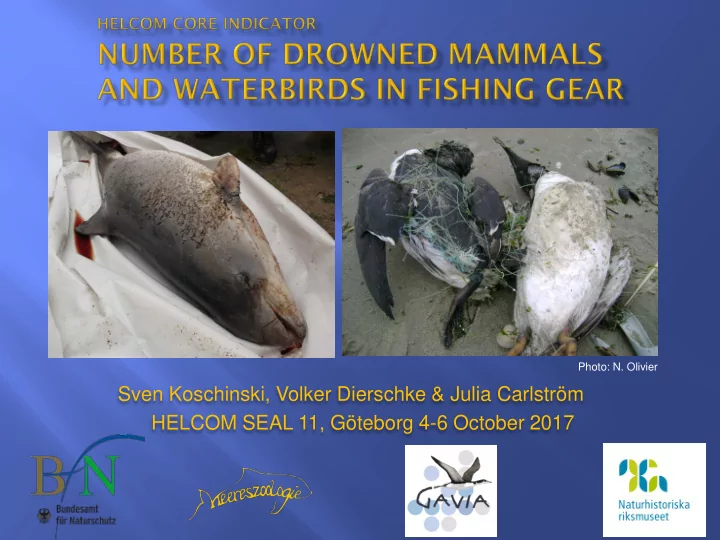
Sven Koschinski, Volker Dierschke & Julia Carlstrm HELCOM SEAL - - PowerPoint PPT Presentation
Photo: N. Olivier Sven Koschinski, Volker Dierschke & Julia Carlstrm HELCOM SEAL 11, Gteborg 4-6 October 2017 Principle of the indicator Provisional assessment Some problems with underlying data Regulatory framework The
Photo: N. Olivier
Photo: K. Skora
Photo: Australian Fisheries Management Authority, graph: Kindt-Larsen et al. 2016, artwork: Jaqueline Rothschies
Photos: Wikipedia
Kattegat (DK, SE) Great Belt (DK, DE) The Sound (DK, SE) Kiel Bay (DE, DK) Bay of Mecklenburg (DE, DK) Arkona Basin (SE, DK, DE) Bornholm Basin (SE, DK, DE, PL) Gdansk Basin (PL, RU) Eastern Gotland Basin (SE, PL, RU. LT, LV, EE) Western Gotland Basin (SE) Gulf of Riga (LV, EE) Northern Baltic Proper (SE, FI EE) Gulf of Finland (FI, RU, EE) Aland Sea (SE, FI) Bothnian Sea (SE, FI) The Quark (SE, FI) Bothnian Bay (SE, FI)
x = incidental catches proven, ? = incidental catches remain to be shown (overlap of distribution with gillnet fisheries) uncertainties in estimated population size and pressure -> bycatch rate close to the tentative threshold does not imply a good or bad status
Photos: R. Borcherding, J. Haelters
Baltic Sea Action Plan BSAP EcoQO EUPoA Seabirds
environmental targets
Regulation 1224/2009 Control Regulation
Baltic Sea Advisory Council BSAC
Council Regulation 2005/2187 Baltic Sea Technical Measures Regulation Council & Parliament Regulation 1380 / 2013 on the Common Fisheries Policy
Data Collection – Multiannual Plan DC-MAP
Habitats Directive Annexes II & IV Marine Strategy Framework Directive MSFD
Commission Regulation 2244 / 2003
regarding Vessel Monitoring Systems
ASCOBANS Birds Directive Annex I
Scientific, Technical and Economic Committee for Fisheries STECF
Parliament and Council Regulation on conservation of fishery resources and the protection of ecosystems through technical measures
COM Decision
European PARLIAMENT
environmental policy - fisheries policy Regional Seas Conventions
European COMMISSION DG MARE DG ENVIRONMENT
European COUNCIL
North Sea Advisory Council NSAC M6 Bycatch Indicator
CORE Indicator
Number of drowned mammals and waterbirds in fishing gear
National interests OSPAR HELCOM Bycatch resolution
Jastarnia Plan GAP Area Plan
North Sea Conservatio n Plan
measures National implementation
Guidance
Council Regulation
812/ 2004
Measures concerning incidental catches of cetaceans
DC-MAP Regional Coordination Meeting „RCM Baltic“
CMS
(Convention
Species)
AEWA
Baltic Sea Fisheries Forum BALTFISH (highlevel
group of national fisheries directors)
KÜFO SH
Coastal Fisheries Regulation
KÜFVO MV
Coastal Fisheries Regulation
Seefischerei-
Sea Fishing Regulation
BNatSchG
Federal Nature Conservation Act
LNatSchG SH
State Nature Conservation Act
NatSchAG MV
Nature Conservation Implementation Law
By- catch data
Voluntary agreement MELUR (SH) CLA
PVA International Council for the Exploration of the Sea ICES
DC-MAP National Work Plan National interests
OSPAR/HELCOM/ ICES Expert Group on Seabirds
JWGBIRD Working Group
Mammal Ecology
WGMME
Working Group on Bycatch of Protected Species WGBYC
Scientific advice
national legislation environment --- fisheries
Federal level State level
Baltic Sea Action Plan BSAP EcoQO EUPoA Seabirds
environmental targets
Regulation 1224/2009 Control Regulation
Baltic Sea Advisory Council BSAC
Council Regulation 2005/2187 Baltic Sea Technical Measures Regulation Council & Parliament Regulation 1380 / 2013 on the Common Fisheries Policy
Data Collection – Multiannual Plan DC-MAP
Habitats Directive Annexes II & IV Marine Strategy Framework Directive MSFD
Commission Regulation 2244 / 2003
regarding Vessel Monitoring Systems
ASCOBANS Birds Directive Annex I
Scientific, Technical and Economic Committee for Fisheries STECF
COM Decision
European PARLIAMENT
environmental policy - fisheries policy Regional Seas Conventions
European COMMISSION DG MARE DG ENVIRONMENT
European COUNCIL
North Sea Advisory Council NSAC
CORE Indicator
Number of drowned mammals and waterbirds in fishing gear
National interests OSPAR HELCOM Bycatch resolution
Jastarnia Plan GAP Area Plan
North Sea Conservatio n Plan
measures National implementation
Guidance
Council Regulation
812/ 2004
Measures concerning incidental catches of cetaceans
DC-MAP Regional Coordination Meeting „RCM Baltic“
CMS
(Convention
Species)
AEWA
Baltic Sea Fisheries Forum BALTFISH (highlevel
group of national fisheries directors)
KÜFO SH
Coastal Fisheries Regulation
KÜFVO MV
Coastal Fisheries Regulation
Seefischerei-
Sea Fishing Regulation
BNatSchG
Federal Nature Conservation Act
LNatSchG SH
State Nature Conservation Act
NatSchAG MV
Nature Conservation Implementation Law
By- catch data
CLA
PVA International Council for the Exploration of the Sea ICES
DC-MAP National Work Plan National interests Working Group
Mammal Ecology
WGMME Scientific advice
national legislation environment --- fisheries
Federal level State level
Voluntary agreement MELUR (SH) Working Group on Bycatch of Protected Species WGBYC OSPAR/HELCOM/ ICES Expert Group on Seabirds
JWGBIRD M6 Bycatch Indicator
Parliament and Council Regulation on conservation of fishery resources and the protection of ecosystems through technical measures
1: European Fisheries and Aquaculture Research Organisations
Photo: Sten Stockmann, badewanne