Sustainable valorization of wastewater sludge into organic - - PowerPoint PPT Presentation

sustainable valorization of wastewater sludge into
SMART_READER_LITE
LIVE PREVIEW

Sustainable valorization of wastewater sludge into organic - - PowerPoint PPT Presentation

6 th International Conference on Sustainable Solid Waste Management (NAXOS2018) Sustainable valorization of wastewater sludge into organic fertilizer through vermicomposting process Presenter : T.Y. Wu Co-researchers : L.H. Lee : K.Y. Ng :


slide-1
SLIDE 1

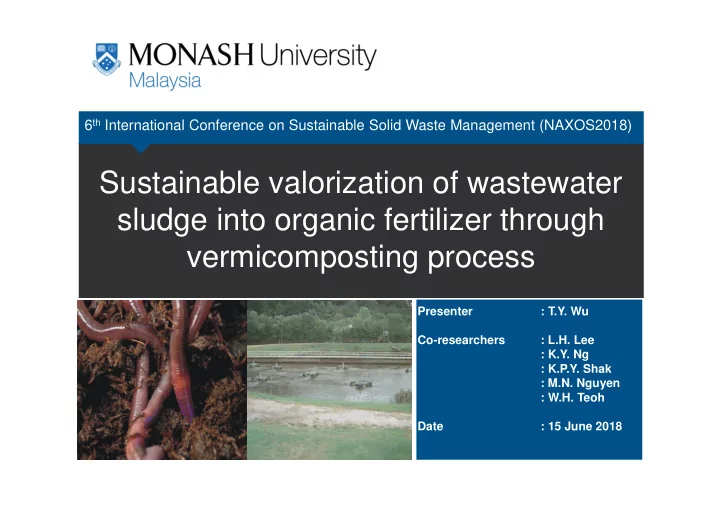
6th International Conference on Sustainable Solid Waste Management (NAXOS2018)

Sustainable valorization of wastewater sludge into organic fertilizer through vermicomposting process

Presenter : T.Y. Wu Co-researchers : L.H. Lee : K.Y. Ng : K.P.Y. Shak : M.N. Nguyen : W.H. Teoh Date : 15 June 2018

slide-2
SLIDE 2
  • 1. Introduction

2

slide-3
SLIDE 3

1 Introduction

Source: (Wu et al., 2007; Foo and Hameed, 2010)

 Malaysia is the world’s leading producers and exporter

  • f palm oil products after Indonesia.

 Waste produced:  Oil palm trunks  Oil palm fronds  Empty fruit bunches  Palm kernel shell  Palm pressed fiber  Palm oil mill effluent (POME)

Solid Waste Liquid Waste

Adapted from thestar.com.my

3

slide-4
SLIDE 4

Research Background - POME

Oil palm fruits

Palm oil extraction

Palm oil mill effluent (POME)

= ~60 million tonnes of wet weight per year = 1 tonnes CPO ~ 3 tonnes POME

Ponding system of POME

1 Introduction (Continued…)

slide-5
SLIDE 5

Parameters a Range c,f Regulatory discharge limits d pH 4.2 ‐ 4.7 5.0 – 9.0 Temperature (oC) 80 ‐ 90 45 Biochemical oxygen demand (BOD3

b)

21,500 – 28,500 100 (50) Chemical oxygen demand (COD) 45,500 – 65,000 ‐ Total suspended solids 15,660 – 23,560 400 Total Kjeldahl Nitrogen 750 200 C:N ratio 6.54 ‐ Calcium (Ca) 276 – 405 ‐ Magnesium (Mg) 254 – 344 ‐ Phosphorus (P) 94 – 131 ‐ Potassium (K) 1281 – 1928 ‐

aAll values, except pH and temperature, are expressed in mg.L-1 bThe sample for BOD analysis is incubated at 30oC for 3 days

Sources: c(Ma, 2000), d(Ahmad et al., 2003), e(Wood et al., 1979; Wong et al., 2009), f (Wu et al., 2010)

Characteristics of raw POME and the regulatory discharge limits

1 Introduction (Continued…)

5
slide-6
SLIDE 6

Typical schematic diagram of ponding system (Ma and Ong, 1985)

1 Introduction (Continued…)

Ponding System

  • Most common treatment method
  • 85% of the palm oil mills in Malaysia employed

the ponding system to treat POME

6

slide-7
SLIDE 7

1 Introduction (Continued…)

Problem

  • Sludge build-up

Current management methods

  • Drying
  • Land Application

Source: (Ma and Ong, 1985; Rupani et al., 2010)

7

slide-8
SLIDE 8

1 Introduction (Continued…)

Vermicomposting

  • Natural conversion of biodegradable waste into organic fertilizer (Lee et al.,

2018)

Organic Waste + Amendments Earthworms & Microorganisms Vermicompost (Organic Fertilizer)

Advantages of vermicomposting process (Lim et al., 2016):

  • Shorter processing time
  • High nutrients recovery

Benefits of vermicompost (Sim and Wu, 2010):

  • Rich in nutrients
  • Improve soil texture
  • Improve plant growth

8

slide-9
SLIDE 9
  • 2. Research

Objective

9

slide-10
SLIDE 10

2 Research Objective

To bio-transform wastewater sludge produced from the (aerobic) treatment pond of POME into organic fertilizer using vermicomposting process. Research Objective

10

slide-11
SLIDE 11
  • 3. Methodology

11

slide-12
SLIDE 12

3 Methodology

  • Earthworm species: Eudrilus eugeniae
  • Vermicomposting duration: 11 weeks
  • Feeding rate: 0.5 kg feed/kg worm/day
  • Organic waste: POME sludge (S)
  • Amendment: rice straw (R)
  • Treatments: S, R, S1:R1, S1.5:R1, S2:R1, S1:R2

Research Methodology

12

slide-13
SLIDE 13
  • 4. Stage 1: Preliminary Research

13

slide-14
SLIDE 14

Summary of Results

 Growth and reproduction of Eudrilus eugeniae  Physico-chemical changes of vermicompost

  • pH
  • Electrical conductivity (EC)
  • C/N Ratio
  • Potassium, Magnesium, Calcium, Phosphorus

4 Preliminary Research (Continued…)

14

slide-15
SLIDE 15

4 Preliminary Research (Continued…) Treatment Description RS Pure rice straw S 1:2 1 Wastewater Sludge : 2 Rice Straw S 1:1 1 Wastewater Sludge : 1 Rice Straw S 2:1 2 Wastewater Sludge : 1 Rice Straw S 1.5:1 1.5 Wastewater Sludge : 1 Rice Straw

Description of the treatment for vermicomposting of wastewater sludge

15

slide-16
SLIDE 16

4 Preliminary Research (Continued…)

 Biomass of earthworms

Biomass of earthworms in wastewater sludge treatment

Growth and Reproduction of earthworm, E. eugeniae

16

slide-17
SLIDE 17

4 Preliminary Research (Continued…)

 Biomass of earthworms

Growth and Reproduction of earthworm, E. eugeniae

17

slide-18
SLIDE 18

4 Preliminary Research (Continued…)

Physico-chemical changes of vermicompost

 pH

pH in wastewater sludge treatment

18

  • Increase in pH: degradation of short fatty acid chains and intensive mineralization of nitrogen (Tognetti et

al., 2007)

  • Decrease in pH: production of CO2 and organic acid (Lim et al., 2011)
  • pH shift is dynamic and dependent on type of organic waste (Gupta and Garg, 2008)
slide-19
SLIDE 19

4 Preliminary Research (Continued…)

 Electrical Conductivity (EC)

Electrical conductivity (EC) in wastewater sludge treatment

19

  • EC: salinity of organic amendment or total amount of dissolved ions available (Lim et al., 2012)
  • Increase in EC: mineral salts were released in a more available form (Tognetti et al., 2007)
slide-20
SLIDE 20

 C/N Ratio

4 Preliminary Research (Continued…) C/N ratio in wastewater sludge treatment

20

  • C/N ratio is used as indication of vermicompost maturation (Singh et al., 2011)
  • Lower C content and higher N content show the maturity and stabilization of the vermicomposts
  • Loss of carbon as CO2 through respiration and increases of nitrogen content due to the production of

mucus, enzyme as well as nitrogenous excrements by the earthworms

slide-21
SLIDE 21

 Major nutrients (Potassium, Magnesium, Calcium, Phosphorus)

4 Preliminary Research (Continued…)

21

slide-22
SLIDE 22

22

4 Preliminary Research (Continued…)

Stage 1 Conclusion

 Best treatment for the wastewater sludge

Parameters S1:1 Treatment Treatment description 1 wastewater sludge : 1 Rice straw pH 7.80 ± 0.04 Electrical conductivity (µS/cm) 1102 ± 8.66 C/N 8.60 ± 0.62 Reduction of C/N (%) 78.2 Earthworms biomass (g) 12.67 ± 1.16 Increase of earthworm biomass (%) 67.1 Vermicomposting duration 11 weeks

Table 3: Ratio of wastewater sludge to rice straw that produced the highest vermicompost quality

slide-23
SLIDE 23
  • 5. Stage 2: Detailed vermicompost

maturity and stability studies

23

slide-24
SLIDE 24

Further evaluation of the maturity and stability of the vermicompost via instrumental characterization

  • Combination of tests should be employed for assessment of maturity and

stability of vermicompost

  • Useful for determining the effectiveness of vermicomposting process in

producing high quality organic fertilizer Type of characterizations:

  • Fourier transform infrared (FT-IR) spectroscopy
  • Thermogravimetric (TG) analyzer
  • Scanning electron microscopy (SEM)
  • Brunauer-Emmett-Teller (BET) method

24

5 Stage 2: Detailed vermicompost Maturity and Stability Studies (Continued…)

* This study is limited to the best ratio of wastewater sludge to rice straw determined from Stage 1 of the study

slide-25
SLIDE 25

25

5 Stage 2: Detailed vermicompost Maturity and Stability Studies (Continued…)

FT-IR

  • Wave number: ranged from 4000 to 500 cm-1.
  • Functional groups: hydrogen bond O-H, aliphatic methylene peaks, aldehydes and
  • rganic esters peak, amines group C=O, C-O stretch of polysaccharides, cellulose and

hemicellulose

TGA

  • The samples were combusted from 30 to 1000ºC with a heating rate increment of

10oC/min under air atmosphere.

SEM

  • Used to determine to microstructures and surface morphology of the samples

BET

  • Brunauer-Emmett-Teller (BET) method
  • By using N2 gas as the adsorbate at 77.3K, the samples were degassed for 2 hours at

90ºC, subsequently 22 hours at 110ºC before the adsorption analysis.

slide-26
SLIDE 26

26

Results and Discussions

5 Stage 2: Detailed vermicompost Maturity and Stability Studies (Continued…)

 Spectroscopic Analysis: FT-IR

Wavenumber (cm-1) Band assignment ~ 3200 Carboxylic group 2921 C-H stretch of aliphatic methylene group 1633 C=O stretch of amides 1034 C-O stretch of polysaccarides FT-IR spectra

slide-27
SLIDE 27

27

5 Stage 2: Detailed vermicompost Maturity and Stability Studies (Continued…)

 Thermogravimetry (TG) Analysis

  • DTG1 at 50ºC: dehydration of the residual water
  • DTG2 at 280ºC: degradation of readily degradable materials and semivolatile compounds
  • DTG3 at 400-600ºC: degradation of complex and condensed organic compounds; shifts

toward higher temperature with increasing stabilization (Lim et al., 2015; Wu et al., 2011)

Differential thermogravimetric (DTG) curve

slide-28
SLIDE 28

28

5 Stage 2: Detailed vermicompost Maturity and Stability Studies (Continued…)

 Structural Analysis: BET and SEM

BET Surface Area (m2/g) Initial substrate 4.1155 Vermicompost (control) 7.3529 Vermicompost (S1:R1) 7.5574 SEM images of (a) initial substrate, (b), vermicompost (control), (c), vermicompost (S1:R1)

slide-29
SLIDE 29
  • 6. Conclusion

29

slide-30
SLIDE 30

6 Conclusion

30

  • E. eugeniae were capable in transforming wastewater sludge obtained

from the POME treatment pond into fertilizer via vermicomposting.

  • Higher quality vermicompost was produced from S1:R1 treatment.
  • The combined FT-IR and TG analysis showed a reduction in readily

degradable materials such as carbohydrates, polysaccharides and aliphatic compounds.

  • Structure characterization showed that the vermicompost was more

fragmented and had larger surface area.

slide-31
SLIDE 31

THANK YOU

31