
SLIDE 1
| 1
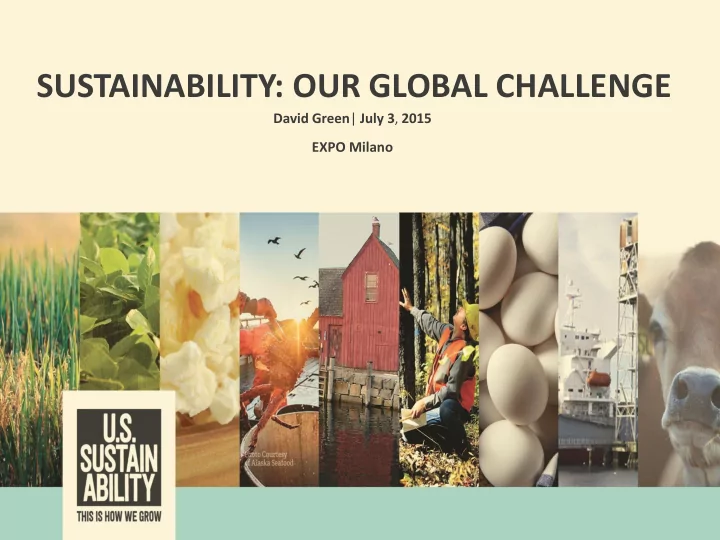
SUSTAINABILITY: OUR GLOBAL CHALLENGE
David Green| July 3, 2015 EXPO Milano
SUSTAINABILITY: OUR GLOBAL CHALLENGE David Green | July 3 , 2015 - - PowerPoint PPT Presentation
SUSTAINABILITY: OUR GLOBAL CHALLENGE David Green | July 3 , 2015 EXPO Milano | 1 U.S. Sustainability Alliance Our Partners USSA sponsors of USA Pavilion THE SUSTAINABILITY OF U.S. AGRICULTURE, FISHERIES & FORESTRY EU stakeholder
| 1
David Green| July 3, 2015 EXPO Milano
| 3
Unanimous interest in learning more about U.S. systems and processes:
– Stakeholders want to see a balanced view. – Demonstrate real on-going commitment & improvement. – Demonstrate an understanding of EU consumer concerns. – Support claims with hard data. – But put a human face to the issue.
EU stakeholder views with representatives from supermarkets, processors, importers, industry groups, academics, NGOs & media in United Kingdom, Germany, the Netherlands and Brussels
| 4
Linking the individual sustainability accomplishments
fisheries through the long history of conservation stewardship.
| 5
| 6
| 7
| 8
| 9
Conservation Compliance Conservation Reserve Program Conservation Stewardship Program Environmental Quality Incentives Program Agricultural Conservation Easement Program Technical Assistance and Other Conservation Programs Coordinated Framework for the Regulation of Biotechnology National Organic Program Lacey Act
| 10
Department of Commerce
Magnuson-Stevens Fisheries Management & Conservation Act
Environmental Protection Agency
Clean Air Act (including air emission aspects of CERCLA and EPCRA) Clean Water Act Renewable Fuel Standard and Biofuels Policy Federal Insecticide, Fungicide, and Rodenticide Act
| 11
Department of Health and Human Services
Food Safety Laws (including USDA laws)
Department of the Interior
Endangered Species Act
Department of Labor
Occupational Safety and Health Act
| 12
As producers, we are deeply invested in stewardship of the land and water, because the earth is our legacy. We believe being sustainable is not reaching an arbitrary threshold; it requires a commitment to innovation and continuous improvement. There is no greater motivation to protect our natural resources than our personal duty to posterity, and our belief that these principles lead to commercial success and economic prosperity.
| 13
– A consistent, predictable and trusted supply. – Safe food, fishery and agricultural products. – A diverse agricultural profile. – Commitment to continuous economic, social and environmental improvement.
| 14
Our ur Producers Our ur Commitment
Programs
Engagement
Our ur System Our ur Fou
studies
Toward the Shared Goal of Sustainability:
Predictable, Consistent Supply of Safe Products · Diverse Agricultural Profile · Continuous Environmental Improvement
Future Generations
Participation
Practices
Relationships
Audits
| 15
| 16
America’s Dairy Farmers: A Legacy of Stewardship, Sustainability and Social Responsibility
Chad Frahm
July 3, 2015
| 17
| 18
respectful workplace.
responsible use of natural resources.
economic vitality. The U.S. Dairy Industry supports socially responsible, economically viable and environmentally sound dairy food systems that promote the current and future health and well being of:
nutritious, high-quality products.
participating, and investing where we live and
| 19
Health and well-being through access to safe, nutritious, high-quality dairy products.
Milk nutrition USDA dietary guidelines call for more consumption of nutrient dense foods like low-fat or fat-free milk or milk products and foods that supply “nutrients of concern” like Calcium, Potassium, and Vitamin D. Milk safety – cow to consumer
manufacturers, etc. Milk is the No. 1 food source
| 20
Animal care and stewardship Education, documentation, transparency
– Animal Care Manual
– Animal care guidelines, protocols, and practices for entire lifespan of dairy cattle
– Herd Health Plan
– Written in consultation with herd veterinarian, established protocols, and reviewed annually
– Quick Reference User Guide, Animal Care DVD - all materials available online in English and Spanish
On-Farm Evaluation
External review of animal care practices using management checklists
Third-Party Verification 90% of U.S. Dairy Industry Enrolled
| 21
Through the stewardship and responsible use of natural resources, producing a gallon of milk now requires much fewer resources than 1944.
Cropland Water Carbon
90% less in 2007 65% less in 2007 63% less in 2007
Source: Capper JL, Cady RA, Bauman D. The environmental impact of dairy production: 1944 compared with 2007. J Anim Sci. 2009;87(6):2160-2167.
| 22
One of largest producers of milk in the world
– U.S. produced 201 billion lbs. of milk in 2013
One of the highest producers of milk per cow per year in the world
– U.S. dairy cows produce 4 times more milk than the world’s average cow
U.S. dairy farmers have the smallest impact
10.6 10.6 12.2 12.6 12.6 13.5 17.2 28.9 31.9 39.8 64.5 10 20 30 40 50 60 70 lbs CO2e / gal milk
GHG footprint for World Dairy Farms world average = 20.4
FAO n,d. Livestock Primary. Production. FAOSTAT. Food and Agriculture Organization. Accessed on August 18th, 2011. Website: http://faostat.fao.org/site/569/default.aspx#ancor FAO 2010. Greenhouse Gas Emissions from the Dairy Sector. A Life Cycle Assessment. Animal Production and Health
| 23
Click here for LCA Special Issue Click here for U.S. Dairy’s Environmental Footprint Click here for Considerations and Resources Report
| 24
| 25
115 companies & 184 professionals in the Sustainability Council
Alliance Dairies Fair Oaks Farms Fiscalini Farms Foster Brothers Farm Gar-Lin Dairy Farm Graywood Farm Haubenschild Farms Inc. Holsum Dairies Kooistra Farms Maddox Dairy MarBec Dairy Medeiros & Sons Dairy McCarty Family Farms Mystic Valley Dairy Nobis Dairy Prairieland Dairy Rovey Dairy Simonson Dairy Spruce Haven Farm Triple A Farms Werkhoven Dairy Coops & Farmers Crop Production Dairy Processor Transport Retail & QSR Community
Sustainability Council
We commit to being leaders in sustainability, ensuring the health and well-being of our planet, communities, consumers and the industry
Cheese Suppliers
Associations/Government
| 26
Voluntary GHG reduction goal…
GHG emissions per gallon of milk
collaborative work to reduce GHG, signed 2009 in Copenhagen.
President’s Strategy to Reduce Methane
New dairy-farmer owned company will focus on economically viable nutrient management solutions, generation of renewable energy and other solutions.
| 27
Chad Frahm Senior Vice President, Sustainability Innovation Center for U.S. Dairy Chad.Frahm@rosedmi.com
| 28
| 29
| 30
| 31
yield unit
climate stability
gas release
| 32
Focused on increasing diversity and abundance of pollinators Supports a thriving agricultural ecosystems long into the future Pollinator health is an important consideration in pest control methods
| 33
Organic supports soil sustainability Contributes to high oil nutrition levels, Boosts microbial diversity and activity, Offers excellent soil structure
| 34
www.ams.usda.gov/nop www.ota.com mmarez@ota.com Ww www.jmsmucker.com kim.dietz@jmsmucker.com
| 35
Jon Harman Alaska Seafood Marketing Institute
| 36
Globally Seafood major protein source
– 17% of animal protein we consume, 7% of total protein – High value protein, low in sat. fat, and carbohydrates, packed with micronutrients, vitamins and omega 3 – Three main sources, wild marine, wild inland and aquaculture – Total world supply 154MMT – Wild Caught 80-85MMT; fairly consistent last 25 years (=/-3% last 10 years) – US wild fishery ~ 4.2MMT, circa 5% of wild catch – Alaska accounts for 2.4MMT worth $1.7bn
| 37
ALASKA MAIN SPECIES:
SIN SINCE 1959, THE ALASKA CONSTITUTION HAS MANDATED THAT “FISH…BE UTILIZED, DEV DEVELOPED AND AND MAINTAINED ON THE SUSTAINED YIELD PRINCIPLE”
Alaska Pollock (1.3MMT) Salmon: 5 species
– King, Coho, Sockeye, Pink & Keta (0.3MMT)
Crab:
– King crab, Snow Crab & Dungeness Crab (0.25MMT)
Alaska flatfish (0.25MMT) Alaska Pacific Cod Halibut Black Cod Other species: Shrimp, oysters, sea cucumbers, sea urchins etc.
| 38
Economic > Environment and stocks >Social and cultural
Complex inter-relationship requiring constant fine tuning, rarely in a “steady state” and more often in constant flux
1976: US passed Magnuson-Stevens Act
– Limited access to fisheries (US) – Rights control & ownership, management. – Focused on eliminating overfishing – Reduce bicatch & environmental impacts US Fisheries: – exceedingly well managed – 91% stocks NOT overfished AK no stocks overfished – Compare 66% NOT overfished NE Atlantic,
– US and AK high proportion of fish caught with science assessment
| 39
ALASKA: FISHING ECONOMICALLY IMPORTANT Largest private employer : 60,000 direct jobs, 10-20,000 indirect jobs Annual catch worth around $1.7bn Commercial fishing and seafood processing are vitally important for many rural, coastal communities in Alaska. The industry accounts for roughly a third of all private sector employment occurring in rural Alaska. Alaska’s commercial fleet is about 6,500 boats. There are 120 shoreside plants.
| 40
– Communities have a willingness to help enforce the sustainability practices mandated by the state. Alaskans recognise the need to protect and maintain the fisheries and the surrounding habitat for future generations.
harvesting and processing Alaska seafood for generations.
a way of life; a relationship with the land and sea; and a culture of fishing that defines the community.
| 41
Since 1959, the Alaska Constitution has mandated that “fish…be utilized, developed and maintained
(Note: concept of MSY introduced EU 2006) Every aspect of Alaska’s fisheries has been strictly regulated, closely monitored and rigidly enforced for nearly five decades All Alaska seafood is wild and sustainable, and it is managed for protection against overfishing, habitat damage, and pollution Alaska is dedicated to preserving and protecting this superior seafood for future generations Alaska sets the standard for precautionary resource management Alaska’s successful management practices are considered a model of sustainability for the entire world
| 42
Collaboration between the federal government and the State of Alaska to monitor environment and to protect aquatic habitats and ecosystems Over 40 Marine Protected Areas (MPAs) established to protect ecological structure and function Of these 40 Marine Protected Areas, 31 prohibit either all commercial fishing or all bottom contact gear, such as trawls
| 43
| 44
THE ALASKA SALMON STORY
Commercially fished since 1880’s Early 1950’s recognized to be in some difficulty River systems surveyed and assessed for required fish numbers = escapement Escapement allows for spawning, sport fisheries and the predators like the bears! The salmon season is operated in a series of “openings” to allow those numbers to enter river system The Alaska Department of Fish and Game monitors salmon “escapement” by basically counting the fish When escapement goals are met, the fishery is opened for a set amount of time in a set area. Alaska also regulations on size limits for boats and the gear types available for use. The number of fishers participating in the fishery is also limited. Biologists at a salmon weir in Kodiak, Alaska
| 45
THE ALASKA POLLOCK STORY
Alaska pollock largest sustainable fishery on the planet. All vessels operate on-board
verification of the catch & location. Satellite technology tracking of exact position at any given time. Completely traceable products, to the boat’s position, date, time
specific haul. Genuine Alaska pollock is 100% traceable back to the vessel and all Genuine Alaska pollock is fished in Alaskan waters.
| 46
Sustainability is nothing new in Alaska. Alaska RFM is a third-party certification of the management of the major Alaska commercial fisheries and cover the major Alaska fisheries Based on the United Nations Food and Agriculture Organization (FAO)
Code of Conduct for Responsible Fisheries (Code) FAO Guidelines for the Ecolabelling of Fish and Fishery Products from Marine Capture Fisheries (Guidelines) –
Both recognized around the globe as the best criteria for responsible fisheries management. MSC certification cover Alaska Pollock, Flatfish, Salmon, Pacific Cod
| 47
Thank You!
| 48
Jim Miller
American Soybean Association Director and USSEC Vice-Chair July 3, 2015 Milan, Italy
| 49
U.S. SOY FOR A GROWING WORLD
| 50
18 M hectares
(45 M acres)
hectares (907 acres)
agricultural exports
bushels per 2 acre or 53 bushels per acre)
MMT=Million Metric Ton M=Million MT=Metric Ton
U.S. SOY FOR A GROWING WORLD
| 51
(3,400 acres) & 280 hectares (700 acres) of
pasture/grazing
FINISH OPERATION
U.S. SOY FOR A GROWING WORLD
| 52
Storage
approximate production Risk Management
U.S. SOY FOR A GROWING WORLD
| 53
the future
U.S. SOY FOR A GROWING WORLD
| 54
Biotechnology
and insect-resistant maize modes of action in 1996
sustainability goals
crop protection agents used Sustainability
U.S. SOY FOR A GROWING WORLD
U.S. SOY FOR A GROWING WORLD
| 56
U.S. SOY FOR A GROWING WORLD
| 57
U.S. SOY FOR A GROWING WORLD
| 58
sustainable:
less energy
Source: Council for Agricultural Science and Technology (2009)
U.S. SOY FOR A GROWING WORLD
| 59
the millimeter
U.S. SOY FOR A GROWING WORLD
| 60
conservation laws
participate
U.S. SOY FOR A GROWING WORLD
U.S. SOY FOR A GROWING WORLD
U.S. SOY FOR A GROWING WORLD