SURREY COASTAL FLOOD ADAPTATION STRATEGY (CFAS) General Phase 1 - - PowerPoint PPT Presentation

surrey coastal flood adaptation strategy cfas
SMART_READER_LITE
LIVE PREVIEW

SURREY COASTAL FLOOD ADAPTATION STRATEGY (CFAS) General Phase 1 - - PowerPoint PPT Presentation

SURREY COASTAL FLOOD ADAPTATION STRATEGY (CFAS) General Phase 1 Workshop Presentation (February 3 through March 8, 2017) Agenda Introductions and Overview Project Overview Activity 1 Hazards BREAK Activity 2 Issues

slide-1
SLIDE 1

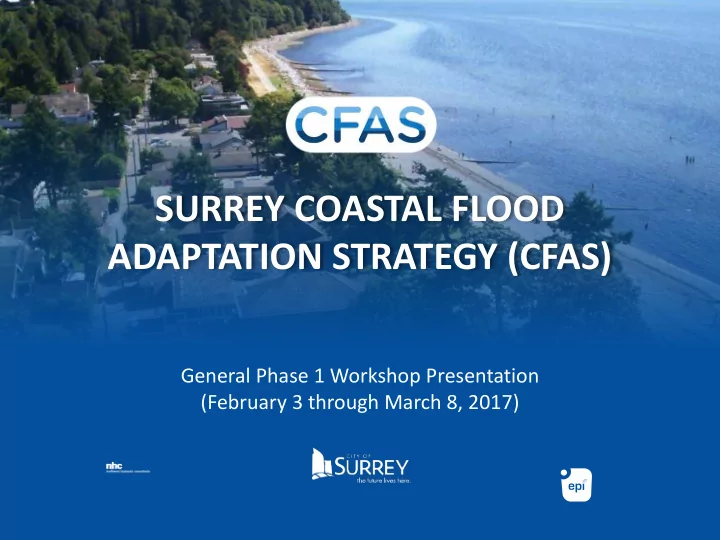
SURREY COASTAL FLOOD ADAPTATION STRATEGY (CFAS)

General Phase 1 Workshop Presentation (February 3 through March 8, 2017)

slide-2
SLIDE 2

Agenda

  • Introductions and Overview
  • Project Overview
  • Activity 1 – Hazards
  • BREAK
  • Activity 2 – Issues and concerns
  • BREAK
  • Activity 3 – Options identification – concerns (if time permits)
  • Next Steps
slide-3
SLIDE 3

INTRODUCTIONS

CFAS Focus Group

slide-4
SLIDE 4

Our objectives for the day

  • Get a better understanding of:

– Sea level rise and its impacts on coastal flooding in Surrey, – Coastal flooding hazards it presents (short-, medium- and long-term) – The Coastal Flood Adaptation Strategy (CFAS) project

  • Identify your issues and concerns around coastal flooding
  • Explore some preliminary options for addressing coastal flood hazards
  • Discuss how best to keep you engaged in the CFAS project
slide-5
SLIDE 5

PROJECT OVERVIEW

CFAS Focus Group

slide-6
SLIDE 6
  • 2011 Provincial Guidelines on sea

level rise published

  • Outlined expected sea level rise

and flood protection requirements

  • 2012 report estimated the cost to

adapt flood protection to meet the rise in sea level predicted by 2100

  • $9.5 Billion estimate for Lower

Mainland

– Estimate of works in Surrey, $1.5B

Introduction & Summary

slide-7
SLIDE 7

Introduction & Summary

  • Multiple Surrey plans

and initiatives recognize challenge

  • CFAS a product of this

work and the next step

slide-8
SLIDE 8

Introduction & Summary

  • CFAS is also continuing

Surrey’s commitment to community-driven, participatory planning

slide-9
SLIDE 9
  • Meeting an identified

challenge

  • Building on past work
  • Linked to current work
  • Continuing commitment to

participatory planning

  • Launched in fall 2016
  • 3-year timeline
  • Large study area with many

communities, stakeholders and partners

STUDY AREA

slide-10
SLIDE 10

Many residential areas and neighbourhoods Semiahmoo First Nation 1,500+ residents Approximately 20% of Surrey’s land area COMMUNITIES AND PEOPLE Destination regional and City parks Beaches and recreation areas Critical foreshore, coastal, and riparian areas PARKS AND ENVIRONMENT 700+ jobs Over $100M in annual farm gate revenue Over $1B in assessed property value Almost $25B annual truck and rail freight traffic LOCAL AND REGIONAL ECONOMY Over 10km of Provincial Highways Over 200,000 vehicle trips a day Over 30km of railway (freight, passenger) INFRASTRUCTURE

Study area @ a glance

slide-11
SLIDE 11

Surrey CFAS Process

  • Many stakeholders

– Farmers and agricultural community – Residents, businesses, community groups – Environmental and recreational groups – Infrastructure operators and

  • wners

– Semiahmoo First Nation

slide-12
SLIDE 12

Surrey CFAS Process

slide-13
SLIDE 13

COASTAL FLOODING & SEA LEVEL RISE

CFAS Focus Group

slide-14
SLIDE 14

Surrey’s Coastal Floodplain

  • A natural floodplain
  • Regularly experiences coastal flooding
  • Ocean-driven flooding (storm surges, king tides)
  • River-driven flooding (rain storms, rapid snow melt)
slide-15
SLIDE 15

The Serpentine & Nicomekl Rivers Flooding

Coastal Flooding in Surrey

January 1968

slide-16
SLIDE 16

The Serpentine & Nicomekl Rivers Flooding

January 1968

slide-17
SLIDE 17

The Serpentine & Nicomekl Rivers Sea Dams CITY FLOOD PROTECTION SERPENTINE & NICOMEKL RIVER

January 2009

slide-18
SLIDE 18

Serpentine WMA

January 2009

slide-19
SLIDE 19

Winter 2016

slide-20
SLIDE 20

Flood Management

  • A long history of work
  • 1890’s first dykes
slide-21
SLIDE 21

Flood management

slide-22
SLIDE 22
slide-23
SLIDE 23

Approximate sea level rise since 1972

Prudhoe Bay: 4cm Sand Point: 4cm Prince Rupert: 4cm Vancouver: 1cm Seattle: 8cm San Diego: 9cm New Orleans: 36cm Miami Beach: 10cm New York City: 11cm Halifax: 12cm

  • St. Johns: 8cm
slide-24
SLIDE 24

Climate Change and Coastal Floods

  • Coastal cities around the world are facing

same challenges

  • Province directed municipalities to plan for

at least 1 m sea level rise by 2100

  • In Surrey and elsewhere most drainage

systems not designed for projected changes

slide-25
SLIDE 25

Sea dams

slide-26
SLIDE 26

Tide out: open Tide in: closed Flood risk: river

Sea Dams

Flood risk: ocean

slide-27
SLIDE 27

Floodboxes

slide-28
SLIDE 28

Floodboxes

slide-29
SLIDE 29

Spillways

slide-30
SLIDE 30

Spillways

slide-31
SLIDE 31

Spillways

slide-32
SLIDE 32

Spillways

slide-33
SLIDE 33

Pumps

slide-34
SLIDE 34

Pumps

slide-35
SLIDE 35

Pumps

slide-36
SLIDE 36

Pumps

slide-37
SLIDE 37

Ocean Dykes

slide-38
SLIDE 38

Ocean Dykes

slide-39
SLIDE 39

Coastal Flooding and Sea Level Rise

slide-40
SLIDE 40
slide-41
SLIDE 41

Extreme Floods

  • Climate change is affecting intensity and

frequency of storms and flood events

  • Extreme floods of today become more

frequent in the future

slide-42
SLIDE 42

Extreme Flood Events

  • Flood of 1948

– +1 metre depth – flowing water

slide-43
SLIDE 43

Calgary 2013 - flood

Extreme flood

– Homes flooded – Electricity failed – Vehicles carried off roadways – Residents evacuated

slide-44
SLIDE 44
slide-45
SLIDE 45

Flood Frequency

chance of an extreme flood today

slide-46
SLIDE 46

Flood Frequency

chance of an extreme flood in 2100

slide-47
SLIDE 47

England 2016 - flooding

Extreme flood

– Homes flooded – Electricity failed – Vehicles carried off roadways – Residents evacuated

slide-48
SLIDE 48

Hazards and Impacts

  • Agriculture

– Increased flooding – Poor and reduced field drainage – Increased risk of soil salination – Impacts field crop planting, growing season, and harvesting

slide-49
SLIDE 49

Hazards and Impacts

  • Community & Residential

– Surface ponding and so-called nuisance flooding may become near permanent

  • ver time in Crescent Beach

– Increased chance of road closures and lengthy detours from flooding and

  • vertopping during storm surges

– Property damage – residential and commercial – Business interruptions – Catastrophic flooding will become frequent (without future improvements)

slide-50
SLIDE 50

Hazards and Impacts

  • Environmental & Recreation

– Foreshore and coastal habitat loss from sea level rise – Riverbank habitat loss from river flooding and erosions – Species loss (and extirpation) due to habitat loss – Increased predation of spawning salmon trapped on ocean-side of closed sea dams

slide-51
SLIDE 51

Natural Shoreline

The Intertidal zone occurs between the low tide and high tide.

slide-52
SLIDE 52

Shoreline with Dyke

The placement of a dyke prevents natural migration of the salt marsh along the intertidal zone, causing coastal squeeze.

slide-53
SLIDE 53

Sea Level Rise

Sea level rise further places the intertidal zone at risk. The salt marsh is further squeezed or lost altogether as it becomes submerged for longer durations.

slide-54
SLIDE 54

Hazards and Impacts

  • Transportation & Infrastructure

– Changing climate and more extreme weather is exposing infrastructure to impacts it was not originally designed to withstand – This exposure may reduce its useable lifespan and as well as expose residents to disruptions to their lives and daily routines. – Serpentine sea dam is not seismically sound – Few Serpentine or Nicomekl River dykes will meet the Provincial 200-year flood standard by 2020 – By 2070, it is expected that all dykes will be overtopped multiple times per year, with overtopping likely resulting in dyke failure. – At present, under the 200-year flood condition, a portion of Highway 99 would be inundated, including bridge decks at three locations – Serpentine and Nicomekl dykes not high enough to protect against anticipated 2100 flood levels – Erosion, interruption of railway operations and goods movement

slide-55
SLIDE 55

Adaptation Approaches

Protect Accommodate Retreat Combination

slide-56
SLIDE 56

Protect Raise Coastal and River Dykes Offshore Sea Barrier Offshore Barrier Islands Protect

slide-57
SLIDE 57

57

Offshore Islands Breakwater or Jetty

slide-58
SLIDE 58

Source: http://www.industrytap.com/the-great-wall-of-louisiana/677

slide-59
SLIDE 59

Accommodate Wet Proofing Dry Proofing Build on Fill Crop Reorganization Wetland Restoration Raised Structures

slide-60
SLIDE 60

Housing on pile foundations in Rotterdam

http://frameworks.ced.berkeley.edu/2015/a-modest-proposal- adapting-to-sea-level-rise/

Coastal marsh restoration

https://blog.savesfbay.org/2014/04/climate-report-supports- wetland-restoration-as-sea-level-rise-adaptation-strategy/

Wet Proofing Strategies

http://cnycn.org/2014/10/copin g-with-big-flood-insurance- changes-in-nyc-part-iv- mitigation/

slide-61
SLIDE 61

Retreat Managed Retreat Complete Retreat

slide-62
SLIDE 62

Retreat at Abbotts Hall Farm, Essex UK

http://factfile.org/8-facts-about-abbotts-hall-farm

slide-63
SLIDE 63

NEXT STEPS

CFAS Focus Group

slide-64
SLIDE 64

CFAS Next Steps

  • City Speaks Survey
  • Open house April 26
slide-65
SLIDE 65

CFAS Next Steps

  • Issues and concerns – issues to objectives
  • Objectives and measures – rank and prioritize
  • Using objectives to evaluate adaptation
  • ptions
slide-66
SLIDE 66

More information?

www.surrey.ca/coastal coastal@surrey.ca

slide-67
SLIDE 67

SURREY COASTAL FLOOD ADAPTATION STRATEGY (CFAS)

Thank you!