
SLIDE 1
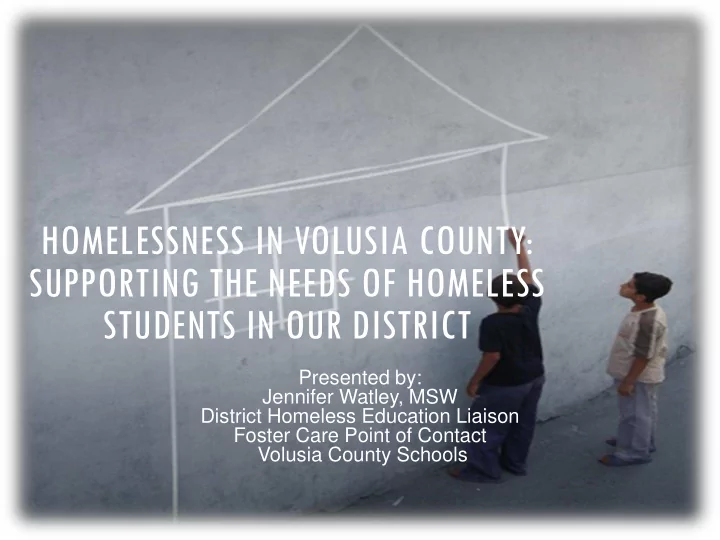
HOMELESSNESS IN VOLUSIA COUNTY: SUPPORTING THE NEEDS OF HOMELESS STUDENTS IN OUR DISTRICT
Presented by: Jennifer Watley, MSW District Homeless Education Liaison Foster Care Point of Contact Volusia County Schools
SUPPORTING THE NEEDS OF HOMELESS STUDENTS IN OUR DISTRICT Presented - - PowerPoint PPT Presentation
HOMELESSNESS IN VOLUSIA COUNTY: SUPPORTING THE NEEDS OF HOMELESS STUDENTS IN OUR DISTRICT Presented by: Jennifer Watley, MSW District Homeless Education Liaison Foster Care Point of Contact Volusia County Schools Increase awareness about
Presented by: Jennifer Watley, MSW District Homeless Education Liaison Foster Care Point of Contact Volusia County Schools
Increase awareness about students who are homeless and in foster care
Increase
Explain federal law and school requirements as it relates to them
Explain
Promote an understanding of barriers that these students experience
Promote
Provide information on how we support educational stability for these children and youth
Provide
EVERY TWO MINUTES A CHILD BECOMES HOMELESS IN AMERICA
High School Identified Homeless 5%FRL Actual FRL #’s Atlantic 24 39 794 Deland 46 76 1533 Deltona 40 70 1238 Mainland 46 71 1426 New Smyrna 19 52 1044 Pine Ridge 48 63 1264 Sea Breeze 10 33 670 Spruce Creek 60 54 1081 Taylor High 22 46 937 University 90 87 1743
24 46 40 46 19 48 10 60 22 90 39 76 70 71 52 63 33 54 46 87 10 20 30 40 50 60 70 80 90 100 Atlantic Deland Deltona Mainland New Smyrna Pine Ridge Sea Breeze Spruce Creek Taylor High University
5% Free and reduced Lunch Numbers versus Identified Homeless in High Schools
Identified Homeless 5%FRL
In 2015/16 reports from Miami Homes for All indicated that approximately one in ten homeless students state wide were an unaccompanied youth (HUY) Reports shared that this population is particularly vulnerable to victimization and exploitation, and are at an increased risk for developing both physical and mental health complications.
According to this report, few counties in Florida
that can accommodate HUY.
Head Start operates 17 Centers in Volusia County and currently serves 977 children. Of these 17 Head Start sites, 5-blended sites have been established at
Blue Lake Elementary (DeLand)) Deltona Lake Elementary Woodward Elementary (DeLand) Indian River Elementary (Edgewater) Horizon Elementary (Port Orange)
Head Start employs the use of a homeless questionnaire to help with identification of homeless students. The presently have 16 students Identified.
Families that are homeless tend to hide their situation. We may often see the changes below before a parent lets us know what is happening. They need to be assured the school will support their
their staff is trained. Students may be homeless if you see any of the following:
arrangements or moving around
their housing and moved out of zone
Enroll in school without having a permanent address
Enroll and attend school while arranging for required school records or documents
Remain in the school attended before becoming homeless (called school of origin)
▪Attend school and participate in school programs with students who are not homeless ▪Receive special programs and services for which they are eligible ▪Receive assistance with transportation to school
IDEA B&C Contain specific obligations to serve children and youth with disabilities who are homeless as part of IDEA’s “Child Find” Part B mandates that states implement the McKinney-Vento Act and provide a Free Appropriate Education (FAPE) for students with disabilities who are homeless.
Vento requires a parallel
to provide FAPE
Part C requires states to Provide early intervention services to infants and toddlers with disabilities who are homeless. IDEA ensures FAPE in the least restrictive environment (LRE)
In the 2015/16 school year, 72,601 students in Florida were identified as homeless. Over 5,000 homeless children and youth with disabilities (IDEA)
74% were doubled up with family or friends 11% were living in motels, and 10% in shelters More than 1,000 students were living in cars, parks, or tents. More than one in ten were Homeless Unaccompanied Youth (HUY)
Students who switch schools frequently score lower on standardized tests Mobility also hurts non-mobile students It takes children 4- 6 months to recover academically after changing schools Students suffer psychologically, socially, and academically from high mobility and are less likely to participate in school activities
Absenteeism was more common among students identified as homeless. 9% were habitually truant (15 unexcused absences within a 90- day period) Less likely to demonstrate proficiency in academic subjects based on FSA scores Homeless students were more likely to be subject to disciplinary action. 16% of homeless students were suspended at least
▪Attendance ▪Transportation ▪Academic Achievement ▪School Stability ▪Services ▪Community Linkages
ESSA Changed Law as it relates to Homeless and Foster Care
Took Effect December 10, 2016
Gives children and youth in foster care many of the same rights
Focuses on school enrollment & stability
Requires collaboration with child welfare agencies
Sections 1001.41; Florida Statutes Laws Implemented: Section 1003.01 (12), 1003.21 (1)(f); Florida Statutes McKinney-Vento Homeless Education Assistance Act VCS Student/Pupil Policy Number 209 (adopted and effective July 28, 2009) University of Florida; Shimberg Center for Housing Studies & Miami Homes for All. Homelessness and Education in Florida: Impacts on Children and Youth. Executive Summary 2015/16. www.shimberg.ufl.edu & www.miamihomesforall.org Skip Forsyth, Florida Council on Homelessness (2016) Every Student Succeeds Act: A Primer. Cynthia Ritchie, MPA, Mid Florida Community Services Head Start www.mfcs.us.com Homeless and Special Education Administrative Collaboration: October 2008, Project Forum at NASDSE. School House Connection; March 15, 2017: The Well-being of Young Children after Experiencing Homelessness: www.schoolhouseconnection.org/the-well-being-of-young-children-after- experiencing-homelessness/.