Supported Decision- Making for People with Developmental - - PDF document

supported decision making for people with developmental
SMART_READER_LITE
LIVE PREVIEW

Supported Decision- Making for People with Developmental - - PDF document

Supported Decision- Making for People with Developmental Disabilities Samantha Crane, J.D., Policy Director The Autistic Self Advocacy Network 2013 H St. 7 th Floor Washington, DC 20035 Voice: (202) 596-1056 www.autisticadvocacy.org What


slide-1
SLIDE 1

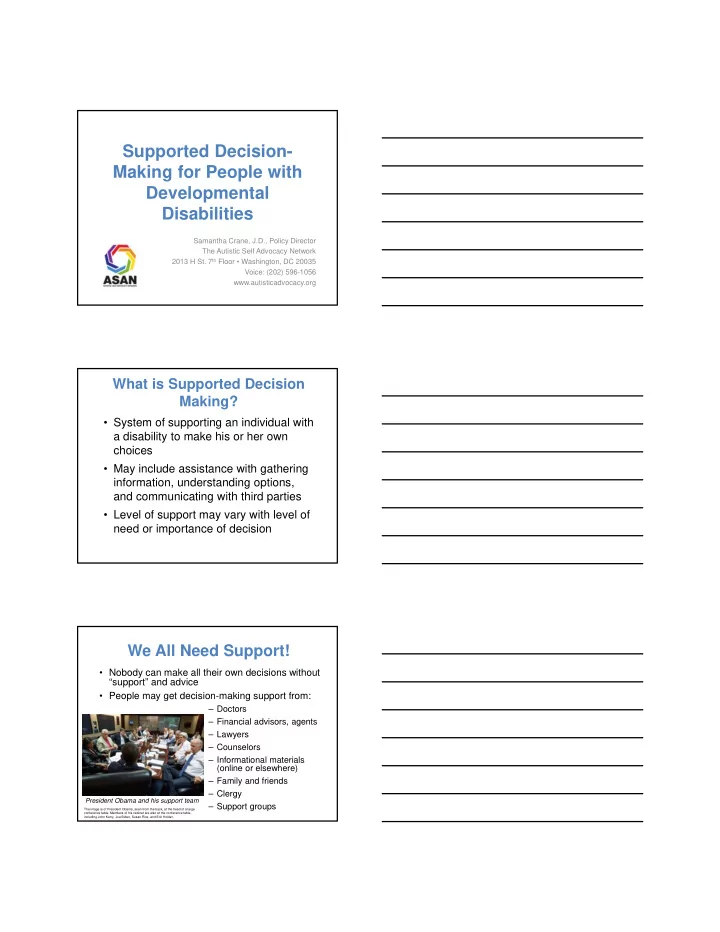
Supported Decision- Making for People with Developmental Disabilities

Samantha Crane, J.D., Policy Director The Autistic Self Advocacy Network 2013 H St. 7th Floor • Washington, DC 20035 Voice: (202) 596-1056 www.autisticadvocacy.org

What is Supported Decision Making?

  • System of supporting an individual with

a disability to make his or her own choices

  • May include assistance with gathering

information, understanding options, and communicating with third parties

  • Level of support may vary with level of

need or importance of decision

We All Need Support!

  • Nobody can make all their own decisions without

“support” and advice

  • People may get decision-making support from:

– Doctors – Financial advisors, agents – Lawyers – Counselors – Informational materials (online or elsewhere) – Family and friends – Clergy – Support groups

President Obama and his support team

The image is of President Obama, seen from the back, at the head of a large conference table. Members of his cabinet are also at the conference table, including John Kerry, Joe Biden, Susan Rice, and Eric Holder.

slide-2
SLIDE 2

People with ID/DD Can Face Additional Challenges

  • Difficulty understanding and remembering

advice and information, or need for cognitive supports (e.g., visual explanations, simplified materials)

  • Difficulty communicating information or

decisions, or need for communication supports (e.g., AAC, written communication)

  • Need for support to learn and carry out

decision-related tasks (e.g., following health care regimen, balancing checkbook, navigating neighborhood)

  • Lack of accessible information

How it Works

  • Person with a disability chooses

supporter

  • Supporter helps to:

– Gather, organize, translate information – Communicate with doctors, bankers, etc. – Explain and explore options and consequences

  • Person with disability makes final

decision

Supported vs. Substituted Decisionmaking

Supported Decisionmaking

  • Individual makes own

decisions (with support)

  • Individual decides who

will provide support

  • Level of support may vary

according to situational factors

Substituted Decisionmaking

  • Another person makes

decisions for the individual

  • Individual may not have
  • pportunity to decide who

will provide support

  • Individual loses legal

capacity to act independently across entire domain

slide-3
SLIDE 3

Unjustified Isolation Is Discrimination: The Olmstead Case Against Overbroad and Undue Organizational and Public Guardianship

Jenny Hatch, Samantha Crane, Jonathan Martinis Inclusion Vol. 3, No. 2, 65–74 (June 2015), http://aaiddjournals.org/doi/abs/ 10.1352/2326-6988-3.2.65

Image is of the cover of the journal "Inclusion." The subtitle reads "The eJournal of the American Association

  • f Intellectual and Developmental Disabilties" and

"aaidd.org."

Isolating Effects of Guardianship

In guardianship:

  • Person with disability cannot make decisions

without approval of guardian

  • People with disabilities become

“disconnected” from decision process and fail to gain – or may even lose – decision-making skills

  • People with disabilities may be

“constructively isolated” from community due to inability to enter into contracts, find housing, see doctor, or go shopping without

  • guardian. - Leslie Salzman

More Isolating Effects of Guardianship

In guardianship:

  • Challenges to guardian’s decision and/or resolution of

conflicts among family members require lengthy court process

– If person with disability lacks assistance with this process, a challenge may not be possible at all

  • Crowded dockets -> Limited court oversight
  • Courts often avoid “limited” guardianships – even

though they’re supposed to favor them – because they want guardians to have as much authority as possible

– Will assume that limited guardians will eventually come back to court seeking additional authority, adding burden to court docket

slide-4
SLIDE 4

Public Guardianships: Special Problems

  • Guardians with multiple wards may opt

for “one size fits all” approach to decisionmaking

  • Guardians do not have personal

relationship with ward, may face communication barriers, may lack background information about ward’s preferences and personality

Example: Washington State

  • Professional guardians tried to “bill” wards for

the time they spent advocating against Olmstead enforcement

  • Court denied payment because there had

been no individualized determination that this advocacy was in the “individualized best interest” of each ward.

  • Guardians represented dozens of individuals

at a time.

  • In re Guardianship of Lamb, 265 P.3d 876,

877 (Wash. 2011)(en banc).

Long-Term Consequences of Presumed Incompetence

  • Inadequate focus on building skills that the

person doesn’t already have – especially in preparation for transition to adulthood

  • Third parties may speak directly to support

persons instead of including people with ID/DD in conversations about their own lives

  • Doctors may refuse treatment to people with

ID/DD who don’t have a guardian, out of fear that people with ID/DD can’t provide “informed consent” to own care

  • Landlords, banks, car dealers, etc. may not

recognize person’s ability to sign contract without help from guardian, fearing it will be voided

slide-5
SLIDE 5

How SDM helps

  • Centers person with a disability in

decision-making process

  • Tailors support to amount needed
  • Helps build decision-making experience

and skills

  • Requires supporters to commit to

interactive process

  • Holds supporters accountable to person

with disability

Beyond “Guardianship Reform”: Combining Autonomy with Support

  • Under guardianship model, autonomy of a

person with cognitive or intellectual disability must be limited to protect the person from exploitation, manipulation, or “bad choices”

  • Early civil libertarian critiques focused on

imposing guardianship only when a person is “truly unable” to make decisions independently

  • Supported decision making acknowledges

need for support while preserving autonomy

How to Make SDM Work for Everyone?

Reforms across multiple systems:

  • Courts: change laws to favor supported

decisionmaking over guardianship

  • Support Professionals: stop “guardianship

pipeline”

  • Service Systems: ensure that people have

actual access to decision-making supports

  • Third Parties: make sure doctors, landlords,
  • etc. understand SDM; provide certainty that

acting consistently with SDM will result in enforceable contracts/health care decisions.

slide-6
SLIDE 6

Implications for Health Professionals

  • Look “beyond guardianship”:

– Can person give informed consent with support? – Can you combine health care proxy or state surrogate decision-making laws with SDM principles? – Existence of a guardian does not mean that a person cannot use supported decision-making as well

Challenges

  • Many professionals unfamiliar with

supported decision-making

  • Professionals may be concerned about

liability

  • Individuals may lack access to

documents clearly outlining support relationship

Supported Decision-Making Legislation

  • ASAN developed model legislation

recognizing Supported Health Care Decision- Making Agreements, a new type of agreement designed to meet the needs of people with significant support needs

  • Developed in collaboration with Quality Trust

for Individuals with Disabilities – a D.C.-based non-profit focusing on self-determination for people with significant disabilities

  • In process of creating broader legislation for

financial, other decision-making

slide-7
SLIDE 7

http://autisticadvocacy.org/2014/07/asan-unveils-toolkit-for- advocates-on-health-care-and-the-transition-to-adulthood/

The image is of the first page of ASAN's modern legislation. At the top of the page is the ASAN logo and the text "Autistic Self Advocacy Network, Nothing about us without us!" In the middle of the page is the text: "Model legislation developed in collaboration with Quality Trust. AN ACT RELATING TO THE RECOGNITION OF A SUPPORTED HEALTH CARE DECISION-MAKING AGREEMENT FOR ADULTS WITH DISABILITIES"

Benefits of Supported Decision-Making Legislation

  • Gives individuals clear option to create

recognized support relationship

  • Avoids costly, traumatic, and/or

lengthy court proceedings

  • Individuals are protected from many

forms of abuse or exploitation because they retain capacity to go against wishes of support person

ASAN’s Model Legislation

  • Allows supported decision-making

arrangements in health care contexts

  • Supporters can access health

information, communicate with health providers under exception to HIPAA

  • Includes standard form in simple

language

  • Provides protection to doctors who follow,

in good faith, directions made through supported decision-making

slide-8
SLIDE 8

How We Designed the Model Legislation

  • Reviewed published guardianship

decisions in past decade to identify why courts awarded guardianship in contested cases

– Major factors were perceived lack of acceptable alternatives, desire to make sure person is “taken care of”

  • Analyzed supported decision-making

legislation in other countries, including Canada, Sweden, U.K.

Major Goals

  • Accessibility to people with limited financial, educational

resources

– Litigating a guardianship case can cost thousands of dollars – Most Americans lack ready access to legal representation – Court proceedings may take a long time

  • Availability to people with significant cognitive impairments

– Process must be understandable – Agreement must be valid even if person has support needs

  • Preservation of decision-making rights

– Goal is self-determination – “Private” agreements that involve potential relinquishment of rights give rise to potential for abuse

Other Considerations

  • Alleviating liability concerns that may

contribute to discriminatory denial of care for people with ID/DD who don’t have guardian

  • Respecting diversity in choice of supporter
  • Avoiding conflict of interest
  • Preventing abuse / providing clear process

for reporting abuse

  • Preventing fraud
slide-9
SLIDE 9

Overview of Legislation

  • Allows person with ID/DD to execute Supported

Health Care Decision-Making Agreement, naming a supporter

  • Supporter is authorized to assist in decision-

making, including communicating with / facilitating communication with doctors, obtaining records, making appointments, accompanying person to appointments, assisting in daily health routines

  • Person with disability makes all final decisions
  • Decision made with support can count as

“informed consent”

Preventing Fraud

  • “Private” agreement eliminates need for court

involvement (in most cases) – this is necessary to ensure access

  • Agreement must be witnessed and notarized,

reducing potential for fraud

– Many similarly high-stakes agreements, like powers of attorney, often have similar protections (depending on state)

  • Person with disability must actively

participate in decision-making; supporter cannot fulfill most support functions without person’s knowledge

Minimizing Conflicts of Interest

  • Conflict of interest provisions restrict who

may serve as supporter

– Treating physicians, people with major financial conflicts of interest, and staff in institutional settings cannot serve as supporters

  • Conflict of interest provisions designed to

ensure that spouses, parents, friends, and home support workers are not automatically excluded from serving as supporters

slide-10
SLIDE 10

Ensuring Availability to People with Significant Disabilities

  • Agreement is valid even if person with ID/DD is

considered unable to execute a valid power of attorney or provide “informed consent” without support

  • This is necessary because otherwise people would be

forced into unnecessary guardianship or would risk denial of care

  • Agreement preserves individual’s right to make final

decisions and to terminate agreement – unlike powers

  • f attorney which can allow agents to make

“unilateral” decisions for the individual. This ensures that people are protected in the case of an unforeseen problem with the supporter.

Preserving Doctors’ Role

  • Health providers retain ability to exercise

professional judgment regarding treatment

  • Do not have to provide care that they feel

is harmful or not medically beneficial

  • Do not have to provide care if they believe

that the supporter hasn’t conveyed important information to the individual, or suspect consent was obtained through abuse or coercion

Solving Disputes and Preventing Abuse

  • Doctors or others may report suspected

abuse to adult protective services agency

– These agencies often investigate complaints faster than guardianship courts can hold hearings on challenges of guardians’ conduct – Substantiated complaints will result in removal of supporter – In states with mandatory reporting laws, reports are mandatory

slide-11
SLIDE 11

State Implementation

  • In 2015, Texas passed supported decision-

making legislation

– ASAN model legislation incorporates key elements, but differs in some ways – Texas will pilot SDM agreements

  • Other target states: DE, MD, NY, CA
  • Some courts, including ones in New York and

Virginia, recognize that people with ID/DD can make decisions with support – but these relationships are often informal and lack clear definitions

Next Steps

  • The form in ASAN’s model legislation can be

used to help people express their intention to form a supported decision-making relationship – but may not be legally recognized or binding

  • Advocates can ask their state legislators to

pass legislation recognizing supported decision-making agreements

– The model legislation may serve as a “starting point”

In the Meantime…

  • The supported decision-making

agreement in the model legislation can still be created using special powers of attorney

  • There still may be challenges to capacity

if families are in conflict, and third parties may need to be educated about this type

  • f agreement.
  • National Resource Center for Supported

Decisionmaking is developing a supported decision-making “forms bank”