Agenda Conservatorship is a legal process, wherein: The Court - - PowerPoint PPT Presentation

agenda
SMART_READER_LITE
LIVE PREVIEW

Agenda Conservatorship is a legal process, wherein: The Court - - PowerPoint PPT Presentation

Supported Decision Supported Decision- -Making Making Supported Decision Supported Decision - - Making Making Civil Liberties Civil Liberties Civil Liberties Civil Liberties 1) The Problem with Conservatorships & & &


slide-1
SLIDE 1

Supported Decision Supported Decision Supported Decision Supported Decision-

  • Making

Making Making Making Civil Liberties Civil Liberties Civil Liberties Civil Liberties & & & & Alternatives to Conservatorship Alternatives to Conservatorship Alternatives to Conservatorship Alternatives to Conservatorship

Susan Mizner American Civil Liberties Union

Disclosure Form: Nothing to Disclose.

Agenda

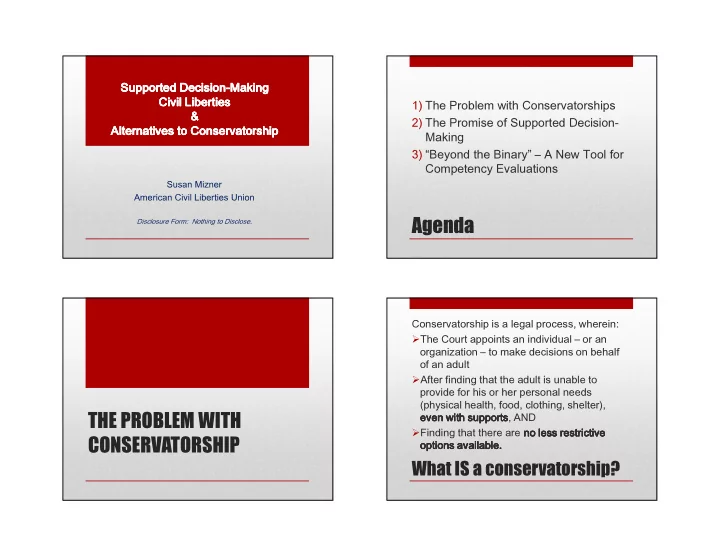
1) The Problem with Conservatorships 2) The Promise of Supported Decision- Making 3) “Beyond the Binary” – A New Tool for Competency Evaluations

THE PROBLEM WITH CONSERVATORSHIP

What IS a conservatorship?

Conservatorship is a legal process, wherein: The Court appoints an individual – or an

  • rganization – to make decisions on behalf
  • f an adult

After finding that the adult is unable to provide for his or her personal needs (physical health, food, clothing, shelter), even with supports even with supports even with supports even with supports, AND Finding that there are no less restrictive no less restrictive no less restrictive no less restrictive

  • ptions available.
  • ptions available.
  • ptions available.
  • ptions available.
slide-2
SLIDE 2

The Conservator Controls:

  • The Money
  • The Living Situation – home? Institution?
  • Religious Observances
  • Whether and where to work
  • Social Choices – up to and including

whether and when to marry

  • Choose who to spend time with, and who

NOT to

  • Medical decisions

What is the problem with Conservatorship?

“The typical ward has fewer rights than the typical convicted felon… By appointing a [conservator], the court entrusts to someone else the power to choose where they will live, what medical treatment they will get and, in rare cases, when they will die. It is, in one short sentence, the most punitive civil penalty that can be levied against an American citizen, with the exception… of the death penalty.” Claude Pepper Chairman of the House Select Committee on Guardianship Abuses

What is the problem with Conservatorship?

  • The Court is in control. Parents may wish to

be the conservator for their child, but the Court will make the ultimate decision.

  • Courts tend to grant full conservatorships –

broader than what the conservator or regional center recommends.

  • Courts don’t like to reverse conservatorships

– once put in place, they are hard to “undo.”

What is the problem with Conservatorship?

Studies show that ‘self-determination’ promotes both physical and mental health. For young people with disabilities, conservatorship may actually hinder development and undermine safety.

slide-3
SLIDE 3

THE PROMISE OF SUPPORTED DECISION-MAKING What is Supported Decision- Making?

  • Supported Decision Making is an

approach that allows people with disabilities to retain their legal status and to make their own decisions, but with the help of people they trust.

  • It is a less restrictive alternative to

conservatorship!

How does SDM work?

Supported Decision-Making recognizes that “capacity” is not all or nothing. People have the ability to make decisions depending on the issue and the context. We all use Supported Decision-Making, whether formal or informal, throughout our lives.

How does SDM work?

  • An individual does not rely on just ONE

person to provide the support – usually it is two or three.

  • The individual chooses the supporters

without going to court… AND can change supporters without going to court.

  • As capacity changes – either because of

learning new skills, or because of aging into disability – supports can be added or subtracted.

slide-4
SLIDE 4

What are some ways of providing support?

  • Identifying options
  • Evaluating Pro’s and Con’s
  • Reminding of values
  • Helping with logistics
  • Translating complicated ideas into plain

language

  • Helping to Communicate wishes to others

How do you know if SDM might work for your patient?

First step:

  • Go “Beyond the Binary” in Competency

Evaluations Second step:

  • Work with them in identifying potential areas of

support and candidates to provide that support.

A NEW TOOL FOR COMPETENCY EVALUATIONS

Competency Evaluation Tool

Traditional Evaluation Tools Traditional Evaluation Tools Traditional Evaluation Tools Traditional Evaluation Tools Ideal Evaluation Process Ideal Evaluation Process Ideal Evaluation Process Ideal Evaluation Process One Option One Option One Option One Option -

  • based on a model the Missouri

based on a model the Missouri based on a model the Missouri based on a model the Missouri AUCD developed AUCD developed AUCD developed AUCD developed

slide-5
SLIDE 5

Assessment Tool Beyond the Binary

Check this box if the person makes their

  • wn decisions
  • r can do this

task independently. Check this box if the person can make decisions or do this task with support. Describe supports needed or in place. Check this box if the person cannot do this task even with supports. Describe why supports don’t work.

PERSONAL CARE Choosing what to wear Getting dressed Choosing what to eat, and when to eat

TRAVEL

Traveling to routine places (for example, getting to work, stores, friends’ homes) Traveling to new places (for example, doctors’ appointments, special events)

Signing contracts and formal agreements Choosing whether to vote and whom to vote for

Thank you!

For more information, go to:

  • www.aclu.org/SupportedDecision

Making

  • www.moguardianship.org
  • www.jennyhatchjusticeproject.org