Supplemental Problem 2 due Friday Testing Clicker Questions Random - - PowerPoint PPT Presentation

supplemental problem 2 due friday testing clicker
SMART_READER_LITE
LIVE PREVIEW

Supplemental Problem 2 due Friday Testing Clicker Questions Random - - PowerPoint PPT Presentation

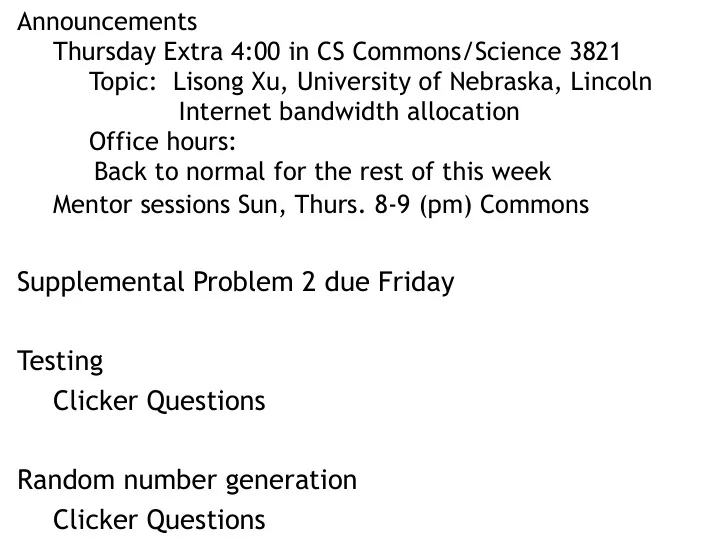
Announcements Thursday Extra 4:00 in CS Commons/Science 3821 Topic: Lisong Xu, University of Nebraska, Lincoln Internet bandwidth allocation Office hours: Back to normal for the rest of this week Mentor sessions Sun, Thurs. 8-9 (pm) Commons


slide-1
SLIDE 1

Announcements Thursday Extra 4:00 in CS Commons/Science 3821 Topic: Lisong Xu, University of Nebraska, Lincoln Internet bandwidth allocation Office hours: Back to normal for the rest of this week Mentor sessions Sun, Thurs. 8-9 (pm) Commons

Supplemental Problem 2 due Friday Testing Clicker Questions Random number generation Clicker Questions

slide-2
SLIDE 2

Write a function that returns the largest and the smallest of three numbers: Consider two approaches to solve this problem (distributed separated). Which code is correct?

  • A. Both Approach 1 and Approach 2
  • B. Approach 1, but not Approach 2
  • C. Approach 2, but not Approach 1
  • D. Neither Approach 1 nor Approach 2
slide-3
SLIDE 3

Suppose a program is supposed to

  • read 10 integers
  • find and print the largest
  • print the numbers in reverse order

How to identify appropriate tests:

  • base tests on statement of problem (black box testing)
  • look at code (white box testing)

Black box testing: is the following adequate?

  • test with largest in first position (e.g., 9, 8, …, 0)
  • test with largest in second position (e.g., 8, 9, 7, 6,…, 0)
  • … (e.g., put 9 in ith position, with 8, …, 0 elsewhere)
  • test with largest in 10th position (e.g. 8, 7, 6, … , 0, 9)
  • A. Adequate
  • B. Need a couple tests for each position
  • C. Need to randomize 0, …, 9
  • D. Use non-consecutive numbers, with repeats (e.g., 3, 1, 4, 1, …
  • E. Need something else (what?)
slide-4
SLIDE 4

Consider the following code segments for generating 10 random numbers: Approach 1:

for (int i = 0; i < 10; i++) printf ("%d", rand ());

Approach 2:

srand (time ((time_t *) 0) ); for (int i = 0; i < 10; i++) printf ("%d", rand ());

Approach 3:

for (int i = 0; i < 10; i++) { srand (time ((time_t *) 0) ); printf ("%d", rand ()); }

  • Ques. 1: Which print a list of pseudo-random numbers?
  • Ques. 2: Which print a different list of numbers with

each run?

  • A. 1 only
  • B. 2 only
  • C. 3 only
  • D. 1 and 2
  • E. some other

combination