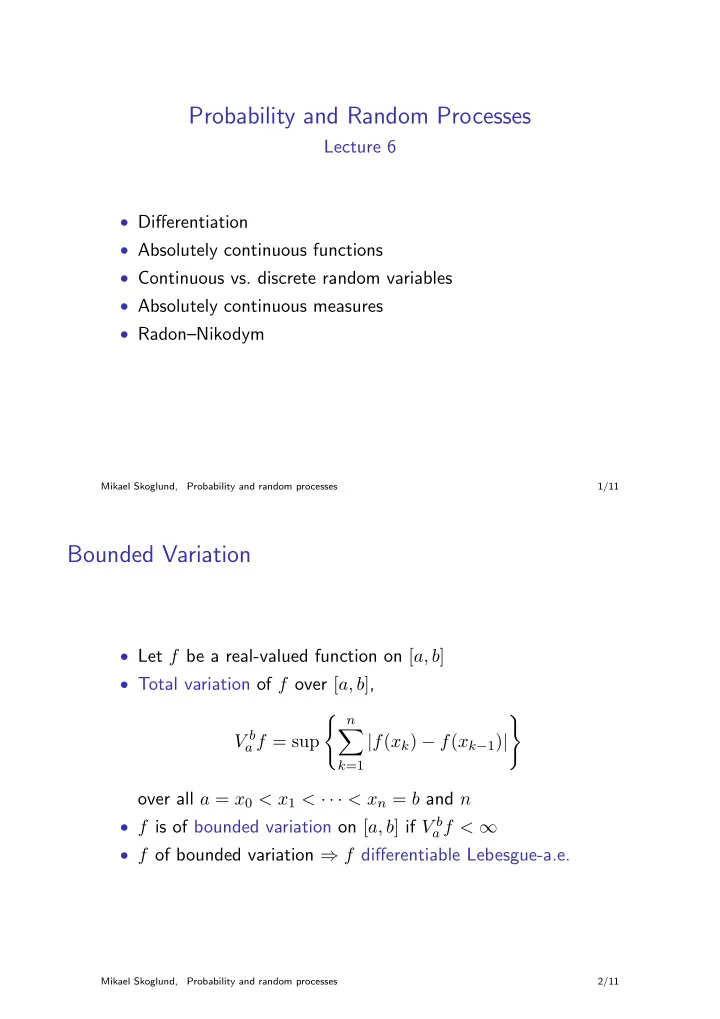
Probability and Random Processes Lecture 6 Differentiation - - PDF document

probability and random processes
SMART_READER_LITE
LIVE PREVIEW

Probability and Random Processes Lecture 6 Differentiation - - PDF document

Probability and Random Processes Lecture 6 Differentiation Absolutely continuous functions Continuous vs. discrete random variables Absolutely continuous measures RadonNikodym Mikael Skoglund, Probability and random


slide-1
SLIDE 1

Probability and Random Processes

Lecture 6

  • Differentiation
  • Absolutely continuous functions
  • Continuous vs. discrete random variables
  • Absolutely continuous measures
  • Radon–Nikodym

Mikael Skoglund, Probability and random processes 1/11

Bounded Variation

  • Let f be a real-valued function on [a, b]
  • Total variation of f over [a, b],

V b

a f = sup

n

  • k=1

|f(xk) − f(xk−1)|

  • ver all a = x0 < x1 < · · · < xn = b and n
  • f is of bounded variation on [a, b] if V b

a f < ∞

  • f of bounded variation ⇒ f differentiable Lebesgue-a.e.

Mikael Skoglund, Probability and random processes 2/11

slide-2
SLIDE 2

The indefinite Lebesgue integral

  • Assume that f is Lebesgue measurable and integrable on [a, b]

and set F(x) = x

a

f(t)dt for a ≤ x ≤ b, then F is continuous and of bounded variation, and V b

a F =

b

a

|f(x)|dx (the integrals are Lebesgue integrals). Furthermore F is differentiable a.e. and F ′(x) = f(x) a.e. on [a, b]

Mikael Skoglund, Probability and random processes 3/11

Absolutely Continuous on [a, b]

Definite Lebesgue integration

  • For f : [a, b] → R, assume that f′ exists a.e. on [a, b] and is

Lebesgue integrable. If f(x) = f(a) + x

a

f′(t)dt for x ∈ [a, b] then f is absolutely continuous on [a, b] ⇐ ⇒ for each ε > 0 there is a δ > 0 such that

n

  • k=1

|f(bk) − f(ak)| < ε for any sequence {(ak, bk)} of pairwise disjoint (ak, bk) in [a, b] with n

k=1(bk − ak) < δ

Mikael Skoglund, Probability and random processes 4/11

slide-3
SLIDE 3

Absolutely Continuous on R

  • f is absolutely continuous on R if it’s absolutely continuous
  • n [−∞, b]

⇐ ⇒ f is absolutely continuous on every [a, b], −∞ < a < b < ∞, V ∞

−∞f < ∞ and limx→−∞ f(x) = 0

Mikael Skoglund, Probability and random processes 5/11

Discrete and Continuous Random Variables

  • A probability space (Ω, A, P) and a random variable X
  • X is discrete if there is a countable set K ∈ B such that

P(X ∈ K) = 1

  • X is continuous if P(X = x) = 0 for all x ∈ R

Mikael Skoglund, Probability and random processes 6/11

slide-4
SLIDE 4

Distribution Functions and pdf’s

  • A random variable X is absolutely continuous if there is a

nonnegative B-measurable function fX such that µX(B) =

  • B

fX(x)dx for all B ∈ B ⇐ ⇒ The probability distribution function FX is absolutely continuous on R

  • The function fX is called the probability density function

(pdf) of X, and it holds that fX = F ′

X a.e.

Mikael Skoglund, Probability and random processes 7/11

Absolutely Continuous Measures

  • Question: Given measures µ and ν on (Ω, A), under what

conditions does there exist a density f for ν w.r.t. µ, such that ν(A) =

  • A

fdµ for any A ∈ A?

  • Necessary condition: ν(A) = 0 if µ(A) = 0 (why?)
  • e.g. the Dirac measure cannot have a density w.r.t. Lebesgue

measure

  • ν is said to be absolutely continuous w.r.t. µ, notation ν ≪ µ,

if ν(A) = 0 whenever µ(A) = 0

  • Absolute continuity and σ-finiteness are necessary and

sufficient conditions. . .

Mikael Skoglund, Probability and random processes 8/11

slide-5
SLIDE 5

Radon–Nikodym

  • The Radon–Nikodym theorem: If µ and ν are σ-finite on

(Ω, A) and ν ≪ µ, then there is a nonnegative extended real-valued A-measurable function f on Ω such that ν(A) =

  • A

fdµ for any A ∈ A. Furthermore, f is unique µ-a.e.

  • The µ-a.e. unique function f in the theorem is called the

Radon–Nikodym derivative of ν w.r.t. µ, notation f = dν

Mikael Skoglund, Probability and random processes 9/11

Absolutely Continuous RV’s and pdf’s, again

  • (Obviously), the pdf of an absolutely continuous random

variable X is the Radon–Nikodym derivative of µX w.r.t. Lebesgue measure (restricted to B), µX(B) =

  • B

fX(x)dx =

  • B

dµX dx dx

Mikael Skoglund, Probability and random processes 10/11

slide-6
SLIDE 6

Absolutely Continuous Functions vs. Measures

  • If µ is a finite measure with distribution function Fµ, then µ is

absolutely continuous w.r.t. Lebesgue measure, λ, iff Fµ is absolutely continuous on R, and in this case dµ dλ = F ′

µ λ-a.e.

Mikael Skoglund, Probability and random processes 11/11