Selection Problem Rank Given n unsorted elements, determine the - - PDF document

selection problem rank
SMART_READER_LITE
LIVE PREVIEW

Selection Problem Rank Given n unsorted elements, determine the - - PDF document

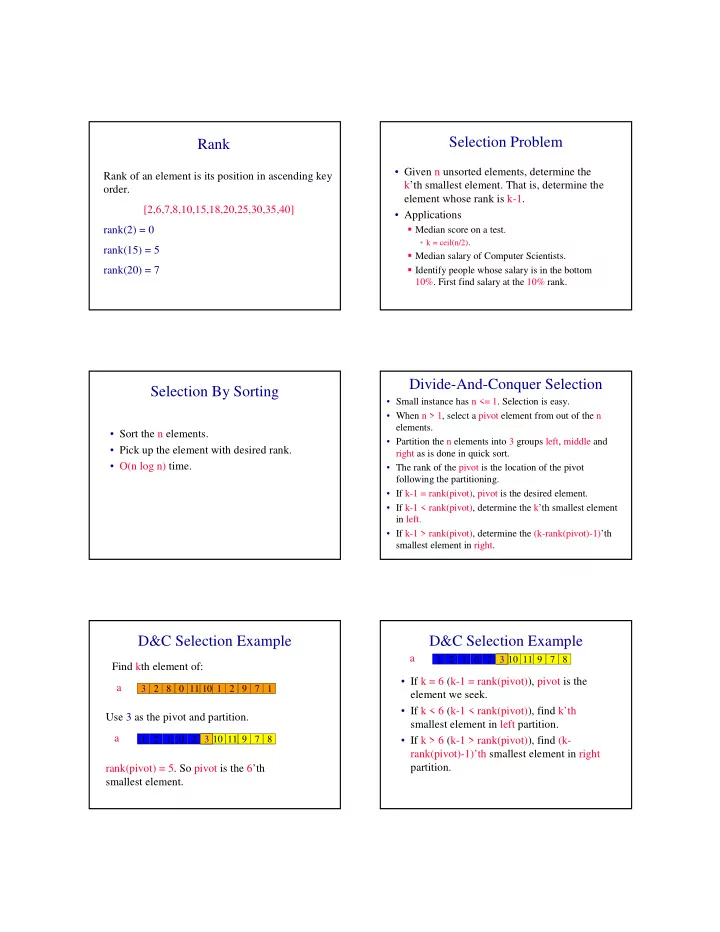
Selection Problem Rank Given n unsorted elements, determine the Rank of an element is its position in ascending key kth smallest element. That is, determine the order. element whose rank is k-1. [2,6,7,8,10,15,18,20,25,30,35,40]


slide-1
SLIDE 1

Rank

Rank of an element is its position in ascending key

  • rder.

[2,6,7,8,10,15,18,20,25,30,35,40] rank(2) = 0 rank(15) = 5 rank(20) = 7

Selection Problem

  • Given n unsorted elements, determine the

k’th smallest element. That is, determine the element whose rank is k-1.

  • Applications

Median score on a test.

  • k = ceil(n/2).

Median salary of Computer Scientists. Identify people whose salary is in the bottom 10%. First find salary at the 10% rank.

Selection By Sorting

  • Sort the n elements.
  • Pick up the element with desired rank.
  • O(n log n) time.

Divide-And-Conquer Selection

  • Small instance has n <= 1. Selection is easy.
  • When n > 1, select a pivot element from out of the n

elements.

  • Partition the n elements into 3 groups left, middle and

right as is done in quick sort.

  • The rank of the pivot is the location of the pivot

following the partitioning.

  • If k-1 = rank(pivot), pivot is the desired element.
  • If k-1 < rank(pivot), determine the k’th smallest element

in left.

  • If k-1 > rank(pivot), determine the (k-rank(pivot)-1)’th

smallest element in right.

D&C Selection Example

Use 3 as the pivot and partition. rank(pivot) = 5. So pivot is the 6’th smallest element. Find kth element of:

3 2 8 0 11 10 1 2 9 7 1

a

1 2 1 0 2 4 11 9 7 8 3 10

a

D&C Selection Example

  • If k = 6 (k-1 = rank(pivot)), pivot is the

element we seek.

  • If k < 6 (k-1 < rank(pivot)), find k’th

smallest element in left partition.

  • If k > 6 (k-1 > rank(pivot)), find (k-

rank(pivot)-1)’th smallest element in right partition.

1 2 1 0 2 4 11 9 7 8 3 10

a

slide-2
SLIDE 2

Time Complexity

  • Worst case arises when the partition to be

searched always has all but the pivot.

O(n2)

  • Expected performance is O(n).
  • Worst case becomes O(n) when the pivot is

chosen carefully.

Partition into n/9 groups with 9 elements each (last group may have a few more) Find the median element in each group. pivot is the median of the group medians. This median is found using select recursively.

Closest Pair Of Points

  • Given n points in 2D, find the pair that are

closest.

Applications

  • We plan to drill holes in a metal sheet.
  • If the holes are too close, the sheet will tear during

drilling.

  • Verify that no two holes are closer than a

threshold distance (e.g., holes are at least 1 inch apart).

Air Traffic Control

  • 3D -- Locations of airplanes flying in the

neighborhood of a busy airport are known.

  • Want to be sure that no two planes get closer than

a given threshold distance.

Simple Solution

  • For each of the n(n-1)/2 pairs of points,

determine the distance between the points in the pair.

  • Determine the pair with the minimum

distance.

  • O(n2) time.

Divide-And-Conquer Solution

  • When n is small, use simple solution.
  • When n is large

Divide the point set into two roughly equal parts A and B. Determine the closest pair of points in A. Determine the closest pair of points in B. Determine the closest pair of points such that one point is in A and the other in B. From the three closest pairs computed, select the one with least distance.

slide-3
SLIDE 3

Example

  • Divide so that points in A have x-coordinate

<= that of points in B. A B

Example

  • Find closest pair in A.

A B

  • Let d1 be the distance between the points in

this pair.

d1

Example

  • Find closest pair in B.

A B

d1

  • Let d2 be the distance between the points in

this pair.

d2

Example

  • Let d = min{d1, d2}.

A B

d1

  • Is there a pair with one point in A, the other in

B and distance < d?

d2

Example

  • Candidates lie within d of the dividing line.

A B

  • Call these regions RA and RB, respectively.

RA RB

Example

  • Let q be a point in RA.

A B

RA RB q

  • q need be paired only with those points in RB that are

within d of q.y.

slide-4
SLIDE 4

Example

  • Points that are to be paired with q are in a d x 2d

rectangle of RB (comparing region of q). A B

RA RB q

  • Points in this rectangle are at least d apart.

d 2d

Example

A B

RA RB q

  • So the comparing region of q has at most 6 points.
  • So number of pairs to check is <= 6| RA | = O(n).

d 2d

Time Complexity

  • Create a sorted by x-coordinate list of points.

O(n log n) time.

  • Create a sorted by y-coordinate list of points.

O(n log n) time.

  • Using these two lists, the required pairs of points

from RA and RB can be constructed in O(n) time.

  • Let n < 4 define a small instance.

Time Complexity

  • Let t(n) be the time to find the closest pair (excluding the

time to create the two sorted lists).

  • t(n) = c, n < 4, where c is a constant.
  • When n >= 4,

t(n) = t(ceil(n/2)) + t(floor(n/2)) + an, where a is a constant.

  • To solve the recurrence, assume n is a power of 2

and use repeated substitution.

  • t(n) = O(n log n).