
SLIDE 1
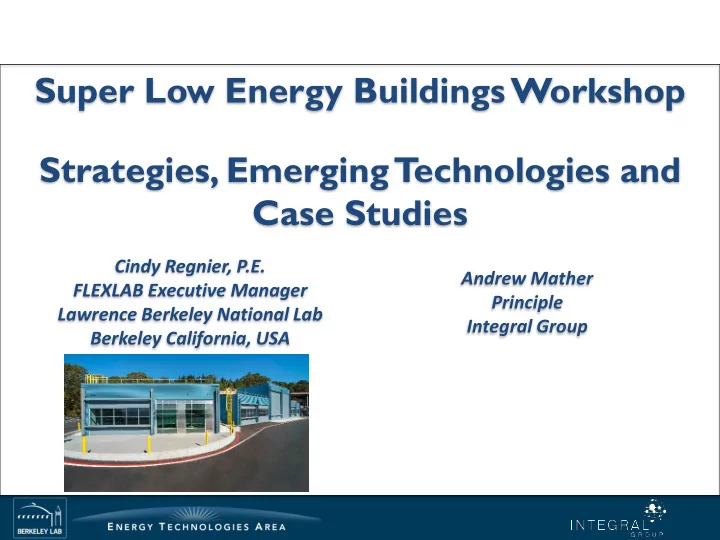
Super Low Energy Buildings Workshop Strategies, Emerging T echnologies and Case Studies
Cindy Regnier, P.E. FLEXLAB Executive Manager Lawrence Berkeley National Lab Berkeley California, USA Andrew Mather Principle Integral Group
Super Low Energy Buildings Workshop Strategies, Emerging T - - PowerPoint PPT Presentation
Super Low Energy Buildings Workshop Strategies, Emerging T echnologies and Case Studies Cindy Regnier, P.E. Andrew Mather FLEXLAB Executive Manager Principle Lawrence Berkeley National Lab Integral Group Berkeley California, USA Outline
Cindy Regnier, P.E. FLEXLAB Executive Manager Lawrence Berkeley National Lab Berkeley California, USA Andrew Mather Principle Integral Group
0845 - 1045
1045 – 1100 BREAK 1100 - 1300
LUNCH
2
3
Paris COP 21 Imperative ≤ 2°C
2030 2050
4
5
Indio Way
32,000 SQFT Retrofit Office 2015 Passive + Roof Top Unit Market Cost
2015 Silicon Valley Business Journal Best Reuse/Rehab
DPR
22,000 SQFT Retrofit Office 2014 Passive + Roof Top Unit Market Cost
2014 ENR California Project of the Year 2014 ENR California Best Green Project
IDeAs HQ
10,000 SQFT Retrofit Office 2007 Passive + GSHP + Radiant Market Cost + PV Grants
First Certified ILFI Net Zero Energy Builidng
Packard Foundation
49,000 SQFT New Build Office 2012 Passive + DOAS + Chilled Beam Institutional
2012 ENR - Best Green Project 2013 ASHRAE Technology Award First Place 2013
Exploratorium
210,000 SQFT New Build Museum 2013 Baywater Cooling + Radiant Museum + PPP $10m
2014 Honor Award Energy + Sustainability, AIA SF Chapter 2014 ULI Global Awards for Excellence
J Craig Venter Institute
45,000 SQFT New Build Laboratory 2013 DC Vent + Chilled Beam Laboratory
2015 Architizer A+ Awards – Architecture + Sustainability Award
Mathilda Avenue
30,000 SQFT Retrofit Office 2015 Passive + Roof Top Unit Market Cost + PV Grants
2015 Silicon Valley Business Journal Green Project of the Year
6
❶ Understand the Imperative ❷ Embed the Net Zero Goal ❸ Come Together ❹ Understand the Context ❺ Model the Whole Building ❿ Disclose Performance ❾ Fine Tune to Zero ❽ Commission for Zero ❼ Integrate Renewables On-site Off-site Offset ❻ Test + Incorporate Efficiency Strategies
7
Early + Targeted
❶ Understand the Imperative ❷ Embed the Net Zero Goal ❸ Come Together
8
❶ Understand the Imperative
❷ Embed the Net Zero Goal ❸ Come Together
Collaborative
Convene goal-setting workshop
9
Informed by Early Analysis
❶ Understand the Imperative ❷ Embed the Net Zero Goal ❸ Come Together
10
39,666 255,141
MWh sqm for 105%
139.7%
roof coverage by PVs Population Potable Water Demand ('000s litres) Energy Demand (MWh) Gross Floor Area
3,415,684
'000s litres
14,800
homes
1,500,000
GFA
762,204
1,204,687 sqm for off-grid 210.2% for off-grid
❶ Understand the Imperative ❷ Embed the Net Zero Goal ❸ Come Together
11
❺ Model the Whole Building ❻ Test + Incorporate Efficiency Strategies ❹ Understand the Context ❼ Integrate Renewables On-site Off-site Offset
12
❺ Model the Whole Building ❻ Test + Incorporate Efficiency Strategies ❹ Understand the Context ❼ Integrate Renewables On-site Off-site Offset
13
❺ Model the Whole Building ❻ Test + Incorporate Efficiency Strategies ❹ Understand the Context ❼ Integrate Renewables On-site Off-site Offset
14
❺ Model the Whole Building ❻ Test + Incorporate Efficiency Strategies ❹ Understand the Context ❼ Integrate Renewables On-site Off-site Offset
15
❺ Model the Whole Building ❻ Test + Incorporate Efficiency Strategies ❹ Understand the Context ❼ Integrate Renewables On-site Off-site Offset
16
❺ Model the Whole Building ❻ Test + Incorporate Efficiency Strategies ❹ Understand the Context ❼ Integrate Renewables On-site Off-site Offset
17
❺ Model the Whole Building ❻ Test + Incorporate Efficiency Strategies ❹ Understand the Context ❼ Integrate Renewables On-site Off-site Offset
18
❺ Model the Whole Building ❻ Test + Incorporate Efficiency Strategies ❹ Understand the Context ❼ Integrate Renewables On-site Off-site Offset
19
❺ Model the Whole Building ❻ Test + Incorporate Efficiency Strategies ❹ Understand the Context ❼ Integrate Renewables On-site Off-site Offset
20
❺ Model the Whole Building ❻ Test + Incorporate Efficiency Strategies ❹ Understand the Context ❼ Integrate Renewables On-site Off-site Offset
21
22
Rooftop locations important, but other locations are needed for aggressive SLE designs
PV – glazing, skylights
Shading designs
❿ Disclose Performance ❾ Fine Tune to Zero ❽ Commission for Zero
Commissioning Authority: Reports directly to the owner and is involved throughout design, construction and beyond…
23
24
5 story office building, ~ 5000 m2, Seattle, WA http://www.bullittcenter.org/
25
Using PV as a shading element
Source – NUS School of Design and Environment, SDE4
26
Perceived Innovation
Limited innovation impact as widely used approach
Market Tested
Standard practice in Australian market
Capital Cost
Minimal cost impact if considered at concept design. Some increase if stepped façade.
Energy Cost
Score based on EUI calculation
Maintenance Costs
Significant annual outlay, but equipment likely to last longer than baselinesystem
Ease of Operations
No impact on operations
Flexibility/Adaptability
No impact / minimal impact
Long Term Rental Return
Optimising form for energy performance may conflict with
Daylight & Views
Reducing east/west facing glazing will improve energy performance, but will impact views if desired
ThermalComfort
Appropriate massing can minimise thermal discomfort near thefaçade
Indoor Air Quality
No impact / minimal impact
A building's form and orientation are considered at the earliest stages of design and are influenced by a number of factors including site constraints, relationships to adjacent buildings, and architectural aesthetic. Consideration of energy efficiency and occupant comfort can significantly impact a building's form and orientation. Due to the sun's movement, it is often more difficult to control solar gain on east and west elevations, leading to a desire for buildings with a greater proportion of north and south façade. Site constraints can make a north-south
solutions that can overcome a large east- or west-facing
Ingels Group in Shenzhen and Grimshaw in Melbourne. For the purposes of this assessment, a modified floorplate form has been analysed, incorporating a sawtooth façade design minimising east- and west-facing glazing. Energy Use Intensity Thermal Comfort Daylight Performance
Feasibilit y
Cooling Heating Equipment Lighting Fans Pumps HeatRejection Other
Good 55% Preferred75%
Spatial Daylight Autonomy (sDA)
100 90 80 70 60 50 40 30 20 10Proportion of time (%)
Too Warm Comfortable Too Cold 0.5 1.0 1.5 2.0Distance from Façade (m)
2.5 3.0Architectural
77%
kWh/m2
Impact on Certification
Impacts associated with energy reduction due to reduced cooling and heating requirements and improved daylighting
Net Zero Emissions Impact
Score based on EUI calculation
27
Perceived Innovation
Not particularly innovative, but also not implemented often enough
Market Tested
Commonly executed in the market but not the default approach
Capital Cost
Considered response may result in cost savings from ceiling/floorfinishes
Energy Cost
Score based on EUI calculation
Maintenance Costs
Significant annual outlay, but equipment likely to last longer than baselinesystem
Ease of Operations
No impact on operations
Flexibility/Adaptability
Exposure of thermal mass can impact flexibility of space usage
Long Term Rental Return
No impact / minimal impact
Daylight & Views
No impact / minimal impact
ThermalComfort
Thermal mass can moderate space conditions by absorbing
Indoor Air Quality
No impact / minimal impact
Thermal mass has been used for thousands of years to moderate the temperature of buildings. The mechanism that drives the behaviour of thermal mass is its heat capacity, which allows the material to absorb excess heat from a space, thereby reducing the thermal demand on cooling systems. This is particularly effective when the thermal mass is exposed to solar radiation, which is absorbed in the material instead of warming up the internal
is often coupled with a night flush strategy, which removes the heat absorbed by the thermal mass during the day and readies the material for the following day of occupancy. Thermal mass can be introduced in a number of ways, with varying impact. For example, mass can be introduced via exposed concrete columns, ceilings or flooring. If carpet is required in occupied spaces, an exposed slab can be limited to the perimeter zone, as implemented at the SFO Consolidated Administration Campus, pictured bottom right. Energy Use Intensity Thermal Comfort
Feasibilit y
Cooling Heating Equipment Lighting Fans Pumps HeatRejection Other
100 90 80 70 60 50 40 30 20 10Proportion of time (%)
Too Warm Comfortable Too Cold 0.5 1.0 1.5 2.0Distance from Façade (m)
2.5 3.0Daylight Performance
Spatial Daylight Autonomy (sDA)
93%
Good 55% Preferred75%
Architectural
kWh/m2
Impact on Certification
Impacts associated with energy reduction due to reduced cooling and heating requirements
Net Zero Emissions Impact
Score based on EUI calculation
28
Perceived Innovation
Limited innovation impact as widely used approach
Market Tested
Standard practice in Australian market
Capital Cost
Potential cost savings through reduced glass
Energy Cost
Score based on EUI calculation
Maintenance Costs
Significant annual outlay, but equipment likely to last longer than baselinesystem
Ease of Operations
No impact on operations
Flexibility/Adaptability
No impact / minimal impact
Long Term Rental Return
Current perception is maximum glazing is desired by tenants
Daylight & Views
Reduced glazing will reduce daylight availability somewhat, but can be designed appropriately
ThermalComfort
Reduced glazing proportions likely to reduce risk of discomfort near façade
Indoor Air Quality
No impact / minimal impact
Window-to-wall ratio (WWR) is a measure of how much glazing there is in a building's façade design. Generally, the higher the proportion of glazing, the higher the energy demand of the building and the greater the risk of occupant discomfort near the perimeter. Conversely, high WWR buildings maximise the external view for occupants within the building. Despite energy codes becoming more stringent, the last few decades have seen fully glazed facades become the norm, particularly in new build commercial real estate. The consequential increase in building energy demand has been somewhat moderated by the use of improving glass technologies, but the challenges in reaching net zero energy and net zero carbon buildings make WWR a key consideration in the design of high performing buildings. For the purposes of this assessment, the proposed floor- to-ceiling glazing of 435 Bourke St has been reduced through the introduction
a 300mm sill and 300 downstand, which maintains external views for
Energy Use Intensity Thermal Comfort Daylight Performance
Feasibilit y
Cooling Heating Equipment Lighting Fans Pumps HeatRejection Other
Good 55% Preferred75%
84%
Spatial Daylight Autonomy (sDA)
100 90 80 70 60 50 40 30 20 10Proportion of time (%)
Too Warm Comfortable Too Cold 0.5 1.0 1.5 2.0Distance from Façade (m)
2.5 3.0Architectural
kWh/m2
Impact on Certification
Impacts associated with energy reduction due to reduced cooling and heating requirements
Net Zero Emissions Impact
Score based on EUI calculation
29
Perceived Innovation
Limited innovation impact as widely used approach
Market Tested
Standard practice in Australian market
Capital Cost
Additional façade package costs
Energy Cost
Score based on EUI calculation
Maintenance Costs
Significant annual outlay, but equipment likely to last longer than baselinesystem
Ease of Operations
Easy to maintain, unlikely to cause operational issues
Flexibility/Adaptability
No impact / minimal impact
Long Term Rental Return
No impact / minimal impact
Daylight & Views
Fixed external shading can interrupt views and remain in place even when solar control is not required
ThermalComfort
External shading controls solar gain before it reaches the glazing, improving near-façade comfort
Indoor Air Quality
No impact / minimal impact
Fixed external shading is one of the most common methods of reducing solar gain and resulting cooling energy. The simplest approach, driven by the sun's movements, is to attach horizontal shading on the north (in the southern hemisphere) and vertical shading on the east and west, which has been simulated for the purposes of this assessment. For a given building within its specific context, the size, angle and shape of these shading devices can be tuned to maximise performance. Some designers incorporate shading as a integral part of the building's aesthetic, which is evident is buildings such as ARM's Barak Building, picturedbelow. One notable disadvantage of fixed shading is its impact on views and daylight, particularly due to the fact that fixed shades cannot be retracted when solar gain is not an issue. Energy Use Intensity Thermal Comfort Daylight Performance
Feasibilit y
Cooling Heating Equipment Lighting Fans Pumps HeatRejection Other
91%
Good 55% Preferred75%
Spatial Daylight Autonomy (sDA)
100 90 80 70 60 50 40 30 20 10Proportion of time (%)
Too Warm Comfortable Too Cold 0.5 1.0 1.5 2.0Distance from Façade (m)
2.5 3.0Architectural
kWh/m2
Impact on Certification
Impacts associated with energy reduction due to reduced cooling requirements and reduced glare risk
Net Zero Emissions Impact
Score based on EUI calculation
30
Perceived Innovation
Technology is not new, but still signifies innovation
Market Tested
Not common in Australia
Capital Cost
Additional cost associated with glass technology
Energy Cost
Score based on EUI calculation
Maintenance Costs
Significant annual outlay, but equipment likely to last longer than baselinesystem
Ease of Operations
May cause operational issues if system is down
Flexibility/Adaptability
Depending on control strategy, zoning may have impacts on flexibility
Long Term Rental Return
Dynamic performance may command higher rent, without sacrificing NLA (as per CCF option)
Daylight & Views
Dynamicism maximises daylight and views while solar control is not needed. Glass is still transparent when shaded.
ThermalComfort
Dynamic glazing provides solar control when it is required, improving near-façade comfort
Indoor Air Quality
No impact / minimal impact
Dynamic glass has been in use for decades, but has seen an increase in popularity in recent years. The technology allows the performance of the glass to vary in response to external conditions, BMS operation, or occupant control. The dynamicism of the technology means the glass can tint to control solar gain or sky brightness when required, but then increase its transparency when control is no longer
balance between energy savings and occupant satisfaction. There are a number
dynamic glass technologies available in the market, most notably the electrochromic variants (produced by Sage, View and Halio) and the liquid crystal glazing (produced by Merck). The products vary substantially with regards to glass colour, switching speed and capital cost. As such, a project-specific assessment should be conducted when appraising the use of the technology. Energy Use Intensity Thermal Comfort Daylight Performance
Feasibilit y
Cooling Heating Equipment Lighting Fans Pumps HeatRejection Other
87%
Good 55% Preferred75%
Spatial Daylight Autonomy (sDA)
100 90 80 70 60 50 40 30 20 10Proportion of time (%)
Too Warm Comfortable Too Cold 0.5 1.0 1.5 2.0Distance from Façade (m)
2.5 3.0Architectural
kWh/m2
Impact on Certification
Impacts associated with energy reduction due to reduced cooling requirements and reduced glare risk
Net Zero Emissions Impact
Score based on EUI calculation
31
32
Aggressively Manage Solar Gain…
Transpiration
Plantings Incorporate exterior solar control
Figure – Text
Perceived Innovation
Relatively new to Australian market, but becoming more mainstream
MarketTested
New in Australia but market exists and is growing rapidly
Capital Cost
Additional cost associated with complex façade build-up and control system
Energy Cost
Score based on EUI calculation
Maintenance Costs
Significant annual outlay, but equipment likely to last longer than baselinesystem
Ease of Operations
Well established technology that is designed to be maintained easily
Flexibility/Adaptability
Depending on control strategy, zoning may have impacts on flexibility
Long Term Rental Return
Depth of façade may impact NLA and resulting rental yield
Daylight & Views
Dynamicism maximises daylight and views while solar control is not needed.
ThermalComfort
Automated blinds provide solar control when it is required, improving near-façade comfort
Indoor Air Quality
No impact / minimal impact
The Closed-Cavity Façade, or CCF, has been popular in Europe for a number of years, but has recently gained traction in the Australian market through the use on projects such as 200 George St and 100 Mount St. The facade system is made up of an exterior single pane and interior double pane, with an interstitial automated shade (typically a venetian blind). The cavity is constantly positively pressurised by a small quantity of supply air, which helps to prevent ingress of dust. The performance benefits of the CCF are a function of its automated shading system, which can control solar gain when necessary but also retract when suitable to maximise daylight and views. The third pane of glazing also helps to improve the thermal performance of the system, reducing heating demand and increasing near-façade thermal comfort. The CCF's main disadvantages are capital cost and increased façade depth, which can impact net lettable area. Energy Use Intensity Thermal Comfort Daylight Performance
Feasibilit y
Cooling Heating Equipment Lighting Fans Pumps HeatRejection Other
87%
Good 55% Preferred75%
Spatial Daylight Autonomy (sDA)
100 90 80 70 60 50 40 30 20 10Proportion of time (%)
Too Warm Comfortable Too Cold 0.5 1.0 1.5 2.0Distance from Façade (m)
2.5 3.0Architectural
kWh/m2
Impact on Certification
Impacts associated with energy reduction due to reduced cooling requirements and reduced glare risk
Net Zero Emissions Impact
Score based on EUI calculation
33
34
Interior blinds and shades are not enough!
energy reduction and comfort
including low-emissivity
shades and blinds
Source – Pella windows.
Perceived Innovation
Still uncommon to see this technology used extensively
Market Tested
Gaining traction internationally
Capital Cost
Designer panels command a higher cost than standard PV modules
Energy Cost
Score based on EUI calculation
Maintenance Costs
Significant annual outlay, but equipment likely to last longer than baselinesystem
Ease of Operations
Unlikely to cause operational issues and building can continue to operate if system is down
Flexibility/Adaptability
No impact / minimal impact
Long Term Rental Return
No impact / minimal impact
Daylight & Views
No impact / minimal impact
ThermalComfort
No impact / minimal impact
Indoor Air Quality
No impact / minimal impact
For buildings that have a proportionally small roof area, such as tall towers, generating electricity using the building's façade can significantly reduce overall energy
solar energy than their horizontal counterparts, but for buildings with large amounts of exposed façade, the energy generated can be significant. Traditionally, building integrated photovoltaic (BIPV) panels have been implemented using the typical photocell aesthetic, which has led many designers to shy away from the technology unless it is applied out of sight (on rooftops). Recent advances in PV design, including those highlighted by the EU Construct PV initiative, have shown that energy can be generated from facades while contributing to the architectural aesthetic. BIPV panels can be screen printed with custom patterns, or be produced to imitate materials such as stone or Corten steel. Energy Use Intensity
Feasibilit y
Renewables
Solar Radiation Yield
kWh/m2
Cooling Heating Equipment Lighting Fans Pumps HeatRejection Other Renewables
1000 900 800 700 600 500 400 300 200 100 Solar Radiation Exposure (kWh/m2)Impact on Certification
Assists with peak load reduction and incorporation of renewable energy. Impact is proportional to generation.
Net Zero Emissions Impact
Score based on EUI calculation
Perceived Innovation
Highly visible, new renewable technology
Market Tested
Technology is very new to market
Maintenance Costs
Significant annual outlay, but equipment likely to last longer than baselinesystem
Ease of Operations
Technology is new and relies on a control system, but building can continue to operate if system is down
Flexibility/Adaptability
Potential impact on internal flexibility due to specific façade appearance
Long Term Rental Return
No impact / minimal impact
Daylight & Views
Despite being transparent, tracking cells will impact external views
ThermalComfort
No impact / minimal impact
Indoor Air Quality
No impact / minimal impact
In
to boost the energy generated by building integrated photovoltaics, it is possible to implement them in a more dynamic way. Wellsun is a start up firm in the Netherlands who have developed a façade solution that utilises high-efficiency PV modules that track the movement
higher than standard static PV systems), the technology is mounted within a double-skin façade. The number of cells can be customised to allow designers to balance energy generation, daylight and external views. Given the system's impact on façade transparency, it is unlikely that the technology would be applied to the entirety
a building's envelope. For the purposes
this assessment, the system has been applied to the exposed sections of the north and west facades of 435 Bourke Street. Energy Use Intensity
Feasibilit y
Renewables
Solar Radiation Yield
Cooling Heating Equipment Lighting Fans Pumps HeatRejection Other Renewables
kWh/m2
1000 900 800 700 600 500 400 300 200 100 Solar Radiation Exposure (kWh/m2)Capital Cost
Significant cost as technology is new and requires double skinfaçade
Energy Cost
Score based on EUI calculation
Impact on Certification
Assists with peak load reduction and incorporation of renewable energy. Impact is proportional to generation.
Net Zero Emissions Impact
Score based on EUI calculation
Perceived Innovation
New innovative product with development within Australia (Perth)
Market Tested
Technology is very new to market
Capital Cost
Additional expense related to glass product
Maintenance Costs
Significant annual outlay, but equipment likely to last longer than baselinesystem
Ease of Operations
Technology is new, but building can continue to operate if system is down
Flexibility/Adaptability
No impact / minimal impact
Long Term Rental Return
No impact / minimal impact
Daylight & Views
Daylight performance is inversely proportional to energy yield
ThermalComfort
No impact / minimal impact
Indoor Air Quality
No impact / minimal impact
Another relatively recent technology, transparent photovoltaics provide an opportunity to generate electrical energy from a typical commercial building's predominant envelope material
There are a number
transparent PV products and technologies on the market, and most work by redirecting solar energy that strikes the glass towards photocells located at the perimeter of the window. ClearVue are an Australian firm developing transparent PV technology in association with researchers at Edith Cowan
generated as much energy as 1m2 of "standard"PV. It should be noted that generally, the higher the efficiency of a transparent PV module, the lower the visible light transmittance of the glass. For this assessment, it has been assumed that the transparent PV technology has been applied on all highly exposed windows on the east, north and west facades. Energy Use Intensity
Feasibilit y
Renewables
Solar Radiation Yield
Cooling Heating Equipment Lighting Fans Pumps HeatRejection Other Renewables
kWh/m2
1000 900 800 700 600 500 400 300 200 100 Solar Radiation Exposure (kWh/m2)Energy Cost
Score based on EUI calculation
Impact on Certification
Assists with peak load reduction and incorporation of renewable energy. Impact is proportional to generation.
Net Zero Emissions Impact
Score based on EUI calculation
39
40
“Energy Cost Savings of Systems-Based Building Retrofits: A Study of Three Integrated Lighting Systems in Comparison with Component Based Retrofits” (Regnier, 2018)
Lighting Energy Savings relative to Baseline
63.1% 84.8% 93.3% 81.3%
41
Each row
LED fixtures dimmed separately to meet illuminance setpoint Automa c shading controlled by glare sensor Occupant heat generators Plug loads Illuminance sensors at 3’ intervals at workplane HDR cameras for glare assessment
Annual Energy Savings Potential: 20%+ Lighting Savings 4-10% Whole Bldg Savings
Source: FLEXLAB, LBNL Berkeley CA USA
Market: Med-large office K-12 Educational ComEd 519–633 GWh savings potential, simple payback for shading and lighting controls only (no light upgrade) >20 years; simple payback w/ lighting upgrade 10.9 years
42
Market: Med-large office Colorado 120–672 GWh savings potential, 8 to 12 years simple payback* at $0.12/kWh Annual Energy Savings Potential: 90%+ Lighting Savings 5-11% Whole Building Savings (applied S, SW, SE
FLEXLAB Setup, Workstation Specific Lighting, 100sf/person
Configurations studied: Light output levels of 500 & 300 lux, Workstation layouts for 100 and 150sf/person occupancy
Source: FLEXLAB, LBNL Berkeley CA USA
43
Integrated task/ambient lighting with plug load
Market: Small-large office NCPA/SCPPA 319/372 GWh savings potential, 6-9 years simple payback at $0.16/kWh Annual Energy Savings Potential: 30%+ Lighting Savings 11-23% Whole Building Savings
44
Use of granular occupancy data provided by lighting systems to enhance ACMV
Enables advanced controls interactions
combined with occupancy sensing
ventilation, combined with occupancy sensing
Figure – Granular occupancy sensing and lighting control (Source Philips SpaceWise)
Perceived Innovation
Recent innovation in lighting controls
Maintenance Costs
Significant annual outlay, but equipment likely to last longer than baselinesystem
Ease of Operations
Manual and auto operation similar to centralised controls. Tenant & FM education will resolve initial unfamiliarity
Flexibility/Adaptability
No impact / minimal impact
Long Term Rental Return
Innovative lighting technology may be more desirable / offset tenant energy costs
Daylight & Views
No impact / minimal impact
ThermalComfort
No impact / minimal impact
Indoor Air Quality
No impact / minimal impact
Organic response technology was developed and manufactured in Australia by Organic Response. It uses distributed intelligence, rather than centralised control to provide peer-to-peer wireless communications allowing standalone fittings to work together as a system. Sensor nodes, either discreet
integrated into luminaires, comprise motion sensors, ambient light sensors, a microprocessor and infrared transmitters / receivers to communicate with their immediate neighbours. Upon occupant detection, the activated luminaire operates at full
and communicates with surrounding luminaires in a cascading manner, to provide zones of descending brightness in the surrounding area to balance visual comfort with energy efficiency. As the occupant moves through the space, luminaires in the proximity respond by adjusting their output while luminaires where no
levels, dwell times and many other programming
are available. The light sensor allows for daylight harvesting and lumen maintenance operations for dimmable luminaires. Daylight harvesting dims luminaires to maintain a predetermined light level when natural light is present. Lumen maintenance allows dimming of the luminaires to a pre- adjusted lighting level to prevent a space being overlit. The system provides high resolution lighting control, improving energy efficiency possibilities. Being wireless and decentralised, it allows for easier modification in the event of spatial or furniture changes. The control platform can be used to monitor system utilisation, performance and history plus certain control functions. Energy Use Intensity
Feasibilit y
Cooling Heating Equipment Lighting Fans Pumps HeatRejection Other
Load Reduction
kWh/m2
Impact on Certification
Proportional energy savings will be small. Ease of system monitoring & reporting may assist in Green Star submission.
Net Zero Emissions Impact Market Tested
New in Australia with limited supplier options, but strong support from industry
Capital Cost
Cost can be similar to centralised DALI dimming equipment and commissioning
Energy Cost
Score based on EUI calculation Score based on EUI calculation
Above: Data from case study of Commercial Office Floor in Melbourne, Australia
45
46
47
Perceived Innovation
Not particularly innovative, but also not implemented often enough
MarketTested
Established technologies exist, but are not mainstream yet
Capital Cost
Minimal cost impact
Energy Cost
Score based on EUI calculation
Maintenance Costs
Significant annual outlay, but equipment likely to last longer than baselinesystem
Ease of Operations
Unlikely to cause operational issues if system is down - more likely to impact energy consumption
Flexibility/Adaptability
No impact / minimal impact
Long Term Rental Return
Innovative technology may be more desirable / offset tenant energy costs
Daylight & Views
No impact / minimal impact
ThermalComfort
No impact / minimal impact
Indoor Air Quality
No impact / minimal impact
Historically, plug loads have not been targeted as an energy savings measure in the same way as lights or
understanding and managing these loads. Not only do they save electrical energy directly, but cooling energy is also reduced due to reduced heat generated by equipment. Based on the current estimates, plug loads represent about a third of the total energy consumption of the baseline
the occupancy and the type and use of equipment, the actual building could use more or less than this estimate. The reduction of plug loads is a multi-faceted process, primarily comprising a detailed assessment
user equipment power requirements, e.g. servers, PCs, monitors, printing, audio visual, kitchen, etc. to ensure that the most energy efficient equipment is selected and that equipment matches the users' requirements rather than exceeding them. Furthermore, the control of these items via smart plugs can further reduce energy consumption by energising attached equipment only when being used. Smart plug control technologies include but are not limited to master / slave outlet arrangements whereby slave outlets (monitors, etc.) switch off when the master outlet senses that the PC has been switched off, timed energisation / de- energisation and proximity sensing
energise outlets when no presence is detected. Given the nature of the 435 Bourke Street project, it is assumed that the majority of energy savings could be achieved by de-energising plug loads during non business hours. Energy Use Intensity
Feasibilit y
Load Reduction
Cooling Heating Equipment Lighting Fans Pumps HeatRejection Other
kWh/m2
Impact on Certification
Potential to exceed benchmark reductions to earn Green Star points, but savings are dependant on tenant adoption
Net Zero Emissions Impact
Server,8.95 Server,8.95 Server,8.95 Server,8.95 Harddrives,3.26 Harddrives,3.26 Harddrives,3.26 Harddrives,3.26 Routers,3.63 Routers,3.63 Routers,5.45 Routers,5.45 Misc,1.00 Misc,1.00 Misc,1.00 Misc,1.00
TV Projectors, 3.05 TV Projectors, 2.59 TV Projectors, 3.87 TV Projectors, 3.18Kitchen,1.66 Kitchen,1.66 Kitchen,2.48 Kitchen,2.48 Printer,1.30 Printer,1.30 Printer,1.94 Printer,1.94 Monitors,6.35 Monitors,4.22 Monitors,9.52 Monitors,6.33 Computers,3.19 Computers,2.12 Computers,4.79 Computers,3.18
5 10 15 20 25 30 35 40 Day 1 Equipment Uncontrolled Day 1 Equipment Controlled Full Buildout Equipment Uncontrolled Full Buildout Equipment Controlled
Annual Energy Use Intensity, kWh/m2
Score based on EUI calculation
Above: Plug load analysis and measurement for US construction firm headquarters
48
Energy Cost
Score based on EUI calculation
Maintenance Costs
Significant annual outlay, but equipment likely to last longer than baselinesystem
Ease of Operations
Unlikely to cause operational issues and building can continue to operate one lift is down
Flexibility/Adaptability
No impact / minimal impact
Long Term Rental Return
No impact / minimal impact
Daylight & Views
No impact / minimal impact
ThermalComfort
No impact / minimal impact
Indoor Air Quality
No impact / minimal impact
The most energy efficient elevators now have: software- and microprocessor-based controls instead of electromechanical relays in-cab sensors and software that automatically enter an idle or sleep mode, turning off lights, ventilation, music, and video screens when unoccupied destination dispatch control software that batches elevator stop requests, making fewer stops and minimizing wait time, reducing the number of elevators required with need destination for in-cab personalized elevator calls used dispatch controls that eliminate the controls. Lift are programmed to go into hibernate/standby mode when demand is low Regenerative drive systems that feed energy back to the network Energy Use Intensity
Feasibilit y
Load Reduction
Cooling Heating Equipment Lighting Fans Pumps HeatRejection Other
Data from Syd team
kWh/m2
Impact on Certification
Limited energy impacts, no impact on other certification requirements
Net Zero Emissions Impact
Score based on EUI calculation
Perceived Innovation
Not particularly innovative, but also not implemented often enough
Market Tested
Well established technologies internationally, starting to become more prevalent in Australia
Capital Cost
Moderate cost increase for vertical transportation
49
50
Minneapolis, MN USA Focus on M&V of performance of use of IT network switches to power and control lighting and plug loads. Conducting energy and cost savings analysis. Demonstrates energy management opportunities where not typically available.
allow up to 100W loads
Ref: https://www.mncee.org/resources/projects/power-over-ethernet/
Figures – POE Architecture (Source: MN CEE) Figures – Cree 2x2 LED troffer directly connected via RJ45 (Source: MN CEE)
51
Perceived Innovation
Not particularly innovative, but also not implemented often enough
Market Tested
Easy to implement, but some briefs require design to standard setpoints
Capital Cost
Minimal cost impact
Energy Cost
Score based on EUI calculation
Maintenance Costs
Significant annual outlay, but equipment likely to last longer than baselinesystem
Ease of Operations
Unlikely to impact operations, minor risk of increased comfort complaints if not commissioned appropriately
Flexibility/Adaptability
No impact / minimal impact
Long Term Rental Return
No impact / minimal impact
Daylight & Views
No impact / minimal impact
ThermalComfort
Allows for greater fluctuation in space conditions
Indoor Air Quality
No impact / minimal impact
Adjusting internal air temperature setpoints slightly within the occupied areas has a significant impact on energy use within buildings. Setpoints can be adjusted by half to a full degree higher than the typical 24°C design limit in summer and half to a full degree lower than the typical 21°C limit in winter. Where this strategy has been implemented in operational buildings, it has been noted that there has been no significant increase in occupant comfort complaints. This is believed to be due to the majority of comfort complaints arising from issues associated with air movements (draughts) and surfaces temperatures, eg. as a result of poor building fabric design. There is also an
for seasonal space temperature setpoints to be implemented within buildings to prevent over cooling in summer and overheating in winter. Energy Use Intensity Thermal Comfort
Feasibilit y
Cooling Heating Equipment Lighting Fans Pumps HeatRejection Other
100 90 80 70 60 50 40 30 20 10Proportion of time (%)
Too Warm Comfortable Too Cold 0.5 1.0 1.5 2.0Distance from Façade (m)
2.5 3.0HVAC Strategies
kWh/m2
Impact on Certification
Impacts associated with energy reduction due to reduced cooling and heating requirements
Net Zero Emissions Impact
Score based on EUI calculation
52
Perceived Innovation
Can still provide marketing differentiation compared to standard VAV design
Market Tested
Chilled beams are well establish in Australia, but radiant slabs are less established
Capital Cost
Additional cost associated with hydronic systems
Energy Cost
Score based on EUI calculation
Daylight & Views
No impact / minimal impact
Radiant systems work by utilising passive (draught-free) convection and radiation from the ceiling or floor to the
delivered by water, which has a significantly higher heat capacity than air. When using chilled beams there is no fan, filter
condensate drain required. The temperature difference of the coil surface temperature and space drives a convective loop to move heat to the beam. Radiant systems offer improved thermal comfort, can reduce floor to floor heights, reduce riser sizing and reduce fan energy. Radiant systems include; passive chilled beams, active chilled beams and radiant ceiling panels, as well as radiant slabs. Passive chilled beams are self-regulating, where as the active beam system integrates with a ventilated air system to magnify the convective process. Energy Use Intensity Thermal Comfort
Feasibilit y
Cooling Heating Equipment Lighting Fans Pumps HeatRejection Other
100 90 80 70 60 50 40 30 20 10Proportion of time (%)
Too Warm Comfortable Too Cold 0.5 1.0 1.5 2.0Distance from Façade (m)
2.5 3.0HVAC Strategies
kWh/m2
ThermalComfort
Radiant systems are consistency rated better for thermal comfort
Indoor Air Quality
Hydronic heating/cooling reduces supply air volumes and associatedpollutants
Impact on Certification
Impacts associated with energy reduction due to reduced cooling and heating requirements
Net Zero Emissions Impact
Score based on EUI calculation
Maintenance Costs
Significant annual outlay, but equipment likely to last longer than baselinesystem
Ease of Operations
Once commissioned and balanced system operation is straight forward
Flexibility/Adaptability
If delivered through radiant slab, zoning of control may be less flexible
Long Term Rental Return
Improved thermal comfort may command higher rental yield
53
Perceived Innovation
Can still provide marketing differentiation compared to standard VAV design
Market Tested
Market is less mature than traditional VAV
Daylight & Views
No impact / minimal impact
ThermalComfort
Reduced risk of draught complaints
Displacement ventilation (DV) systems deliver air at low level rather than from overhead. The benefit of this is that air can be introduced at a slower speed and more moderate temperature, reducing the risk of cold draughts and reducing energy consumption. The progression of air from low level to the top of a space, where it is returned to air handling equipment, means pollutants are taken away from the occupied space and indoor air quality is improved. A common implementation of DV is the Underfloor air distribution (UFAD) system, which supplies air through grilles on the floor and returns/exhausts at high level. A raised floor void is required (400 to 450mm) and zones are split into separate plenums with supply air being distributed within ductwork to each of the plenums. DV systems have a higher economy cycle working range, local adjustable air supply control, minimal space recirculation, quiet operation and provide great flexibility for
distribution, which removes this from the ceiling space. Energy Use Intensity Thermal Comfort
Feasibilit y
100 90 80 70 60 50 40 30 20 10Proportion of time (%)
Too Warm Comfortable Too Cold 0.5 1.0 1.5 2.0Distance from Façade (m)
2.5 3.0HVAC Strategies
Cooling Heating Equipment Lighting Fans Pumps HeatRejection Other
kWh/m2
Indoor Air Quality
Air movement through space takes pollutants away from
Impact on Certification
Impacts associated with energy reduction due to reduced cooling and heating requirements and improved air quality
Net Zero Emissions Impact
Score based on EUI calculation
Capital Cost
If raised access floor is included then cost increases comparable to chilled beam system
Energy Cost
Score based on EUI calculation
Maintenance Costs
Significant annual outlay, but equipment likely to last longer than baselinesystem
Ease of Operations
Once commissioned and balanced system operation is straight forward
Flexibility/Adaptability
DV system is flexible in rasied access floor plenum system. Floor grilles can be relocated to suit tenancy layouts.
Long Term Rental Return
Improved air quality may command higher rental yield
54
Perceived Innovation
Depending on building typology, it's not common to see
Market Tested
Uncommon in Australian market for non-residential buildings
Capital Cost
Additional costs associated with operable façade elements, sensors, BMS interlocks
Energy Cost
Score based on EUI calculation
Maintenance Costs
Significant annual outlay, but equipment likely to last longer than baselinesystem
Ease of Operations
Likely to require additional maintenance if using integrated
Flexibility/Adaptability
Interlocked mixed-mode systems can be less adaptable to updated layouts
Long Term Rental Return
Improved thermal comfort and occupant control may command higher rental yield
Daylight & Views
No impact / minimal impact
ThermalComfort
Occupant control improves perception of thermal comfort
Natural ventilation can be implemented when the outside ambient conditions are within certain temperature and humidity ranges. This system relies on the air conditioning system being turned off with the cooling and ventilation being provided from outside via operable windows. The system provides energy savings in cooling compressor energy and fan energy. This system requires operable windows with actuators, a weather monitoring station to confirm ambient temperatures/conditions and that the air conditioning system be turned off through integrated reed switches and related controls. Energy Use Intensity Thermal Comfort
Feasibilit y
100 90 80 70 60 50 40 30 20 10Proportion of time (%)
Too Warm Comfortable Too Cold 0.5 1.0 1.5 2.0Distance from Façade (m)
2.5 3.0HVAC Strategies
Cooling Heating Equipment Lighting Fans Pumps HeatRejection Other
kWh/m2
Indoor Air Quality
Opportunity for higher levels of fresh air, provided openable windows are closed when outdoor air quality is low
Impact on Certification
Impacts associated with energy reduction due to reduced cooling and heating requirements and localised controls
Net Zero Emissions Impact
Score based on EUI calculation
55
56 Figure – Text
Image
ABC
Figure – Text
Image
57
58
59 Source– Loisos & Ubbelohde, University of Hawaii at Manoa
60
Direct solar gain control while providing daylight and views
Source – Loisos and Ubbelohde
61 Figure – Text Source– Loisos & Ubbelohde, University of Hawaii at Manoa
Section through faculty offices wing with PV awning and sound attenuation from outside.
62
Source – Loisos & Ubbelohde, University of Hawaii at Manoa
Provide ‘transitional’ thermal comfort zones in corridors, atria, creates increased setpoint and deadband Make use of air movement to enhance comfort with natural ventilation
63
Source – Loisos & Ubbelohde, University of Hawaii at Manoa
64
Education Center High humidity environment (35C DB/23.3C MCWB 0.4% ASHRAE Design Conditions) Operational 2007
and cooling system
pumps
system with enthalpy heat recovery
compared to conventional construction
Figures – Fort Osage exterior and interior, exposed thermal mass for radiant heating and cooling (Source: BNIM Architects)
65
66
DC System Application, Fraunhoffer Institute, Germany Office building, operational 2014/15 15kW PV, 3 kW micro CHP 380V for car charging, lighting 24V for laptops, monitors, mobile equipment Uses DC/DC converter to translate PV DC to stable 380V DC
PV system
Figure – Philips smartbalance 380V DC lighting (Source: Fraunhoffer) Figure – Emerson Integrated Solar MPPT (Maximum Power Point Tracker) DC/DC converter (Source: Fraunhoffer)
67
American Geophysical Union, Washington DC USA Retrofit of existing 6-story commercial office building to NZE. Includes 250 kW PV. Includes microgrid.
Source: American Geophysical Union, Washington DC
68
Alliance Center, Denver CO USA Retrofit of 6-story all-electric building. Includes 26.4 kW PV. Project implemented in 3 stages, stage 1 is 1st floor DC lighting, plugs. Stage 2 is upper floors DC lighting, plugs. Stage 3 is HVAC
building load
Source: Alliance Center, Denver CO USA
69
The best use of renewable energy is to use it directly when it’s produced! Avoid battery storage losses and costs Reduces utility scale distribution and transmission inefficiencies Important for considering ZNE when using source energy Use of DC power produced by PV directly can reduce transformer and distribution losses
70
Strategies During PV Overgeneration Periods:
commercial grocery
tank
– Ensure within a desirable deadband
storage
Select inverters that report net power supply or install power meters to provide net metering signal to EMS
71 Source: Piette, LBNL
72
Shift Service Type: Shifting load from hour to hour to alleviate curtailment/
Shed Service Type: Peak Shed DR
Source: Piette, LBNL
73
Strategies to Reduce Peak Power Demands beyond Available PV Generation:
coincident load
events
– E.g. ceiling fans, with cooling setpoint increase 6F
Source: Piette, LBNL Source: Haiku by Big Ass Fans, haikuhome.com
Cindy Regnier, P.E. FLEXLAB Executive Manager Lawrence Berkeley National Lab Andrew Mather Integral Group
75
ABC
Figure – Text
Image
Thermal comfort Visual comfort Indoor environmental quality
Comparative Testing Under Real World Conditions Controlled Environment
Highly Flexibility — Interior and Exterior
New Construction and Retrofit
High Accuracy, Granular Sensing