Sums of Random Variables n Consider n RVs x i and let s x i . n i - - PowerPoint PPT Presentation

sums of random variables
SMART_READER_LITE
LIVE PREVIEW

Sums of Random Variables n Consider n RVs x i and let s x i . n i - - PowerPoint PPT Presentation

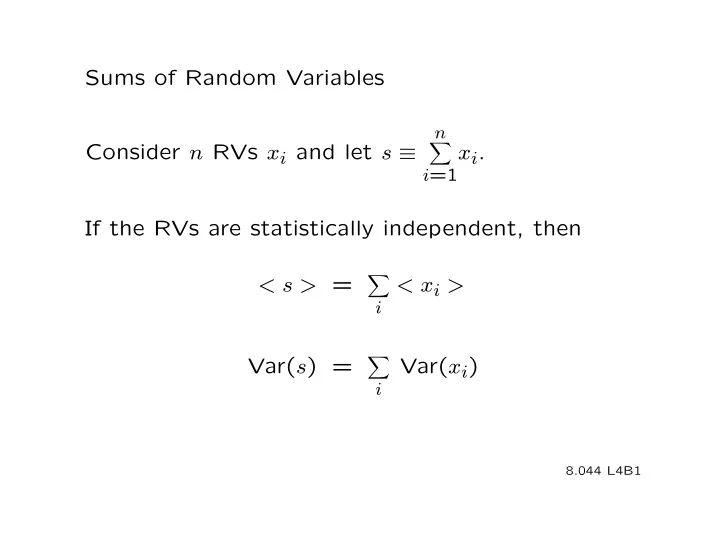
Sums of Random Variables n Consider n RVs x i and let s x i . n i =1 If the RVs are statistically independent, then < s > = n < x i > i Var( s ) = n Var( x i ) i 8.044 L4B1 The individual p ( x i ) could be quite different


slide-1
SLIDE 1

Sums of Random Variables

n

n

Consider n RVs xi and let s ≡ xi.

i=1

If the RVs are statistically independent, then

n

< s > = < xi >

i

n

Var(s) = Var(xi)

i

8.044 L4B1
slide-2
SLIDE 2
  • The individual p(xi) could be quite different
  • Both continuous and discrete RVs could be present
  • True for any n
  • Even if one RV dominates the sum

8.044 L4B2

slide-3
SLIDE 3

Results have a special meaning when 1) The means are finite ( = 0) 2) The variances are finite ( = ∞) 3) No subset dominates the sum 4) n is large

p(s) ∝ n ∝ n s n

1

width mean

8.044 L4B3

slide-4
SLIDE 4

Given p(x, y), find p(s ≡ x + y)

A

dx y = α−x x+y = α

x y α α

∞ α−ζ

B

Ps(α) = dζ dη px,y(ζ, η)

−∞ −∞

8.044 L4B4

slide-5
SLIDE 5

C

ps(α) = dζ px,y(ζ, α − ζ)

−∞

This is a general result; x and y need not be S.I. Application to the Jointly Gaussian RVs in Section 2 shows that p(s) is a Gaussian with zero mean and a Variance = 2σ2(1 + ρ).

8.044 L4B5

slide-6
SLIDE 6

In the special case that x and y are S.I. ps(α) =

∞ dζ px(ζ) py(α−ζ) = ∞ dζI px(α−ζI) py(ζI)

−∞ −∞

The mathematical operation is called “convolu- tion”.

p ⊗ q ≡ p(z)q(x − z)dz = f(x).

−∞

8.044 L4B6

slide-7
SLIDE 7

Example Given: 1 p(z) = (z/a)n exp(−z/a) n!a 1 q(z) = (z/a)m exp(−z/a) m!a

p(z) ∝ zn z ∝ (z/a)n e-z/a

0 < z and n, m = 0, 1, 2, · · · Find: p ⊗ q

8.044 L4B7

slide-8
SLIDE 8

q(z) z q(-z) z q(x-z)=q(-(z-x)) z x q(x-z) z x p(z)

finite product

  • 8.044 L4B8
slide-9
SLIDE 9
  • n

m

1 1

x

z x − z p ⊗ q = e

−z/a e −(x−z)/a dz 2

n!m! a a a

n+m+1

1 1 1

x −x/a

= e zn (x − z)m dz n!m! a a

n+m+1

1 1 x

1 −x/a

= e ζn (1 − ζ)m dζ n!m! a a

  • n!m!

(n+m+1)!

8.044 L4B9

slide-10
SLIDE 10

n+m+1

1 1 x

−x/a

p ⊗ q = e (n + m + 1)! a a a function of the same class

8.044 L4B10

slide-11
SLIDE 11
  • Example Atomic Hydrogen Maser

flask cavity H* beam

ν0 ν1 ν = 1.4....... GHz ν1−ν0 about 10 KHz

RF out

p(twall | n stays) = ?

8.044 L4B11

slide-12
SLIDE 12

n

n

twall (given n stays) = ti

i=1

ti ≡ duration of ith stay on wall. Each stay is S.I.

−t/τ

p(t |1) = (1/τ ) e

−t/τ

p(t |2) = p(t |1) ⊗ p(t |1) = (1/τ )(t/τ) e

−t/τ

p(t |3) = p(t |2) ⊗ p(t |1) = (1/2)(1/τ )(t/τ )2 e

8.044 L4B12

slide-13
SLIDE 13

n−1

1 1 t

−t/τ

p(t |n) = e (n − 1)! τ τ

5 10 15 20 25 30 0.02 0.04 0.06 0.08 0.1 0.12

10 20 30 0.15 0.10 0.05

τ p(t | 12)

t / τ

8.044 L4B13

slide-14
SLIDE 14

Facts about sums of RVs

  • Exact expressions for < s > and Var(s) if S.I.
  • p(s) = p(x) ⊗ p(y) if S.I.
  • p(s) slightly more complicated if not S.I.

8.044 L4B14

slide-15
SLIDE 15
  • ⊗ usually changes functional form
  • But not always
  • Fourier techniques are very useful

8.044 L4B15

slide-16
SLIDE 16

Very important special case: Central Limit Theorem

  • RVs are S.I.
  • All have identical densities p(xi)
  • Var(x) is finite but < x > could be zero
  • n is large

p(s) ∝ n ∝ n s

Central Limit Theorem: p(s) is Gaussian

8.044 L4B16

slide-17
SLIDE 17

If x is continuous

√ 1 −(s−<s>)2/2σ2

p(s) = e

2πσ2

< s >= n < x > σ2 = n σ2

x

8.044 L4B17

slide-18
SLIDE 18

If x is discrete in equal steps of ∆x

∆x −(s−<s>)2/2σ2

p(s) =

e δ(s − i ∆x

2πσ2

v

)

)

i

v )

comb envelope

p(s) s

∆x

8.044 L4B18

slide-19
SLIDE 19

Non­rigorous extensions of the Central Limit Theorem

  • The Gaussian can be a good practical approxima-

tion for modest values of n.

  • The Central Limit Theorem may work even if the

individual members of the sum are not identically distributed.

  • The requirement that the variables be statistically

independent may even be waived in some cases, particularly when n is very large

8.044 L4B19

slide-20
SLIDE 20

MIT OpenCourseWare http://ocw.mit.edu

8.044 Statistical Physics I

Spring 2013 For information about citing these materials or our Terms of Use, visit: http://ocw.mit.edu/terms.